
The village occupies a position in African lore, lore about Africa, African art and music as a place at once idealized and caricaturized by the very sights and sounds that make up its cultural topography and soundscape. For those of us who consider ourselves to be students of Africa and African music, the village and its inhabitants are libraries on fire. These are places and people who have much to teach the world when we are willing to listen. One of the main reasons I have come back to Uganda is to learn what I can about local cultural logic and ontology, what V.Y. Mudimbe called African gnosis, from a specific kind of music rooted in village life.
This music has many names depending on the regional and linguistic context and the instrumentation, but most of the local peoples associate it with spirit mediumship, or kusamira. I’ve spent the last several years reading and writing about spirit possession and mediumship in Africa with a specific focus on the music of spirit mediumship in East Africa. In my master’s thesis I theorized this kind of music broadly as a clear manifestation of expressive culture common to the entire Interlacustrine or “Great Lakes” Region of East Africa. In this context, I used the term kubandwa, deriving from the proto-Bantu root –band– (something pressed or oppressed). Having read a lot of literature on so-called “cults of affliction,” I later posited kubandwa as a musical habitus (in the Maussian understanding of techniques du corps) that people in this region use to approach common health problems. In short, people in this region situate kubandwa as a set of bodily techniques within rituals that Victor Turner would call dramaturgies (basically, drama + liturgy = dramaturgy). This has a lot of other implications, but I’ll save them for more academic forums. It suffices here to say that kusamira, a local conception of the kubandwa concept, emerges from the same context: a village approach to understanding and solving problems.
In Uganda today, the popular understanding of kusamira practitioners paints them at best as “traditional healers” (whatever that is) and at worst “witch doctors.” The latter is inaccurate on two counts. First, there are witch doctors in East Africa who make their living as hired specialists either inflicting harm or removing curses inflicted on their clients by their fellow witch doctors. In Luganda, these are baloggo. Secondly, popular parlance filters the term “witch doctor” through a post-colonial Christian notion of evil people who associate themselves with demons and other witches as they carry out their satanic deeds. That’s quite a stigma to attach to people who, like their parents and grandparents, work to alleviate the most common problems facing their communities.
My trips “up-country,” to the village, to places where kusamira practitioners do their work, paints a much different picture: these people are basawo w’ekinansi (Luganda) or basawo w’ekilugavu (Lusoga), literally meaning doctors of native or local medicine. They are also basamize (Luganda) or baswezi (Lusoga): those on whom the spirits come, those who samira (the verb is actually transitive, which is significant if you’re into language). They do this in order to perform a spiritual diagnosis of their clients’ problems, and they use music to call the spirits for the diagnosis. These people do not choose their profession; the spirits choose them through kusamira. So among the general purposes for kusamira performance, diagnosis, therapy, and the need for a new basawo in a community are common reasons make this kind of music.
However, I’m noticing a different kind of kusamira performance here. I’ll call it a kusamira exhibition performance. It’s the kind of performance that a muzungu like me is most likely to see. It has the feel of “Look at us—this is how we kusamira—it looks like this.” It’s present in the culture, however, for other reasons. It’s a kind of rehearsal of appropriate ritual behaviors. The performers treat these performances as if the spirits are no less present there than in diagnosis or therapy but things are a bit looser. Children often learn how to play and sing this kind of music in these exhibition performances. Adults use them to train young basawo, and they’re common enough that one of my field consultants says “it’s hard to go a day without hearing the drums somewhere nearby.” The drums he’s referring to are nswezi, the Soga drums for kusamira.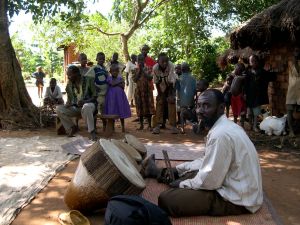
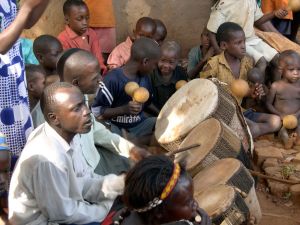
So one day I’m asking questions about these drums called nswezi. They’re unique to kusamira performances in Busoga, the eastern kingdom/region of Uganda. They’re hanging above my head in a small hut where a man named Kyambu (pronounced “cha-mbu”) conducts his sessions with clients. I don’t have to show Kyambu my insatiable interest in these drums for very long before he starts pulling them down and calling in his brother and his sons to play them. We get them all set up in his little hut, but then it’s crowded and he decides we might as well get them outside really play them. This doesn’t take long to draw a crowd.
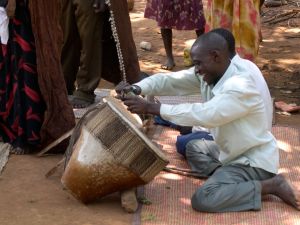
His sons lay them out on emikeeka or palm mats and clean the heads just as they would before any kusamira session: they use a banana leaf drenched with water.
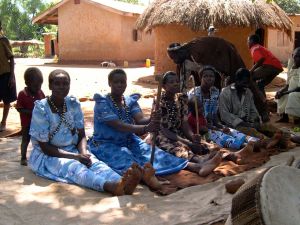
When they hear the drums, Kyambu’s wives and some neighbors decide that they want part of the action and they start preparing the appropriate ritual accoutrement. They wear lukinga headbands and large necklaces, and the various objects in their hands belong to specific spirits within the regional pantheon.
The children follow suit, displaying a phenomenon of village life crucial to transmitting expressive culture between generations: the process of enculturation in this case literally inscribes tradition onto/into the body through ritual objects and musical behaviors.
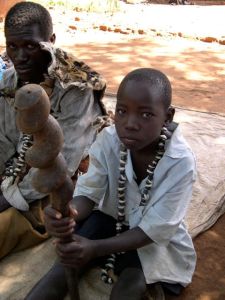
Kyambu runs back and forth from his hut bringing a seemingly endless supply of these ritual objects. Soon he comes walking briskly out of the hut with small aerophones made from gourds.
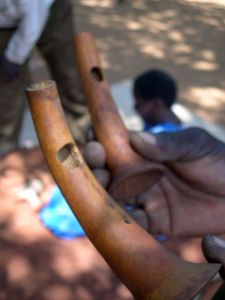
At right: these are eggwala, and basamize sing through them like transverse kazoos with either a spider web or a thin piece of paper stretched over the smaller end. They mask the vulgarities and epithets common in ritual singing.
The drums start up, and people casually start singing a few at a time. The whole thing has the feel of a rehearsal—even the spatial arrangement of the musicians, who face each other.

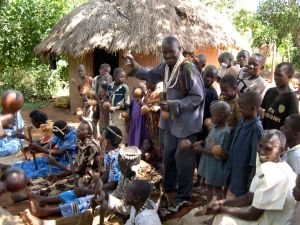
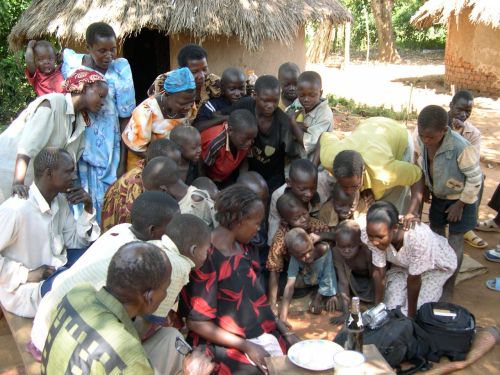
Below right: the gooddoctor, Kyambu, his many children, and some others from the village, with his wives and other basamize seated in front.
They finish a couple of songs in this arrangement, and then they invite me to try my hand with the drums. I had hoped things would happen this way. These are some of the people I want to apprentice as I vacillate between observation and participant observation. The smallest drum in the set, mugejje, has the simplest part, so I take a seat and play for a while as I observe the more complex four-drum part.
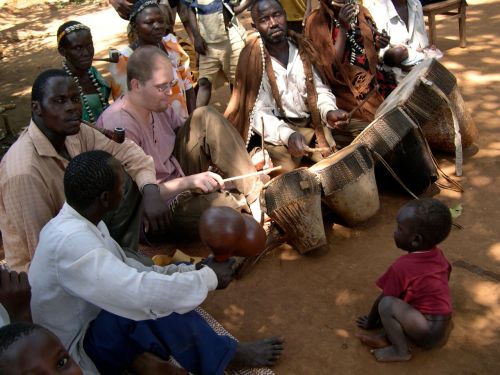
It’s quite a spectacle. The child in front of me doesn’t want to get within five feet of me without screaming in fear (he’s literally never seen a muzungu before), but I guess once I start playing he gets to thinking I’m okay after all. The other drummers agree to teach me to play the lower four drums when I come back, but presently it’s time for lunch.
Earlier in the day, Kyambu’s wives presented me with a live male chicken. This is a common gift for a muko or male in-law and for honored guests. I am humbled and honored by the gift, especially because Kyambu doesn’t eat chicken (it’s taboo for some basamize for spiritual reasons). I don’t seen any chickens around, so they might have gone to some length to procure this one. I decide to respond as a gracious guest is expected to here: I tell them to cook it and during lunch I share it with the others present—those who eat chicken, that is. It’s not the first time anyone has ever presented me with chicken as a gift of food when I visited, but it’s the first time that anyone has ever done it the traditional way by presenting me with the live chicken and asking for my instructions. I’m overwhelmed and humbled by their hospitality. I can’t escape the irony of negative stigma regarding basawo. They have in my experience been as kind and hospitable as any of my other hosts and close friends here.
After lunch a very interesting thing happens. The group sets up again, but this time they put the drums in front of the singers and the basamize adjacent to the drums where they can get up and dance in front of the whole ensemble. It’s more like…well, more like they’re on stage.
 The two men seated on a nearly perpendicular line to the larger group are basamize mediums. They’re kind of “staging possession” here. This is what I mean by a kusamira exhibition. They do all of the things they would normally do in any kusamira ritual: they tremble when the spirits grab their heads/bodies (“kwata ku mutwe”), they shout rhythmically as this is happening, and when they’re possessed their voices sound different, as they are the voices of the ancestors. The other performers greet the ancestors as they would greet their bajajja (grandparents), and they resume singing songs, now to welcome the spirits who have already come rather than to call spirits.
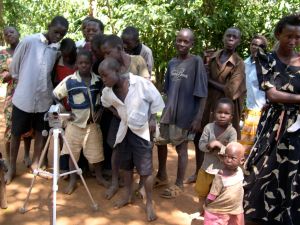
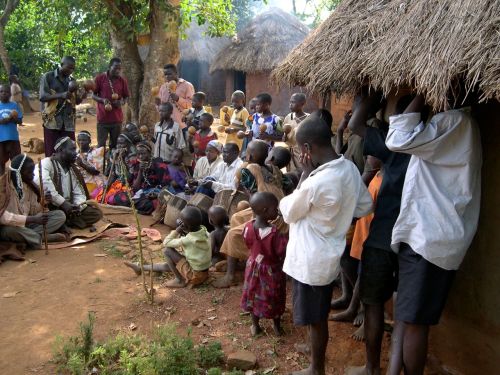
Above, you can see part of an audience under the shade of the hut at the right. The rest of the audience is more interested in my camera and video camera, so they’re standing behind me, something like this:
The youngsters aren’t just watching. Some of them are also participating and learning. Others are just getting a feel for a rattle (ennengo) that will have a much different meaning to them in a few short years.
Why do I think that this “exhibition” performance differs from a “normal” kusamira performance (whatever that is)? Spirits can say funny things through mediums, and laughter is a normal part of this context, but people are chuckling for other reasons now. It’s as if they’re not sure what a muzungu will think of this, so they make it kind of light. The basamize don’t stay possessed as long as they normally would. I won’t say it’s because people are eager to see the video I’ve shot, but they certainly are eager all the same. They’ve cleaned the drums, but they haven’t ritually bathed themselves in the way that Baganda basamize do before such a session. Maybe Basoga don’t do that? The basamize (those who get possessed) don’t seem to have the same amnesia about what they did or said under the influence of the spirits. It’s as if they’re performing what this looks like, but it’s so close to the original, to a “normal” kusamira ritual, that I frankly can’t tell what’s being emphasized for my benefit, what’s being exaggerated for the sake of training young ones, and what’s not being done that might otherwise be done. The spiritual atmosphere is the same, though: despite a few chuckles, people treat the ancestors with respect just as they always would. If those ancestors are functioning as they always do, as helpers for the living, then what truly is the difference? Maybe the camera can tell us.
 Next week I’m going to a different village to work with some of the basawo from this group and some of their colleagues in a different district. Here’s where it gets interesting from a spiritual perspective: they’re preparing an end-of-year/Christmas celebration for the 23rd and 24th. Many of the people I work with practice Islam or Christianity, and nearly all celebrate Christmas no matter what their religious loyalties. It’s plainly not because the kids want presents on Christmas morning (they don’t really do that). Whatever their reasons, one thing is clear: everything from the rosaries people wear around their necks even as they welcome ancestral spirits to the celebration of holidays in multiple religious traditions indicates a kind of spiritual flexibility, a plurality uncommon in a world of increasing polarization and religious extremism. This is not merely tolerance; it’s a full-on embrace of two forces that collided head-on through colonization and missionization, and Uganda has the martyrs to prove it. As I move forward with this work, I wonder what that aspect of the village can teach us about being-in-the-world (as existential phenomenology would have it). What might these performances reveal about a village African gnosis and its value in the world?





 Peter Hoesing