
Do you know this man? A friend sent me his video recently, and I’ve never seen anything quite like it. It’s like steel pan meets tabla, but with rather guitar-like harmonics and an apparently unique technique. The wiki on it is pretty informative, and I thought this was a nice break from some of the heavier issues I’ve dealt with lately here. After a work-induced absence, I hope readers will enjoy checking out Dante Bucci. If you find other players of the Hang, please let me know! In the mean time, enjoy…
Ugandan Journalism and the Production of Power
You wouldn’t have to be living under a rock to have missed what was going on in Uganda over the last two weeks. Major North American news outlets provided lackluster coverage in rather inconspicuous places, and it seems the largest networks now have bigger fish to fry jerks to gawk at. Admittedly, I’m a bit more closely tuned in to Ugandan news than the average American, but I’m no less interested in a concept we have in common with Uganda: free speech is supposed to be a cornerstone of both constitutional governments. Permit me this temporary departure from strictly artistic concerns in favor of a concern that many artists share.
Uganda is a tricky setting for examining this issue, because on the surface, major media appear to be reporting the facts. This seems to be the case even when police make outlandish claims about how many citizens can suddenly get a hold of illegal firearms (note: while it’s true that a small number of firearms were stolen from police stations, that doesn’t seem to add up as the sole cause for the total number of people injured and dead). Good thing that by Sunday, things appeared to be back to normal. President Yoweri Kaguta Museveni must have cleverly used that magic “combination of political might and political nuance to handle the situation” as his supporters put it (via Voice of Africa). It’s the ratio that’s really troubling; Museveni seems to lean more toward might all the time.
French intellectual Michel Foucault famously wrote in several different ways about the relationship between force and authority. For the purposes of examining the contemporary Ugandan situation, we can boil Foucault’s observation down to this: true and effective authority cannot rest on force, brute strength, or military power (the power over life and death) alone. Museveni apparently knows this, which is why he also makes every attempt to control something else Foucault wrote extensively about: the regime of truth.
Evidently Museveni thinks he will be able to control the flow of information to bolster his government during turbulent times. His supporters think along the same lines, making it hard to believe that every journalist held for any charge was held on Museveni’s orders. He may in some cases be an unwitting accomplice to his loyal followers power hungry police brigades who, while attempting to restore order to the streets of Kampala, have violated journalists’ constitutional rights. However, if current reports about the growing importance of citizen media or indeed the increasingly sophisticated commentary of the blogren are any indication of things to come, neither Museveni nor the police will be equipped to quell social unrest by controlling mass media outlets and the journalists who write for them. Dare I ask what their next steps would be?
Museveni is no fool. While for various reasons his government has not put a stop to an LRA conflict that remains rather distant from the capital and the state house, he has been in African politics long enough to know that there’s a difference between an extended bush war and an all-out civil war that plays out in urban violence. For now, an already war weary Uganda seems to be finding ways to keep the peace even at the cost of many of its independent news media. Museveni has played a role in making this a one-sided conversation during the past week, and perhaps people accept this on the surface as they draw on all too recent memories of the role that radio played in the Rwandan genocide of the mid 1990s. Citizen media, on the other hand, behave on their own terms. People can blog or microblog anonymously, and Ushahidi maps crises like this one outside the scope of any single government’s reach. Then again, I haven’t seen any tweets or blogs on these issues from those I follow on those media since about five days ago. Have things really calmed down that much, or are we seeing a new caution among the blogren borne out of fear, censorship, or both?
Filed under art & politics, uganda
New Directions in Research
Okay, so I’ve been teasing along with this for months now, dropping hints about a return trip to Uganda. At first it was simply hopeful (as in someday), but it’s been more than that for weeks now. The truth is, two weeks after I got back from the last trip, I received a Fulbright-Hays Doctoral Dissertation Research Abroad (DDRA) Fellowship. I haven’t exactly kept this a secret or anything. It’s just that this is a windfall that I had written off as so unlikely it would never happen. It’s humbling to know how many more deserving applicants could be out there.
One of those applicants comes from FSU’s beleaguered Anthropology Department. I claim Anthropology as a kind of disciplinary home away from home on campus, and I have great respect for their students and faculty. So it is with bittersweet admiration that I congratulate Bryan Rill. Bryan works on issues that are very close to home for me, and I can think of no more deserving candidate for this fellowship. Congratulations, Bryan. While we’re at it, congrats to your colleagues on three NSF Dissertation Improvement Grants. Maybe FSU will see fit to reconsider some if the more unfortunate budgetary decisions of the past few years in light of your achievements and those of the distinguished anthropology faculty. Maybe.
FSU has done well in the past few years with national and international fellowships at the undergraduate level, thanks in no small part to the Office of National Fellowships (ONF). There are, however, strong graduate students at FSU winning other awards. Jason Hobratschk in the College of Music and Victoria Penziner in the History Department both snagged Fulbright IIE grants this year. Kimberly Leahy is among 22 others to do the same since 1985, but it’s interesting to note that a disproportionately large number of those have come since the ONF opened. BTW, I’ve had the privilege of knowing both Jason and Vicky for a few years, and I know both of their projects will yield fascinating results.
These accomplishments and others across campus in the past few years have started to make FSU look more like a Carnegie Doctoral Research Institution, and it seems the university is starting to take that role seriously. After a tremendous success rate with the pilot of the ONF, The Graduate School announced the opening of a new Office for Graduate Fellowships and Awards (OGFA) this semester. It’s about time. ONF was really gracious about helping graduate students with fellowship applications (my own included), but even their staff recognized a major gap between their own undergraduate focus and the faculty-only nature of the Office of Research. I applaud FSU’s efforts to help more graduate students secure outside funding through the new OGFA. In fact, its sole staff member has already been very supportive as she administrates these new Fulbright-Hays and NSF awards. Having watched similar programs help generate thousands of research dollars for students at other institutions, I am confident that the OGFA will be a successful project for FSU.
I offer a few critiques here even as I champion FSU’s recent efforts to make graduate research a priority, and I do so at the risk of soiling the extraordinary sense of gratitude I feel for having been selected as a Fulbright-Hays Fellow. This is the most honest brand of school spirit: ONF is great, but OGFA is proof that we can do better at the graduate level. The next step must be to support the academic programs and professors that foster bright students and award-winning ideas! (Ahem: ‘Noles Need Anthropology)
Staging African Music
This afternoon, I’ll embark on a new endeavor that I’ve been looking forward to for a long time: leading an African music and dance ensemble. This is a near-inevitable feature of academic life for many ethnomusicologists, particularly in North America. I just had no idea it would happen for me at FSU. The ethnomusicology program here places heavy emphasis on integrating performance and scholarship and using performance in scholarship. That’s a major reason why I came here for a master’s degree and stayed here for the Ph.D. However, a good friend and colleague from Uganda usually directs the ensemble, and when he doesn’t do it, my major professor does. Needless to say I’m thrilled to have this opportunity.
Ever since I read Kofi Agawu’s book on Representing African Music, I’ve been trying to get my head around what it means for a white guy from Iowa to engage in scholarship on Africa and African music. This isn’t the first opportunity I’ve had to do that through performance, but I certainly have more creative control over performative representations now. It’s a challenge I’m looking forward to.
One thing that playing in “academic” ensembles has made me think about is the notion that we’re putting folklore on stage. That can be a problematic experience in many ways, but it’s not a phenomenon entirely unique to academic culture. In his dissertation, Welson Tremura proposes the term “stage lore” to describe the peculiar effect that commodifying folkloric music has on festival and other staged performances. Philip Bohlman and others have also commented on this effect, especially as it relates to festivals. If creating a public spectacle for nation building or staging folkloric performance as a form of respect to indigenous peoples have potential to artificially standardize or “freeze” music (Ted Levin’s term), academic ensembles ought to give us more controlled opportunities to avoid getting locked into myopic caricatures of the cultures we study. Unfortunately, these “frozen” images of Africa are all too common to the college world music ensemble.
Florida State has broken the mold when it comes to African music and dance. To my knowledge, it’s the only ensemble in the country that has focused primarily on East African music over the last five years. (Please, correct me in the comments if I’m wrong about that; I’d love to know about others.) Fortunately, we’re not tied into that permanently because we have an instrument collection and teaching resources to perform music from all over the continent. We have had good luck focusing on music from a single country or ethnic group for a semester or a year, and in that way the ensemble has been a good laboratory for students and professors to teach performance skills related to their research interests.
I plan to begin this semester with this kind of lab tactic, but then expand our repertoire to develop a kind of Pan-African performance consciousness among the students. I’ll begin by bringing in music from my field research: songs of the Baganda and Basoga. While FSU has plenty of Ganda instruments, I’m excited to diversify our ensemble’s Ugandan offerings with my new Soga skins:

You might remember seeing some of these here. I had the pleasure of learning to play them as I learned songs from several different teachers in Eastern Uganda.
A colleague here at FSU recently went to Morocco, picked up some new instruments and took some lessons, so we’re excited to have a North African component. However, since we’re both still relatively new to our recently acquired instruments and skills, we want to incorporate some people, sounds, and skills that have a bit more longevity in this ensemble. One guy has been playing with the FSU group as long as I have and with other groups even longer. He and I will work with another colleague who has experience teaching Ewe music. We also hope to collaborate with other local groups on some Guinean music. Finally, I’m hopeful for a reprise of a performance at last year’s SEM annual meeting: who’s ready for some Bolingo?
I hope to convey to students and audiences that Africa is a big, diverse place. I hope to give them some idea of what that means with regard to the boundless variety of musical and dramatic expressions found across the continent. I’ll continue to update here as we schedule more performances, but for now plan on getting your seat early at our biannual College of Music show: this fall it’ll be on November 16 at 8 PM in Dohnányi Recital Hall.
Filed under Uncategorized
Beatles Redux: Community of Affinity or Crass Capitalism?
A little over a year ago, I decided that it was time to incorporate gaming into my Modern Popular Music course at Florida State University. I had been inspired by two colleagues in ethnomusicology. Trevor Harvey, a friend and classmate at FSU, researches online music communities. He had successfully incorporated this topic into his own teaching on popular and American roots music, and I knew his input could make this a much more illuminating experience for my students and me. Trevor and I had both seen Kiri Miller‘s paper presentation at SEM the previous year. Along with another colleague (a Grand Theft Auto enthusiast), we started an important discussion with our students about what I call performative gaming.
Allow me a brief flashback. The first gaming contexts in which I noticed elements of player performance were games like Dance Dance Revolution and Parappa the Rapper (old school…late 90s). About the time Harvey started asking probing questions about the nature of these interactive performances (and indeed whether or not they are performances at all), Rockstar Games had released several versions of Grand Theft Auto and Guitar Hero was fast becoming the most popular video game on several gaming consoles. By the time Harmonix Music Systems released Rock Band, it was clear that if the RIAA and other music moguls of yesteryear could not control a measured commodification of and profit from music, gamers could and would.
Even as I was considering this new reality and what it meant for my classroom, I heard this NPR piece. Sometimes teaching materials just fall right in my lap. I knew I wanted my class to read Miller’s piece on GTA (from Ethnomusicology 51/3). The NPR piece offered an ideal prelude to that article that touched on some of the broader issues I had hoped to cover.
Incorporating these articles into our class discussion on popular music and mass music markets, I involved my students in one of the most successful teaching experiments I have ever conducted. They first either read or listened to the NPR piece. Then I brought in the GTA enthusiast to familiarize students with the games in a kind of participatory gaming laboratory. Students participated as gamers and pointed out their own favorite musical features. Not wanting to shape that experience with anything but the game and their ideas about it, I waited until after that day to have them read Miller’s “Jacking the Dial.” They came back to class with so much discussion material that I had to put off the next part of the gaming lab. Harvey came in for that next phase in order to facilitate participation in Guitar Hero and Rock Band for the class. By this time, we were not so much introducing students to games (most had already played them) as we were trying to get them to think critically about their participation.
While I’m happy to report that this experiment worked (insomuch as it provided me with a framework for starting this conversation with students in the future), we also got hung up by the mesmerizing question of whether or not this kind of participatory, performative gaming constitutes an “actual” or “authentic” musical performance. Students on both sides of the issue were passionate and articulate about their arguments, but I think there are more interesting questions at play here.
Last week, Daniel Radosh published an article in the New York Times that begins to reveal some of those questions in a more public way (thanks to wayneandwax and Sandra Graham for pointing me to this article). Alex Rigopulos, co-founder and CEO of Harmonix Music Systems, comments in the article: “I actually on some levels see what we are doing now as a massive historical throwback to the time in which the way people experienced music that they loved was as active participants in the music.” Rigopulos knows what he’s doing. Yes, it’s a throwback to a time when people a) went to concerts where mania over the artist became a standard element of the experience or b) covered their favorite artists’ tunes in garage bands and local dance halls around the country. Yes, both of these things are still happening, but Rigopulos makes the essence of both of those experiences much more accessible than all that. By requiring technical facilities that are much more accessible to a general population than say, creative songwriting or a distinctive vocal sound, participatory performative gaming harnesses the social essence of musical experience, commodifying it for public consumption.
Miller has gone a long way toward pointing out that the value of this commodity has nothing to do with whether it requires musical skill and everything to do with the social essence that gives performative gaming its own authenticity. This is “a new way of musicking,” argues Miller. Whether music purists and “real” instrumentalists like it or not, Miller draws on her survey evidence to point out that this new modality has a major impact on the ways in which people experience recorded music even when they are NOT gaming. It seems that beyond creating communities of affinity revolving around specific repertories, the new generation of media moguls is changing how people engage with musical commodities of all kinds.
In Marxian terms, people like Alex Rigopulos have somehow found a way to re-fetishize musical commodities. People already fetishize musical commodities in that they relate to each other in a variety of ways (production, distribution, consumption, and presently P2P consumptive production) through those commodities. With performative gaming, companies like Harmonix have made a new kind of commodity out of the experience, a capitalistic fetish peculiar to these games through which people relate not only through the commodity, but because of it. Moreover, the commodity goes further to shape the ways in which people fetishize other commodities; i.e. the tail wags the dog. This could explain McCartney’s feeling that fans have some “new” sense of agency within The Beatles’ music that they didn’t have before. Sooo…if a plastic guitar-shaped video game controller can somehow endow users with a brand of fan agency that a “real” guitar can’t, clearly value lies somewhere beyond the instruments themselves. But has Rigopulos gone too far with his latest project?
Consumers have, until now, happily and even passionately participated in elements of performative gaming that allow them to personalize the experience. Drum fills, improvised guitar solos, and the ability to export songs onto other media for other uses have been all but removed from Harmonix’s forthcoming release, The Beatles: Rock Band. “The decision to make the Beatles game a “walled garden” from which songs cannot be exported and added to a party mix alongside other Rock Band tunes,” writes Radosh, “violates the central shuffle-and-personalize ethos of modern music consumption.” Will these restrictions take away the personal experience that adds so much fun to performative gaming, or will we instead see that social essence to which I refer above as the unaltered and ultimately lucrative commodity here? How important will the ability to customize be to communities of affinity interested in this release? Will the absence of this ability reveal a capitalist tendency to commodify social experience that, up until now, had been masked by the illusion of individuality in the experience? Will it allow Beatles enthusiasts to claim an entirely new form of authenticity borne out of Paul McCartney, Ringo Starr, and Yoko Ono’s participation in the game’s creation? However consumers answer those questions, Rigopulos and Harmonix continue to pose them in interesting ways.
Filed under art & politics
An Iowa Story
postdated: Aug. 1, 2009

Above and header: a classic image at Iowa’s Historic Arnold’s Park.
If I have been too quiet, I hope my few faithful readers will think that the reasons are as good as I do. I’m back from what I now know was a much-needed trip to my birthplace: Iowa. Jenn and I had planned to go up for a long weekend. This was for her family, recently bereft of a beloved grandmother and only very recently able to gather for a proper memorial service. However, it turned into a much more varied and exciting journey than we had originally expected.
The time everyone was able to come turned out to be the weekend after a ten-year reunion that my high school classmates had planned. Neither of us had been to Harlan for at least the six years we’ve lived in Florida, so we decided to go up early for this shindig and enjoy some of the pleasures of late summer in Iowa. Ten days later, I am convinced that the lifelong Iowan we came to mourn would have heartily approved.
The entire trip resonated with overtones of formative musical experiences that, for both Jenn and me, made Iowa a great place to grow up. The town square is home to a relatively new restaurant, paradoxically called the Sandwich Bowl, where we had lunch and a long, soulful conversation with two of my former music teachers, Steve and Dianne Lawson. Although they are now both retired from public school jobs, Dianne had to leave for an afternoon wedding gig. We relaxed with Steve in a multi-purpose facility that provides his daily musical playground: he watches DVDs, plays music, teaches lessons, rehearses high school groups and engineers recording sessions. I enjoyed the privilege of thanking the Lawsons in person for laying the foundation for many and varied other musical studies and experiences.
Later that evening, we met up with my high school classmates for the reunion. Standard fare here: beers and steaks at a local country club. It was a good time, but we cut out a bit early to stop by another reception for a friend and former bandmate who had been living in China. His wife finally got her visa, and it was time to celebrate that victory and their marriage with his family. It was surreal to see people I hadn’t seen in ten years and think about how I hadn’t been the only one who was half a world away, only to see them again here in our quiet Iowa hometown. This called for more beverages. The reunion had migrated to the downtown square, where we found my classmates and proceeded to close the oldest local bar in town. They probably haven’t had a night like that since RAGBRAI came through town last year.

Above: cathing up with classmates and friends. Thanks for taking the pictures, Jenn!
The next day we traveled to Jenn’s parents’ place, where I did what I always do when I show up there: set up the drum set in the basement. My in-laws played a lot of dance jobs when they were first married. Jenn grew up playing clarinet and saxophone, accompanied by her father on keys and either her mother or her brother on drums. It’s a really rare vibe, a place where I always feel privileged to sit in on drums. Moreover, with two other drummers in the family, there’s always some nice gear sitting around the house. Knowing that I have been in Uganda and haven’t played any drumset for most of the last year, Steve came home for lunch ready to play a couple of tunes with me.
In the afternoon, we got back in the car to go to Okoboji, where Jenn’s father plays piano during the summer in the Dick Bauman Monday Night Big Band. Bauman was the founder of a jazz program at a nearby community college and a good friend of the man who first taught me to play drumset, Steve Lawson. Now this isn’t exactly the Village Vanguard or anything, but the sections are stacked with some of the best band directors in the state, and they are solid players. There’s a tradition of good jazz in Iowa, and these people have sent some fantastic players on to the best college jazz programs in the country. It was a privilege to sit in with the band,
The weekend brought other activities. Jenn’s brother and his wife showed up on Friday, along with their aunt. We wasted very little time after they arrived before jumping back in the car and heading to the world’s finest steakhouse. Archie’s Waeside in LeMars, Iowa rivals many of the finest steakhouses in the country according to some, but we in Iowa know that you cannot buy a finer cut of meat, a tastier corn fritter, or a more delicious grasshopper sundae anywhere (a creme de menthe ice cream treat–not to be confused with these). Wash that down with a selection of regional micro-brews, and you’ve got one tasty Friday night!
Saturday brought more chill time. Jenn golfed with her folks and her brother. She amazes me. She hasn’t golfed but twice in the last eighteen months, and she was still able to par hole six and log several impressive drives. Meanwhile, I shucked corn and prepared the grill to burn some bratwurst. Guy Clark sings that there are “only two things money can’t buy: true love and homegrown tomatoes.” Owing to the generosity of neighbors, I add Iowa sweet corn to that list, and we enjoyed all three with lunch on Saturday.
Jenn’s grandfather joined us for the occasion, and as is their custom, the Smith Family Variety Show followed. Grandpa Jimmy worked as a saxophonist and singer during World War II and with his own dance band after that. His repertoire has remained largely unchanged since: Peg o’ My Heart, Left My Heart in San Francisco, I Can’t Give You Anything But Love, Bill Baily…basically standards. Seeing his son and grandson accompany him at family events has always been an indescribable joy.

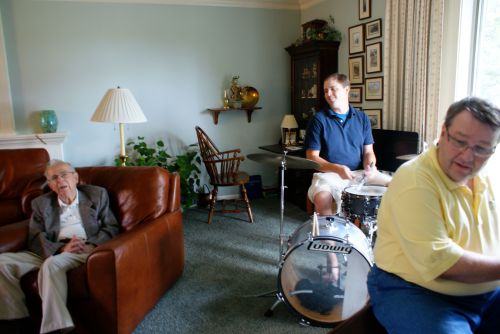
What a privilege it is when they ask me to sit in on drums or sing a tune! That’s the story of our family gatherings in Iowa. I think it’s an important story to tell, because it’s also the story of music education working in really interesting ways. The democratic character of jazz filters organically into every musical event in Jenn’s family.
I’d experienced this atmosphere many times before, but somehow this time “When the Saints Go Marching In” seemed particularly poignant. The next day, as we all drove to Des Moines to hold a memorial service for Jenn’s maternal grandmother, I looked through the Methodist hymn they had asked me to sing and my sister-in-law looked through the Debussy piece she was to play on flute. It seemed somehow significant that this family of musicians had chosen to focus on mourning and ask the in-laws to provide appropriate music. In death, as in life, this family welcomes such a beautiful range of expression, incorporating each unique voice into an ongoing performance that, if our generation and our children have anything to do with it, will never end.
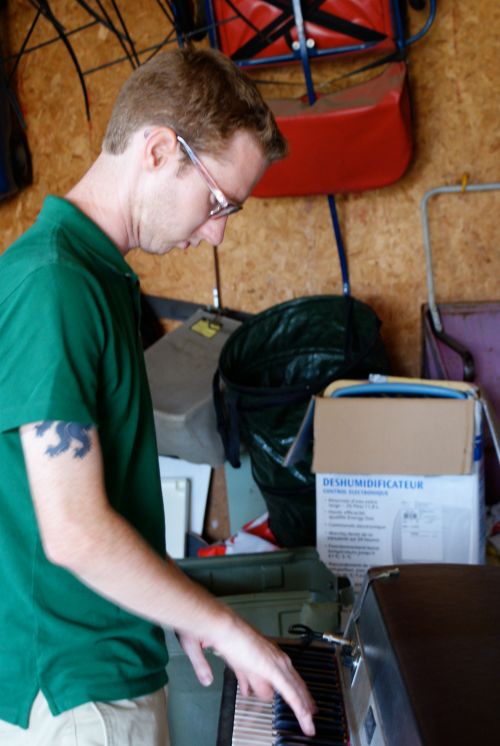
Chris picks up an old Rhodes from his pop to outfit his new digs in CO.
Meet Me at the Fair
Well, it’s that time of year again: all over the country, prize pies and blue ribbon bulls from county fairs are going to compete at State Fairs. But unless you’re a long-time member or advisor of your local chapter of FFA, that’s probably not why you attend. I never chased a prize pig around the pen so judges could compare it to next year’s other pork chops on a stick, but some of my friends did. I did, however, love fairs of all kinds as a kid, and I still do. Today I got a chance to tell Neal Conan and the rest of the country a little bit about why.
My answer was predictable: it’s about the soundscape. Conan’s guest today was Garrison Keillor, who also commented on hawkers and barkers as essential elements of the Fair experience. But my memories of fairs both local and state would not be complete without music wafting through the midway from the carousel or, later in the day, popular tunes shouted from loudspeakers at the teenagers getting cheap thrills while trying to keep their corn dogs down.
I only went to the Iowa State Fair a few times, and there are two musical experiences that stick out in my mind. The first is the one that I mentioned on Talk of the Nation today: the Iowa State Fair Singers and Jazz Band. I first saw this group in a high school gym in Pocahontas, Iowa. An ambitious young musician with interests in jazz and singing, I was floored by the quality of the musical product. I saw them the next year at the Fair, and it was even more polished. A couple years later, I saw their show and then went to a larger stage with some of the cast members to see the Count Basie Orchestra. Among a cacophony of ambient sounds that generally characterize the Fair, these eclipsed the noisy atmosphere during their brief performances.
The State Fair Singers and Jazz Band don’t perform at the Iowa State Fair anymore. Now they’re called Celebration Iowa. They still take their show on the road each summer to many communities throughout the Tall Corn State, and they still produce a fantastic show. So today on my first and so far only successful NPR call-in, I had to come up with another artistic favorite from memories of the Iowa State Fair: the butter sculpture. It was supposed to be Michael Jackson, but apparently the idea has been “vetoed,” as Conan put it. The butter sculpture of a cow will be there as always.
I missed the Fair again this year, though I have just spent a week in Iowa. One of these years I’ll get my timing right and behold the great butter cow before consuming roughly half that much animal fat in the form of corn dogs and funnel cakes. For now I’ll have to be content with an old Oscar winner and some other good Iowa memories. More to come on the latter tomorrow…
Filed under reviews
Saying Goodbye to the King of Pop
If ever I had a good reason to delay a post for a few days, this is it. The truth is that I was so stunned by MJ’s untimely passing, it’s taken me this long to wade through the funereal hype (how few times in human history has that phrase even existed?) and express some cogent thoughts on the matter.
It’s not surprising that worldwide, people have had a strong reaction to the death of a legend. Public testimonials about what Michael Jackson meant to people seem to be the order of the day, first on newscasts, now on the official MJ website. Various stars have chimed in as well, citing MJ’s heavy influence on their own careers. Fox even aired a timely Simpson’s episode last weekend. Then there are the aficionados, who had updated the Michael Jackson wiki within minutes of his death. Given his history with the court system, prominent haters evidently felt the need to re-condemn him for crimes he was never convicted of committing. (Aren’t people in this country supposed to be innocent until proven guilty?) Mostly, however, people miss their favorite pop icon.
Why shouldn’t people have a strong reaction? This is the man who broke down MTV’s color barrier in the 1980s with material that stretched the boundaries of what a music video is and what it can do. Notwithstanding Rev. Sharpton’s classic over-the-top style in reacting to this issue, he’s been consistently right about one thing in all of his public statements: MJ had a positive impact on race relations in this country and in the world during his lifetime. Michael pursued and achieved a transcendent quality in his music and dance that crossed all kinds of boundaries. Even despite the ability that gave him to reach all kinds of open-minded people, it was bound to make others uncomfortable.
With a funeral scheduled today at 10 AM Pacific for the King of Pop, the world cries out in the lyrics of and early Jackson 5 hit:
Filed under art & politics
Home
My concept of home has become rather fuzzy over the past few years. When I left my parents’ house for college, I left a pseudo-hometown that I liked (but had really only lived in for ten years) for a college town that I loved. I felt very at home there, and my closest mentors and friends cultivated that feeling. When we moved to Florida, I moved into the first of several dwellings with my wife. Now that we’ve lived here in Florida for six years, this feels more like home than anywhere else. And yet, when you live somewhere for eight months with the same people and they quite purposely become your family, the notion of home shifts once again. This poem has come back to me again and again as I’ve traveled back and forth to and from Uganda.
Home, oh Home
Africa
The soul of your variety
All my bones remember
-Lucille Clifton
I now also have a home in Africa. Trite and potentially corny as that sounds, I do feel a kinship to the people whom I lived with in Uganda.
Now I’m HOME, and that means the only place in the world that feels completely like my home: I’m with my wife. I’m in our house. We’re with our dog. We cook and relax and have fun together. I have never been away from this home for this long, and now that I’m back, I seem to have a stronger sense of home. I’ve taken almost a month to reflect on this, and it is perhaps fitting that I should post about it on Independence Day weekend. I’ve just spent the past two days on the beach with Jenn and on the water with some friends who have a boat. Prior to that, I’ve been enjoying some of the many things that are just not the same when I’m not home.
I’m about to make a totally cliché case in point. When Jenn asked me what I wanted my first meal to be when I got home, my first instinct was steak. Ugandans don’t eat that much beef. Half the time their beef has been boiled so long it has the consistency of a shoe, and the other half of the time, it might be tender or flavorful, but rarely both. (n.b. this is not a commentary on Ugandan food, which more generally speaking is very good.) After some thought, I started considering that a steak was all of the things I DON’T miss about American food: it’s a big hunk of meat, it’s way to much protein for one meal, and it makes me fat. If I was going to eat meat, I decided that I wanted a burger. A good Ugandan restaurant can serve you a steak that will rival anything you can order in a decent American steakhouse. No Ugandan I’ve ever met can cook a burger that’s anywhere close to this:

Jimmy Buffett starts running through my brain just looking at this. Wash it down with a cold domestic lager and it tastes like home to me. The kale chips next to it are a testament to the changes that inevitably happen at home any time I’m gone this long. Don’t knock ’em ’til you’ve tried ’em though; they’re very tasty.
We didn’t wait too long after I returned to get back to a summer routine that includes regular visits to the beach. Here’s a shot from our first trip out: Bald Point.

We’ve been out twice since then to our favorite place, Cape San Blas. The most recent trip was Friday, when Jenn had the day off. Saturday we were back out in the sun with some friends who have a boat. How fun was that? Well, I’ll offer a hint: I’ll post more pictures when I find my camera. Until then, suffice it to say that I’m happy to be home!
UPDATE! A few pix from San Blas:

me in my hat that reminds me how lucky I am and how good life truly is

some of the rugged beauty of the dunes

friends out on the “mega station” (winner, best flotation device ever)

finally, my favorite time of day on the beach. Enjoy!
Filed under uganda
Bye muzungu!
I’m never sure how to say goodbye to Uganda because every time I’ve left, it’s been with the distinct feeling that I will return. This time is no different. In fact, I started writing this post on the day I left a couple of weeks ago, but I am only finishing it now because my brain is only now getting re-adjusted to the U.S.
Perhaps this feeling of ambivalence about how I leave Uganda can be summed up using the enigmatic phrase that children often use to greet me: “bye muzungu!” They say this to me even when I am saying hello in their language and even if I’m clearly going to be around for a while. An elder once told me that the etymology of the term muzungu refers not to the color of white skin, but to a habit that white people in East Africa still have: they pass through, they are transitional, they ultimately don’t stick around. In this way the children remind me with their greeting that they were here long before I came and they will be here long after I leave. I alternate between the discomfort that this causes (it lumps me into a group with 19th century explorers, colonialists, and missionaries) and the notion that when I do come back, Ugandans always receive me with warm hospitality. Maybe that’s why I keep coming back.

So it’s goodbye to these schoolchildren who feign shyness when I reply to their collective “bye muzungu” in Luganda. It’s goodbye to their families in the village:
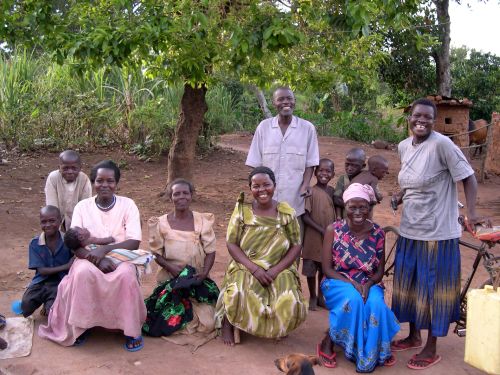
Goodbye to baakisimba dancing,

and to drumming with my friends.
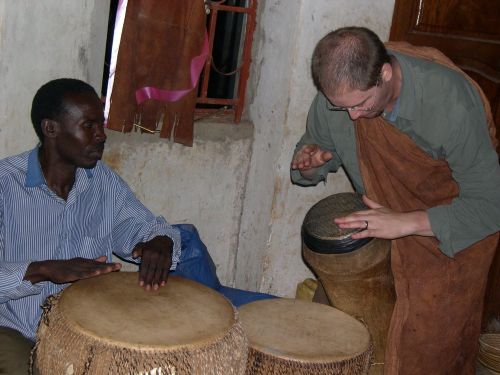
Goodbye to the host family that was so good to me. Magobas, how can I ever adequately thank you?

The charm, wit, and wear-with-all of these folks have been the heart of my living experience. I have been fortunate to have all kinds of instructive research experiences in my time here, but a soulful host family really makes a journey extraordinary. You’ve seen other pictures of Magobas and their family on this blog, but I’m not sure any sum up the simple, beautiful way they bid me goodbye on the day I left their home and Uganda than this silent gesture that young Mugumya sent my way:

So among all of the things I take with me as I leave Uganda, the most appropriate memory to leave here in the public sphere is one of family and warm hospitality. I don’t see the world through rose-colored glass, so it’s only fair for me to note here that my stay in Uganda this time saw challenges and frustrations as well. Those things are natural, and I write about the ones relevant to my research here and elsewhere. The others I simply let go in the hope that when I face similar challenges in the future, I will be prepared to deal with them.
Until next time, Uganda:

Filed under uganda


 Peter Hoesing