Tragic is an Understatement

In my last post, I mentioned the tragic cuts proposed by FSU’s budget crisis committee. In addition to the abandonment of a piece of Americana in the Ringling Museum and plans for a new Performing Arts Center, that particular link mentions “program closures.”  Well, leave it to the Booster club to keep things diplomatic.  It turns out that German and Anthropology are on the chopping block.  Tell me, President Wetherell, apart from the notion of classical Greek education, where did we inherit our academic tradition from?  Oh yeah, the GERMAN system!  Also, can you please explain to me how a top-tier research institution justifies cutting its program for the study of human life?

Maybe I should be happy.  I mean, without anthropologists around, maybe the ethnomusicologists will have less competition for the International Dissertation Research Fellowships, and more lucky winners will come out of my program.  But wait: that won’t fix the gaping hole in their required curriculum for anthropology electives.  It won’t make up for the loss of wonderful colleagues that we have in the students and professors of that department.  It definitely won’t make up for the loss of amazing opportunities for meaningful cross-campus discourse that we have enjoyed with Anthropology for the entire life of the Ethnomusicology program (over thirty years).  Tell me, what good does it do for the Office of National Fellowships to help students with their DAAD applications for wonderful undergraduate and graduate programs in Germany if they won’t be able to speak the language when they get there?  What good is a Global Pathways Initiative if you no longer care about understanding the people we encounter around the world?  Where do you leave that fledgling Initiative when you abandon the students and professors doing ethnographic research in over sixty-five countries around the world?

Luckily, these cuts have not been finalized and cannot be finalized by the Budget Crisis Committee, who are clearly in such a state of panic that their concern for the bottom line has impaired their ability to think straight.  It’s up to the legislature to either give the university what it needs or really foul things up.   With a track record of deep lasorations into the education budget, we might not have much reason to believe that the state legislature will put the university back on track.  However, that’s no reason not to let them know that they need to try.  Please find the contact information for individuals below who still have power to stop these senseless cuts.  Write to them.  Tell them to invest in education in Florida.

Senate:
Jeff Atwater 1-561-625-5101
Senator Jeff Atwater
Room 312, SOB
404 S. Monroe Street
Tallahassee, Florida 32399-1100
Atwater.jeff.web@flsenate.gov

JD Alexander 1-863-298-7677
Senator J. D. Alexander
Room 412 SOB
Tallahassee, Florida 32399-1100
Alexander.jd.web@flsenate.gov

Evelyn Lynn 1-386-238-3180
Senator Evelyn J. Lynn
Room 212, SOB
404 S. Monroe Street
Tallahassee, Florida 32399-1100
Lynn.evelyn.we@flsenate.gov

Stephen Wise
Senator Stephen R. Wise
Room 220, SOB
404 S. Monroe Street
Tallahassee, Florida 32399-1100
Wise.stephen.web@flsenate.gov

Don Gaetz
Senator Don Gaetz
Room 320, SOB
404 S. Monroe Street
Tallahassee, Florida 32399-1100
Gaetz.don.web@flsenate.gov

Steve Oelrich
Senator Steve Oelrich
Room 314, SOB
404 S. Monroe Street
Tallahassee, FL 32399-1100
Oelrich.steve.web@flsenate.gov

Nancy Detert
Senator Nancy Detert
Room 318, SOB
404 S. Monroe Street
Tallahassee, Florida 32399-1100
Detert.nancy.web@flsenate.gov

House:
Larry Cretul 1-352-873-6564
Representative Larry Cretul
Room 420, CAP
402 S. Monroe Street
Tallahassee, Florida 32399-1300
Larry.cretul@myfloridahouse.gov

Marti Coley 1-850-718-0047
Representative Marti Coley
Room 319, CAP
402 S. Monroe Street
Tallahassee, Florida 32399-1300
Marti.coley@myfloridahouse.gov

Bill Proctor 1-904-823-2550
Representative Bill Proctor
Room 223, CAP
402 S. Monroe Street
Tallahassee, Florida 32399-1300
Bill.proctor@myfloridahouse.gov

Faye Culp
Representative Faye Culp
Room 1102, CAP
402 S. Monroe Street
Tallahassee, Florida 32399-1300
Faye.culp@myfloridahouse.gov

Dean Cannon
Representative Dean Cannon
Room 422, CAP
402 S. Monroe
Tallahassee, Florida 32399-1300
Dean.cannon@myfloridahouse.gov

Anitere Flores
Representative Anitere Flores
Room 422, CAP
402 S. Monroe Street
Tallahassee, Florida 32399-1300
Anitere.flores@myfloridahouse.gov

John Legg
Representative John Legg
Room 1101, CAP
402. S. Monroe Street
Tallahassee, Florida 32399-1300
John.legg@myfloridahouse.gov

David Rivera
Representative David Rivera
Room 223, CAP
402 S. Monroe Street
Tallahassee, Florida 32399-1300
David.rivera@myfloridahouse.gov

Will Weatherford
Representative Will Weatherford
Room 223, CAP
402 S. Monroe Street
Tallahassee, Florida 32399-1300
Will.weatherford@myfloridahouse.gov

Greg Evers
greg.evers@myfloridahouse.gov
Eddy Gonzalez
eddy.gonzalez@myfloridahouse.gov
Rich Glorioso
rich.glorioso@myfloridahouse.gov

Need help finding the legislators who represent you?

1 Comment

Filed under art & politics

And now, a word to my sponsors…

20 March 2009

In the introduction to a book that’s now standard reading for most ethnographers, Fieldwork, Bruce Jackson wrote, “Only a fool or someone with an endless supply of disposable income would attempt to undertake fieldwork without some concrete plans about what to do in the field.”  Lucky for me, my concrete plans have been funded by generous support from the Florida State University Office of Graduate Studies (OGS).  As part of a new program, I have enjoyed funding from an International Dissertation Research Fellowship for the 2008-2009 academic year.  This is the first internal FSU program to specifically fund international research on this scale.  Along with the Global Pathways Initiative, this program shows FSU’s promising commitment to actively developing a global profile as a Carnegie Doctoral Research institution.  I am extremely grateful to the Office of Graduate Studies for this support.

I had originally planned to write a post that would both thank OGS and encourage an expansion of this kind of support.  FSU has literally hundreds of students whose graduate work depends on overseas research.  Predictably, funding is constantly in short supply.  Even as I was composing this post, my advisor received a letter from OGS.  I did not receive the e-mail copy until a couple of days later, but that letter gave official notification that OGS has agreed to extend my fellowship through the summer term.  This willingness to see a project through to its full potential is consistent with FSU’s other fellowship programs, all of which reflect a commitment to high-quality research.  In a national financial climate of budget cuts and layoffs, and especially considering the tragic cuts proposed by FSU’s budget crisis committee, I am humbled by this continuing support.  I thank the FSU Office of Graduate Studies, and I commend them for the example they are setting for other programs around campus and around the country.  With so many students in need of support for overseas research, it is wonderful when a program supports students as well as OGS supports me.

This next term of the fellowship will support follow-up research with many of the contacts and friends I have made over the last few months and years.  It will also pay for crucial language assistance for transcription and translation of song texts and interviews.  These activities will launch me into the write-up phase with all of the support I need for continuing analysis and a successful wrap-up of the field research.  I humbly thank the Office of Grad. Studies for this generous funding.  Stay tuned for more updates on my continuing research activities!

Interested in Grad. School?  Check out the Florida State University Office of Graduate Studies.
FSU grad. students: need funding for field research?  Check out the OGS Fellowship programs.  Need funding for other research?  Check out the other fine OGS programs and the Office of National Fellowships.  That one’s under the Office of Undergraduate Studies, but from there both undergraduate and graduate students can link to a number of other useful sites for information about scholarships, fellowships, and other merit-based funding.

2 Comments

Filed under Uncategorized

Respite from Research

16 March 2009

Prior to embarking on my field research, a colleague advised me to pick a day every week and do nothing.  “You’re on all the time,” she said, “whether you want to be or not.”  I rarely take an enitre day off, though I have been known to rent movies on Sunday afternoons or go out to a bar on occasion.  I live by what I believe to be a more pragmatic method of balancing work and play: when I need a break, I take one.  No matter how you slice it, fieldwork is tiring, and I do feel a certain vigilance toward mundane details that wouldn’t otherwise make it onto the radar.

Needless to say, when it came time for my wife Jenn to visit Uganda, the specter of respite from research never looked more attractive (literally).  While nothing can force a complete shutdown of ethnographic tendencies to observe and analyze, having a loved one around certainly makes those habits more entertaining.  This break from routine also gave me the opportunity to see some things I would not have sought out on my own in Uganda, to get a more comprehensive view of the country.  It also brought us into contact with a community of tourists and other bazungu (white people) who reminded both of us how obnoxious we must appear to locals at times.

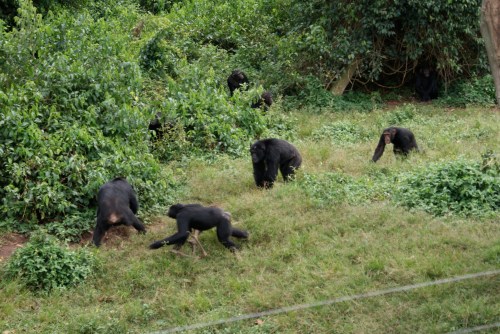
Jenn arrived in Entebbe late in the evening on Sunday, March 1.  We decided to stay in Entebbe for a couple of days and check out the scenery there.  It turned out to be a great idea, as Jenn had time to relax after a long flight and we made our way to see some pretty cool wildlife there.  Among the highlights, we went to Ngamba island to see a chimp preserve.  Here’s the alpha male, whose minions are beating the path before him:

alphamonkey

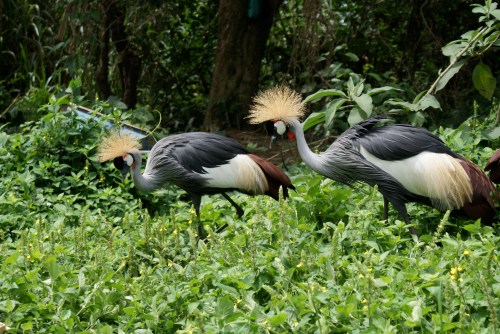
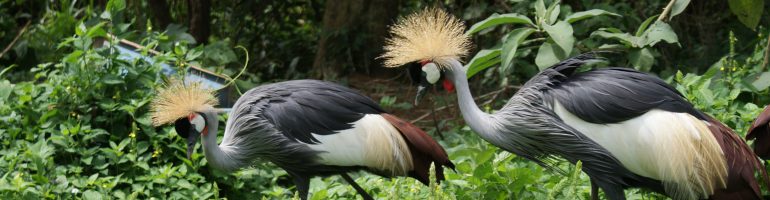
We also saw a really beautiful symbol of Uganda up close: the crested crane.

crestedcranes

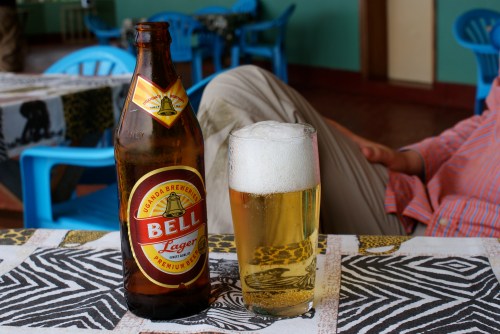
The cranes were kind of the last stop on our tour of the Entebbe Wildlife Education Center (something the rest of the world simply calls a zoo).  So we took a break from walking for Jenn’s first of many stops on the Uganda Beer Tour!

bell

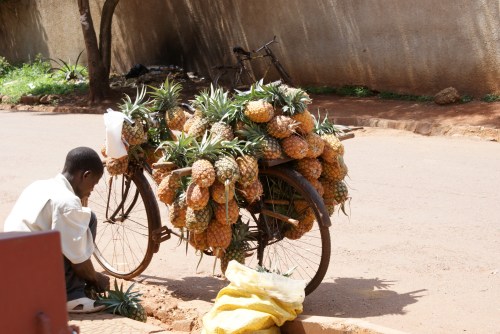
These were just a few of the highlights of a fun couple of days in Entebbe, where Jenn also got her first taste of local food and food transport logistics:

pineapplebike

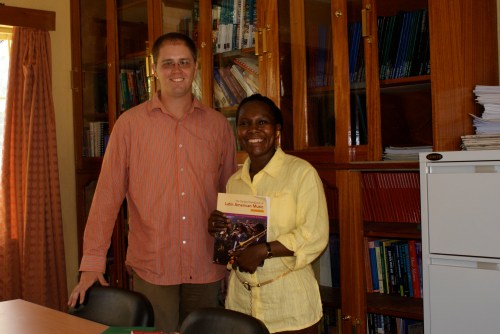
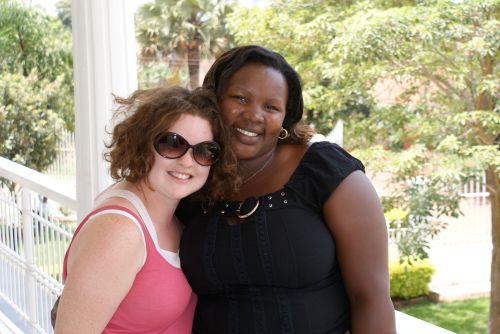
One of our first stops in Kampala was the Department of Music, Dance, and Drama at Makerere University.  Continuing a special project to build a reading room collection there, Jenn helped out by bringing a suitcase worth of books with her.  She was able to bring some really nice materials, including the new Garland World Music Handbooks.  She photographed Dr. Sylvia Nannyonga-Tamusuza here, where we’re pictured with Dale Olsen’s contribution to that Handbook series.

pnswdalebook

Once again, we enjoyed the good fortune of safe arrival for all of the materials, which will now be catalogued, stamped, and shelved with the rest of MDDs growing collection.  The reading room is starting to run short of space already (a great problem to have), but Dr. Sylvia tells us that the university seems interested in backing a new building project for MDD.  Hopefully that would include more library and research space.

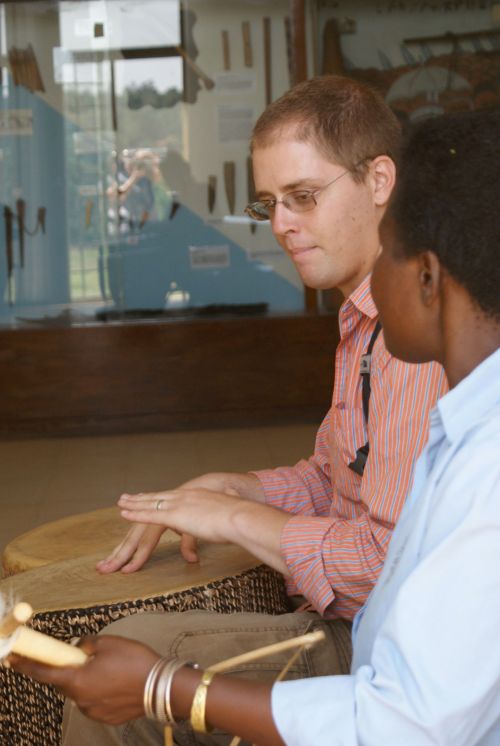
After the MDD stop, we checked out Kasubi Tombs and the Uganda Museum.  Both are kind of off the beaten path for tourists, but they’re interesting stops along the way.  There are always musicians at the museum.  Here’s one of me playing with a lady who’s fiddling on an endingidi (single-string tube fiddle).

museumdrummin2

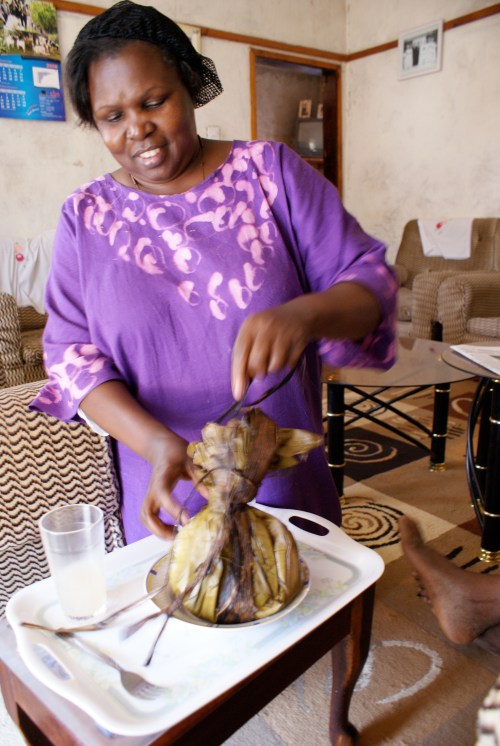
At week’s end, we joined my host family in Ntinda for some traditional fare so they could meet Jenn for the first time.  We all had a lot of fun, and they even made a cake for the occasion.  They also made a real Ugandan specialty: Luwombo.  It’s really nice, tender cooked meat inside a banana-leaf package with good sauce.  Yum!  Here’s Mama Magoba opening up her home cookin’ for my mukyala (wife):

mamaluwombo

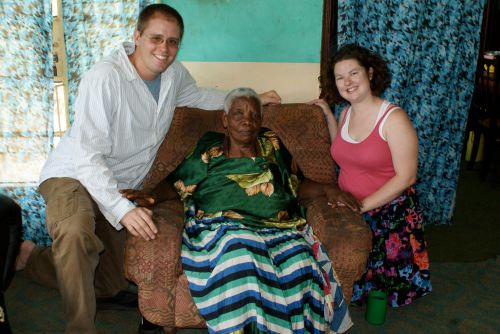
The next day, we went to see some more family at Kawuku.  It was time to meet the bajjajja (grandparents).  We had a nice visit, though unfortunately we excluded Jenn by default since they speak exclusively Luganda.  Nevertheless, it was fun for her to try out her new greeting skills in the local language.  Here we are with Jjajja Mukyala (Grandma):

jpjajja

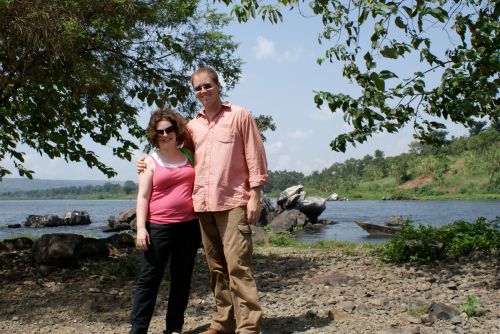
We spent some time shopping in Kampala, but the next week we had to make sure to visit Busoga.  We tried to visit a field colleague with whom I’ve done a lot of work, but it turned out he was busy, so we ended up in Jinja.  We’d planned to see some things there anyway…we ended up going to the essential Jinja attractions, namely Bujagali Falls and the Source of the Nile.  Here we are at the Source, on a break from a really nice boat ride:

jpsource

While in Jinja, we stopped by mwanyinaze (my sister) Gloriah’s place of work.  It’s a really nice place called Children’s AIDS Fund, where she does noble work with HIV/AIDS patients.  We got a chance to check it out and then go out for some nice muchomo (roasted meat) that evening.  Here’s Jenn with Gloriah at her workplace, which incidentally is not far from the Source of the Nile:

jenngloriah

We spent some quality quiet time by the banks of the Nile at a place called Gately Inn.  We had enjoyed the same company’s hospitality in Entebbe, so we tried to check out the Jinja version, and we were not disappointed.  That close to the Source, Jenn’s next stop on the Uganda Beer Tour had to be the True Reward from the Source: Nile Special.  You’ve earned it, Jenn.  You’ve earned it.

truereward

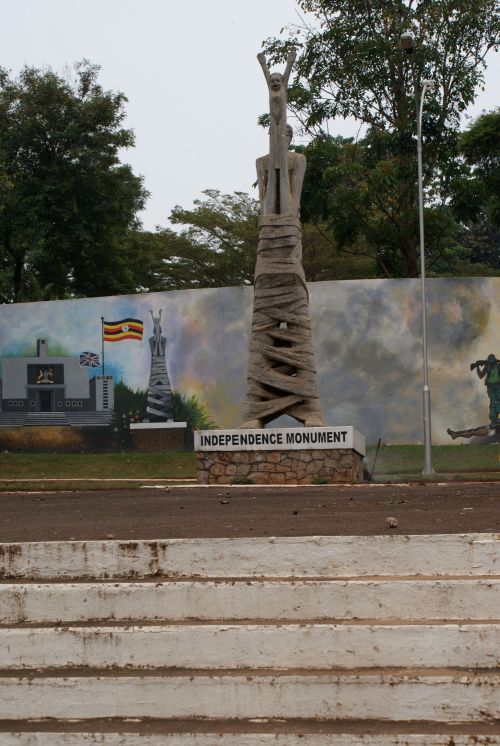
It was back to Kampala then, for a couple of days of R&R before Jenn had to go back.  That’s exactly what we did: sat by the pool at the hotel, finished up some shopping, and ate at some yummy restaurants in Kampala.  One of the last things we saw before she left was the Independence Monument.  I pass by it all the time, as it’s right in the middle of town, but I rarely stop to take notice of what a beautiful sculpture it is.

independence

So with that, it was goodbye Fair Kampala for Jenn and back to work for me.  More about the recent research developments to come…

2 Comments

Filed under uganda

Overdue Update

Dear Friends, these next few posts have been post-dated. I’ve written them primarily offline, but haven’t had a chance to post them until now (or, when I have, I’ve had internet connectivity issues). In any case, thanks for sticking with me…enjoy catching up on the last few weeks!

Leave a comment

Filed under uganda

Not Your Average Office Meeting

unlsignpost

This sign welcomed me this morning to a meeting of roughly 1000 basawo b’ekinansi (doctors of native medicine) at the Mengo Social Centre, home of Uganda’s oldest association for native healers.

Many people dread meetings at work.  They go in knowing they’re either going to be under the gun with some project their boss is expecting results on or so bored that Snood on the BlackBerry can’t compete with the latent urge to turn that tiny stylus into an instrument of suicide. I’m lucky. The meetings I attend are at least interesting, and even when they’re not I can still occupy myself with real-time translation (the meetings are usually held in Luganda). During the past week I’ve attended two such challenging affairs, both involving large groups of basawo.  Both meetings addressed the same topic, which has sparked growing concern among the Ugandan public: why are people performing ritual murders or human sacrifice? More important to these groups of healers, why are some of those people calling themselves traditional healers and what can be done to separate legitimate physicians from charlatans?

The first meeting was at the Ministry of Gender, Labour, and Social Development (i.e. Ministry of Culture).  This meeting had been called once before, but on that day President Museveni spontaneously decided to call the Minister to the State House in Entebbe because he wanted to meet with her about it before she met with practitioners about it.  That day was an exercise in the gross inefficiency of Ugandan bureaucracy that slaps citizens in the face daily.  Now square with the Prez, the minister was kind enough to show up nearly an hour late for the re-convening of these hard-working homeopaths.  Nice.

For the next five hours, we listened to a variety of people present their views on the situation.  Madame Minister started out by noting the laws on the matter.  In Uganda’s Penal Code, the Witchcraft Act says that anyone who kills via witchcraft or supernatural means can be sentenced to life in prison.  That explains why the ministry is interested in calling together these basawo (not that actual witches (baloggo) would be likely to arrive and announce their most violent forms of witchcraft).  She further noted that sacrificing a human, no matter what the purpose, is still murder and as such warrants the death sentence. If the others present at the meeting hadn’t already been completely alientated, they were now.

Some raised concerns about how dangerous the “witch-hunt” atmostphere on the radio is right now. Others noted that it was legitimate Ugandan homeopaths who first reported ritual crimes.  Still others preached to this choir by saying that newspapers and television stations are uncovering murders and blaming them on “ritual sacrifice,” witch doctors,” or “traditional healers” automatically.  The problem with a stigma is that it doesn’t matter whether its foundation is fact or fiction; the stigma sticks.

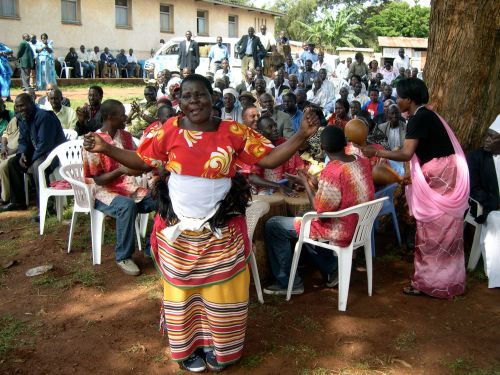
The bottom line at this meeting and the one I attended today is that Ugandan Traditional Medical Practitioners (henceforth TMPs) are angry. They are being blamed for things they haven’t done and they are being associated with charlatans who ruin honest work for all of them.  A picture of the main singer from today’s performing group captures the emotionally charged atmosphere of both gatherings: what the hell is going on here?

nakayima

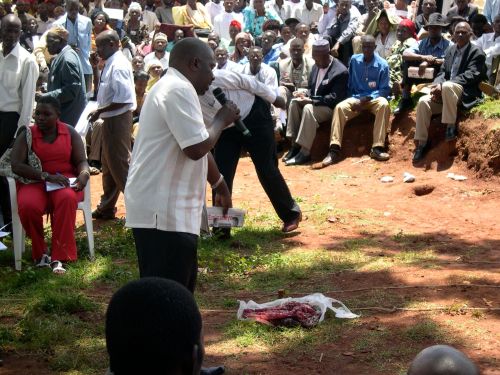
Well, one thing that’s going on, as noted at the Ministry of Culture meeting, is a witch hunt.  People are so desperate for a scapegoat that they’ll pin nearly anything on “traditional healers” and cast them out as witch doctors or worse before they have any facts.  Newspapers and television stations are milking this for all it’s worth and then some.  One of the healers present brought forward a plastic bag for a disturbing illustration of how far the media are willing to go to sensationalize this human sacrifice phenomenon.

breadnjam

What you see on the ground in this picture is bread soggied with an excess of red berry jam.  The man who brought it forward collected the sample from the scene of a local “news” story that one of the local television stations had been shooting when he arrived there (I won’t say which station, though he didn’t hesitate to out them).  They made this concoction to look like butchered remains of a sacrificed person.  Whatever they were covering, whether a real murder or not, they had decided to sensationalize it with this manufactured gore.  I’m not sure what’s more sick: sacrificing a human being to get riches or power or whatever else people ask for, or fabricating stories about such sacrifices to make the evening news more interesting.  Mama Fina, the president of Uganda n’eddagala Lyayo (Uganda and its Medicines) looked on with contempt as her bemused colleagues laughed to keep from crying:

mamafina

This problem plaguing Uganda’s native homeopaths and general public touches literally every person I come into contact with in my research.  I’ve hesitated to comment on it because it has little to do with music.  However, on top of the stigma of quackery that these healers already have to fight, now they have another thing to worry about.  For groups who make music about TMPs and their practices (musical and otherwise), this is one more reason to keep singing.

4 Comments

Filed under art & politics, uganda

Featured Artist: Kabindi

dscn9795

Today I’d like to introduce an artist I’ve known for a few years through my research in Uganda.  He’s unlike any musician I’ve ever met, even those who share his profession and specialization.  The story of his initiation as a particular kind of healer reveals volumes about his profession and his personality.  I offer a brief version of that story to honor a musician who has dedicated his life to his family and community.

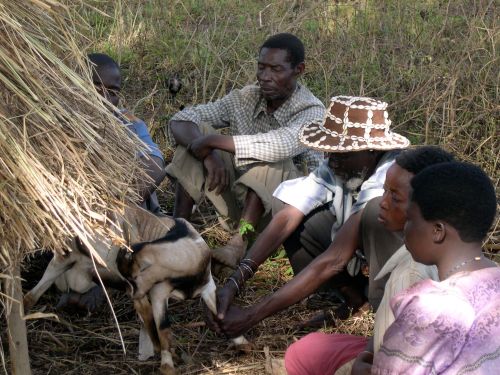
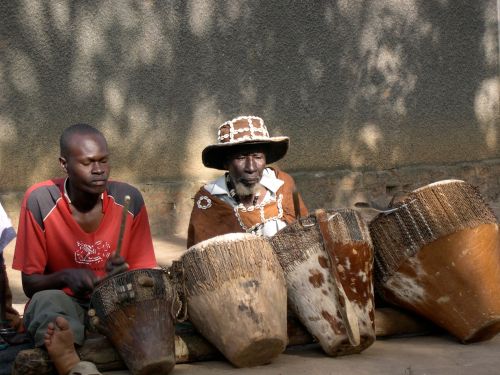
When Mzee Erukaana Waiswa Kabindi was seventeen years old, a wave of illness swept through his village, and it was particularly harsh on his clan mates.  The elders, having watched their parents draw on local wisdom to cope with their problems, knew what this meant: the ancestors were discontent.  Their task was to call them into their midst and know their demands that they might be placated and restore health to the community.  This required a ritual called nswezi in which ab’ekika, those of the clan, came together, beat the drums, and called their ancestors through song.  When they came, they possessed some of the clanmates, speaking through them to tell the rest of the clan their desires.  On the day of that ritual, young Kabindi was possessed for the first time.  The spirits made their demands, the clanmates offered an animal sacrifice, and the ancestors restored health and order to the community.

oldandnew

Above: Mzee Kabindi playing nswezi drums with his son, Kyona.

This is a common pattern for many communities throughout Uganda.  Along with sacrifices, clanmates will frequently have to build small houses in which the ancestors can dwell.  These massabo shrines form an integral part of many compounds in the communities where I study.  When they are ill kept, the spirits demand their repair or replacement, and that work must be done before a clan can offer a proper sacrifice.  This tells us a lot about an ontology or worldview situated in indigenous religion here.  People see ancestors as active forces within their lives.  They must take specific measures to give voice and place to these respected members of the community.  When they don’t, they suffer the consequences through various forms of affliction: muteness, temporary insanity, persistent fever, headaches, or stomach aches, none of which can be treated using allopathic means (hospital medicine).  That places spiritual experts in a category somewhere between indigenous clergy and medicine men.

kabindiasenga

Mzee Kabindi offering a goat for sacrifice.  Directly in front of him there’s a new mini-hut that the clansmen have erected for the ancestors.

Like many who get possessed during an nswezi performance as youngsters, Kabindi continued after this ritual by studying the craft of spiritual healing with elders in the profession and becoming a full-fledged muswezi.  Now a veteran muswezi with over sixty years of experience, he has returned the favor by tutoring numerous other baswezi.  I was fortunate to be introduced to several of these students, which gave me the advantage of instant trust and solid rapport with those people when Mzee Kabindi introduced me as his “son.”  This ethic of generosity guides everything he does, how he spends his time, and how he has built his practice.

These practices raise interesting questions about indigenous music and healing.  If those illnesses can’t be treated using allopathic medicine, does that mean they only occur in communities that deal with them in this way (i.e. can ancestors cause problems outside their clan or tribe)?  Is it more a matter of people not being open to healing that is inconsistent with time-honored community-based healing?  I propose answers to these questions in my developing dissertation based on the cultural logic of musical healing, but for now, I’d like to know what you think!

3 Comments

Filed under Uncategorized

Ritual and Expressive Culture

Public service announcement: those of you familiar with my travel patterns in Uganda know that I post in clusters because that’s what my internet access allows.  Thanks for sticking with me despite the sporadic nature of my posting habits.  Since I know many of my readers are new to the blogosphere, let me just say this: I hope it isn’t terribly disruptive to your blogging experience.  I’m working to update my blogroll so that when there’s nothing new to read on my page, you can check out other writers, particularly in overlapping Ugandan, African, and musical blogospheres.

During the month of January, I have done even more traveling than usual in eastern Uganda.  I’m attending several different kinds of rituals on these trips.  The first was a funeral for a muswezi healer.  Both that one and the next one installed new baswezi (plural of muswezi) within their clans.  In keeping with my field writing pattern, what follows is a kind of photojournal of my experiences this month.  In contrast to earlier posts and at the request of some readers, I’ve dispensed with trying to make it look pretty and just used big versions of the pictures.  Enjoy!

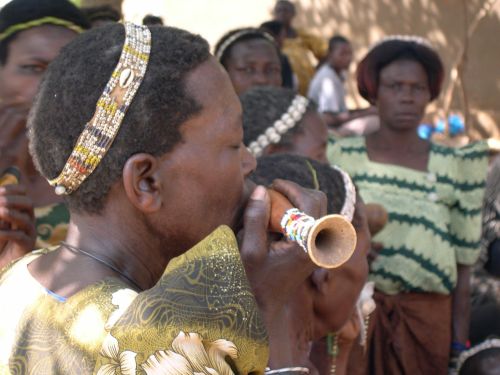
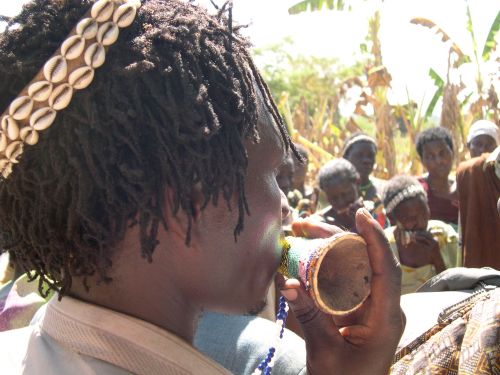
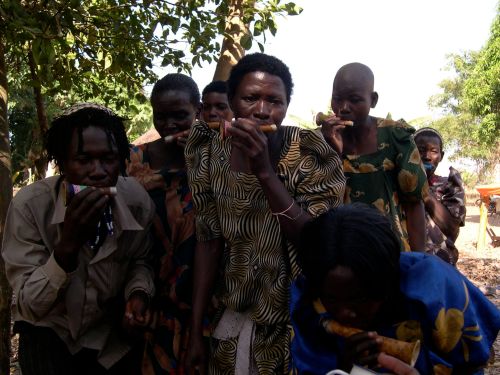
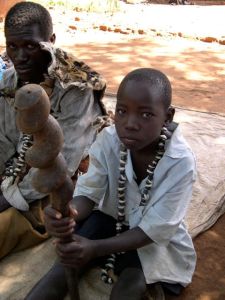
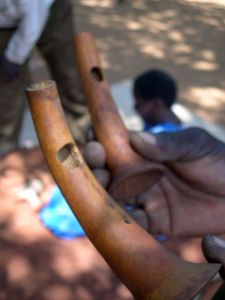
So much of my experience here has been consistent with patterns that I observed in my master’s thesis: ritual expressive culture brings together music with other arts in an aesthetic common to the entire Interlacustrine Region (that’s academic fancyspeak for the place between all those big lakes in East Africa).  That thesis used musical instruments as one form of evidence for these cultural cross-currents.  Well, I’ve discovered some new instruments that appear to be unique to eastern Uganda, but their appearance remains consistent with other ritual art in this region.  These are called bugwala (singular: kagwala) and they work somewhat like a kazoo in terms of sound production.

kagwala1

They’re pictured above and below with the rukinga headbands found among spirit mediums throughout this region.

kagwala2

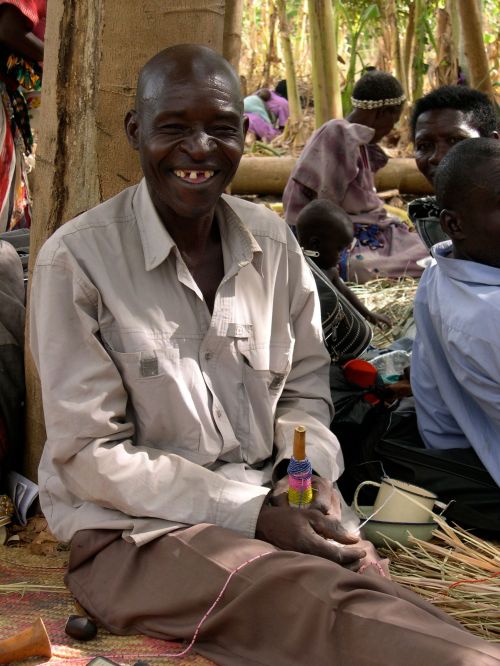
At an olumbe (funeral) for a muswezi healer, I got the rare opportunity to see the ritual master of ceremonies “dressing” these instruments.  The man named Kyambu below calls the beads “clothing for the bugwala.”  Here’s his infectious grin as he finishes the work:

kyambuakolabugwala

Some might eschew comparisons to the kazoo (particularly when they want their research to be taken seriously).  I’ve thought about this for a long time, and I think the comparison is apt.  Those who play bugwala are called nabuzaana when they are possessed, because they play out the un-lived dramas and games of children who died as babies.  They beat the ground looking for edible ants, they sing children’s songs, and they go around blowing their bugwala in cacophonous heterophony as people offer ritual contributions for their mini-performances:

bafuuwabugwala

Finally, one of the most interesting things to note about the physical culture of ritual here has been how it marks the initiated.  In some cases it’s clear simply by looking at someone’s attire that he can be musically initiated without having been ritually initiated.  The ritually initiated must wear appropriate garb, because otherwise their patron spirits will either refuse to come or rebuke them when they note the absence of proper attire (or music, or sacrificial animals).  Here a young drummer embodies this divide, which is sometimes generational, sometimes merely experiential, and always notable:

oldandnew

I return to the east this week for some follow-up work on the rituals I’ve attended there and hopefully scheduling more trips to observe other rituals.  January has gone fast, and I’m sure February will go even faster.  However, I plan to be in Kampala more in the coming months, so hopefully that can mean more posts.  Until next time, beera bulungi (be well).

5 Comments

Filed under uganda

Exporting Hope

I wrote this half-post as Obama was closing in on the American elections in early November:

Today I woke up in Ntinda, a sizeable suburb of Kampala, and and ate breakfast while I watched an Al-Jezeera feed about the American presidential elections.  In just less than two weeks while I’ve been here, the East African media has gotten very creative with the  amount of influence that an Obama presidency would have on Africa as a whole.  Kenya has been particularly excited about president-elect Obama, which comes as no surprise.  Many politicians in this part of the world are loyal to their families, clan mates, and fellow soldiers before anyone else.

There are few moderate voices in this hopegasm.  The New Vision, Uganda’s English language daily, printed a front page banner headline last week saying, “AFRICA TO TOP OBAMA’S AGENDA.”  The story they printed made me think that the entire continent has forgotten one very important detail: Obama is still American.  His agenda is still going to have to respond to the constituency that elected him.

Now with three months’ distance, we are a week into the new president’s first term (and I say first because I am still audacious and hopeful).  The spectre of worldwide divisions over the current Isreali conflict, the sobering picture of what the American economy will serve up for the rest of the world next, and the Iraqi quagmire exacerbating the whole thing, it seems that America’s current #1 emotional export might be more necessary in the States than anywhere else right now.  So far I like the Ugandan approach: where the top choice of medium for news is usually radio, people have been listening to Obama’s inauguration speech over and over again.  I’ve written before about the art of great leadership.  If speech writing and delivery gives any clear indications of that art, then that oration is worth reproducing here in America’s newest preferred form of info flow.

My fellow citizens:

I stand here today humbled by the task before us, grateful for the trust you have bestowed, mindful of the sacrifices borne by our ancestors.  I thank President Bush for his service to our nation, as well as the generosity and cooperation he has shown throughout this transition.

Forty-four Americans have now taken the presidential oath.  The words have been spoken during rising tides of prosperity and the still waters of peace.  Yet, every so often the oath is taken amidst gathering clouds and raging storms.  At these moments, America has carried on not simply because of the skill or vision of those in high office, but because We the People have remained faithful to the ideals of our forbearers, and true to our founding documents.

So it has been.  So it must be with this generation of Americans.

That we are in the midst of crisis is now well understood.  Our nation is at war, against a far-reaching network of violence and hatred.  Our economy is badly weakened, a consequence of greed and irresponsibility on the part of some, but also our collective failure to make hard choices and prepare the nation for a new age.  Homes have been lost; jobs shed; businesses shuttered.  Our health care is too costly; our schools fail too many; and each day brings further evidence that the ways we use energy strengthen our adversaries and threaten our planet.

These are the indicators of crisis, subject to data and statistics.  Less measurable but no less profound is a sapping of confidence across our land – a nagging fear that America’s decline is inevitable, and that the next generation must lower its sights.

Today I say to you that the challenges we face are real.  They are serious and they are many.  They will not be met easily or in a short span of time.  But know this, America –  they will be met.

On this day, we gather because we have chosen hope over fear, unity of purpose over conflict and discord.

On this day, we come to proclaim an end to the petty grievances and false promises, the recriminations and worn out dogmas, that for far too long have strangled our politics.

We remain a young nation, but in the words of Scripture, the time has come to set aside childish things.  The time has come to reaffirm our enduring spirit; to choose our better history; to carry forward that precious gift, that noble idea, passed on from generation to generation:  the God-given promise that all are equal, all are free, and all deserve a chance to pursue their full measure of happiness.

In reaffirming the greatness of our nation, we understand that greatness is never a given.  It must be earned.  Our journey has never been one of short-cuts or settling for less.  It has not been the path for the faint-hearted – for those who prefer leisure over work, or seek only the pleasures of riches and fame.  Rather, it has been the risk-takers, the doers, the makers of things – some celebrated but more often men and women obscure in their labor, who have carried us up the long, rugged path towards prosperity and freedom.

For us, they packed up their few worldly possessions and traveled across oceans in search of a new life.

For us, they toiled in sweatshops and settled the West; endured the lash of the whip and plowed the hard earth.

For us, they fought and died, in places like Concord and Gettysburg; Normandy and Khe Sahn.

Time and again these men and women struggled and sacrificed and worked till their hands were raw so that we might live a better life.  They saw America as bigger than the sum of our individual ambitions; greater than all the differences of birth or wealth or faction.

This is the journey we continue today.  We remain the most prosperous, powerful nation on Earth.  Our workers are no less productive than when this crisis began.  Our minds are no less inventive, our goods and services no less needed than they were last week or last month or last year.  Our capacity remains undiminished.  But our time of standing pat, of protecting narrow interests and putting off unpleasant decisions – that time has surely passed.  Starting today, we must pick ourselves up, dust ourselves off, and begin again the work of remaking America.

For everywhere we look, there is work to be done.  The state of the economy calls for action, bold and swift, and we will act – not only to create new jobs, but to lay a new foundation for growth.  We will build the roads and bridges, the electric grids and digital lines that feed our commerce and bind us together.  We will restore science to its rightful place, and wield technology’s wonders to raise health care’s quality and lower its cost.  We will harness the sun and the winds and the soil to fuel our cars and run our factories.  And we will transform our schools and colleges and universities to meet the demands of a new age.  All this we can do.  And all this we will do.

Now, there are some who question the scale of our ambitions – who suggest that our system cannot tolerate too many big plans.  Their memories are short.  For they have forgotten what this country has already done; what free men and women can achieve when imagination is joined to common purpose, and necessity to courage.

What the cynics fail to understand is that the ground has shifted beneath them – that the stale political arguments that have consumed us for so long no longer apply.  The question we ask today is not whether our government is too big or too small, but whether it works – whether it helps families find jobs at a decent wage, care they can afford, a retirement that is dignified.  Where the answer is yes, we intend to move forward.  Where the answer is no, programs will end.  And those of us who manage the public’s dollars will be held to account – to spend wisely, reform bad habits, and do our business in the light of day – because only then can we restore the vital trust between a people and their government.

Nor is the question before us whether the market is a force for good or ill.  Its power to generate wealth and expand freedom is unmatched, but this crisis has reminded us that without a watchful eye, the market can spin out of control – and that a nation cannot prosper long when it favors only the prosperous.  The success of our economy has always depended not just on the size of our Gross Domestic Product, but on the reach of our prosperity; on our ability to extend opportunity to every willing heart – not out of charity, but because it is the surest route to our common good.

As for our common defense, we reject as false the choice between our safety and our ideals.  Our Founding Fathers, faced with perils we can scarcely imagine, drafted a charter to assure the rule of law and the rights of man, a charter expanded by the blood of generations.  Those ideals still light the world, and we will not give them up for expedience’s sake.  And so to all other peoples and governments who are watching today, from the grandest capitals to the small village where my father was born:  know that America is a friend of each nation and every man, woman, and child who seeks a future of peace and dignity, and that we are ready to lead once more.

Recall that earlier generations faced down fascism and communism not just with missiles and tanks, but with sturdy alliances and enduring convictions.  They understood that our power alone cannot protect us, nor does it entitle us to do as we please.  Instead, they knew that our power grows through its prudent use; our security emanates from the justness of our cause, the force of our example, the tempering qualities of humility and restraint.

We are the keepers of this legacy.  Guided by these principles once more, we can meet those new threats that demand even greater effort – even greater cooperation and understanding between nations.  We will begin to responsibly leave Iraq to its people, and forge a hard-earned peace in Afghanistan.  With old friends and former foes, we will work tirelessly to lessen the nuclear threat, and roll back the specter of a warming planet.  We will not apologize for our way of life, nor will we waver in its defense, and for those who seek to advance their aims by inducing terror and slaughtering innocents, we say to you now that our spirit is stronger and cannot be broken; you cannot outlast us, and we will defeat you.

For we know that our patchwork heritage is a strength, not a weakness.  We are a nation of Christians and Muslims, Jews and Hindus – and non-believers.  We are shaped by every language and culture, drawn from every end of this Earth; and because we have tasted the bitter swill of civil war and segregation, and emerged from that dark chapter stronger and more united, we cannot help but believe that the old hatreds shall someday pass; that the lines of tribe shall soon dissolve; that as the world grows smaller, our common humanity shall reveal itself; and that America must play its role in ushering in a new era of peace.

To the Muslim world, we seek a new way forward, based on mutual interest and mutual respect.  To those leaders around the globe who seek to sow conflict, or blame their society’s ills on the West – know that your people will judge you on what you can build, not what you destroy.  To those who cling to power through corruption and deceit and the silencing of dissent, know that you are on the wrong side of history; but that we will extend a hand if you are willing to unclench your fist.

To the people of poor nations, we pledge to work alongside you to make your farms flourish and let clean waters flow; to nourish starved bodies and feed hungry minds.  And to those nations like ours that enjoy relative plenty, we say we can no longer afford indifference to suffering outside our borders; nor can we consume the world’s resources without regard to effect.  For the world has changed, and we must change with it.

As we consider the road that unfolds before us, we remember with humble gratitude those brave Americans who, at this very hour, patrol far-off deserts and distant mountains.  They have something to tell us today, just as the fallen heroes who lie in Arlington whisper through the ages.  We honor them not only because they are guardians of our liberty, but because they embody the spirit of service; a willingness to find meaning in something greater than themselves.  And yet, at this moment – a moment that will define a generation – it is precisely this spirit that must inhabit us all.

For as much as government can do and must do, it is ultimately the faith and determination of the American people upon which this nation relies.  It is the kindness to take in a stranger when the levees break, the selflessness of workers who would rather cut their hours than see a friend lose their job which sees us through our darkest hours.  It is the firefighter’s courage to storm a stairway filled with smoke, but also a parent’s willingness to nurture a child, that finally decides our fate.

Our challenges may be new.  The instruments with which we meet them may be new.  But those values upon which our success depends – hard work and honesty, courage and fair play, tolerance and curiosity, loyalty and patriotism – these things are old.  These things are true.  They have been the quiet force of progress throughout our history.  What is demanded then is a return to these truths.  What is required of us now is a new era of responsibility – a recognition, on the part of every American, that we have duties to ourselves, our nation, and the world, duties that we do not grudgingly accept but rather seize gladly, firm in the knowledge that there is nothing so satisfying to the spirit, so defining of our character, than giving our all to a difficult task.

This is the price and the promise of citizenship.

This is the source of our confidence – the knowledge that God calls on us to shape an uncertain destiny.

This is the meaning of our liberty and our creed – why men and women and children of every race and every faith can join in celebration across this magnificent mall, and why a man whose father less than sixty years ago might not have been served at a local restaurant can now stand before you to take a most sacred oath.

So let us mark this day with remembrance, of who we are and how far we have traveled.  In the year of America’s birth, in the coldest of months, a small band of patriots huddled by dying campfires on the shores of an icy river.  The capital was abandoned.  The enemy was advancing.  The snow was stained with blood.  At a moment when the outcome of our revolution was most in doubt, the father of our nation ordered these words be read to the people:

“Let it be told to the future world…that in the depth of winter, when nothing but hope and virtue could survive…that the city and the country, alarmed at one common danger, came forth to meet [it].”

America, in the face of our common dangers, in this winter of our hardship, let us remember these timeless words.  With hope and virtue, let us brave once more the icy currents, and endure what storms may come.  Let it be said by our children’s children that when we were tested we refused to let this journey end, that we did not turn back nor did we falter; and with eyes fixed on the horizon and God’s grace upon us, we carried forth that great gift of freedom and delivered it safely to future generations.

As the world listens to these words and reads them over again in the blogosphere, as we observe Obama’s actions and measure them against these words, we also react expressively.  East Africans’ faith in Obama often literally makes a caricature of his campaign promises:
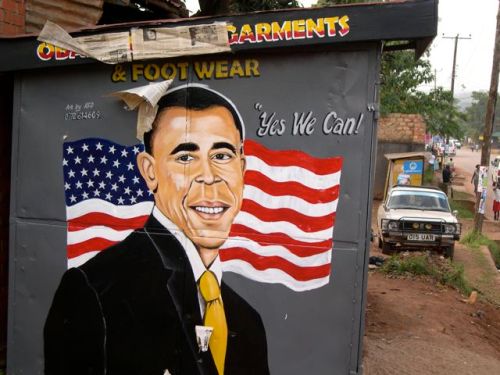
yeswecan

And, less creatively, tries to capitalize on his popularity:

obamashopping

But if the Professor President has anything tangible to offer the world, it will almost surely take the form of new directions that we never knew possible within the boundaries of our system…because that’s what it means to “form a more perfect union.”
2 Comments

Filed under art & politics, uganda

Victorian Holiday

thelookout

I’m just back from a few days of much-needed R&R at Lake Victoria.  My dear hosts, members of the Ffumbe Clan all, took me to Nalubaale (the Luganda name for the giant lake that feeds the Nile).  We had a really nice dinner on Christmas day and then left the following day for Nabinoonya Beach.  Incidentally, 75 degree weather by the lake isn’t that much different from sunny Florida this time of year.

We do Christmas dinner Kiganda style: on the floor with banana leaves for a table.  Here’s Maama and her house girl, a clanmate whom Maama and Taata took in as part of the family.  Her name is the female version of mine—Nakigozi—but I nicknamed her Nakinyonyi (basically meaning “Big Bird”) because she smiles a lot.  Oh.  Except in pictures.  People seem to have an aversion to smiles in pictures here unless prompted.  xmasdinner

Anyway, dinner on the floor makes a fantastic mess.  Fun for the kids and all, but probably not so for Maama and Nakinyonyi, who might not be smiling because they put all of this together AND clean it up.  Three cheers for them!  I generally have two roadblocks to helping with such things: I’m a man and I’m a guest, and neither of those people usually helps out in the kitchen or with cleaning.  Still, I try to do what I can when nobody is looking.  Nakinyonyi still scolds me for it.
sunnynalubaale

winkdoug

The beach is beautiful as we arrive.  Douglas Mugumya is pretty stoked up for several days of nonstop soccer (and I do mean nonstop).

Gloria just got her hair done before Christmas.
gloriabeach

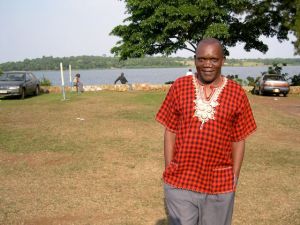
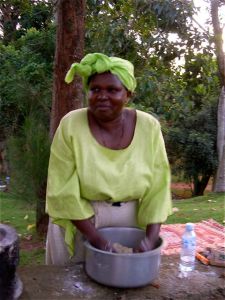
Mr. Magoba is in good spirits, wearing what I deem to be a typical “Dad” shirt: red plaid, but African style.  What a combination!  He wears it when he’s in relaxation mode.  Maama is decked out in her day-glo green quasi West African garb as she kneads dough for chapatti and the men sharpen sticks to roast meat.  Yum!

magobabeach

chapattimama

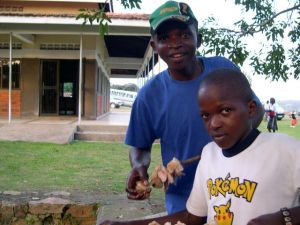
That’s my muganda (brother) Frank on the left and my kojja (mother’s brother) Vincent on the right.   frankvincemeatFor a boy who’s allergic to meat, Vincent sure does like to butcher animals and roast meat.  I don’t get it; maybe he can sort of live vicariously through smell or something.  Maybe he doesn’t miss it at all.  I don’t get that either. Vegetarians escape my understanding.  I’m an omnivore (excluding readers, of course).
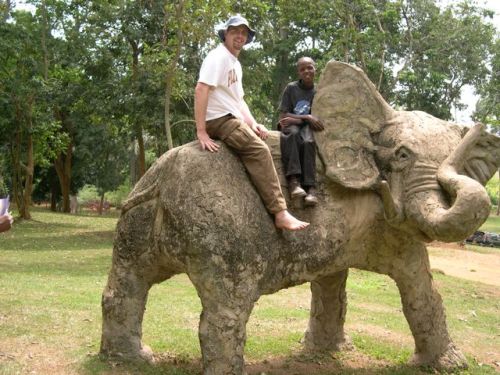
The rest of the weekend is totally fun.  There’s a dance party (meat-in-hand! What?)

danceparty

An elephant ride (well, sort of)

elephantride

goatslaughter

We butcher a goat (yes, that’s me stringing up a headless goat) and have a feast:

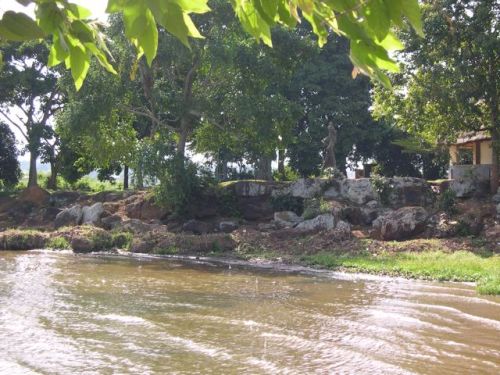
And there’s ample time to enjoy the lake (I insist on lake instead of beach and my Florida readers understand why, but it is truly beautiful here). We even see a couple of monkeys!  No good pix of that; those suckers are hard to capture on film!

rockysunnybeach

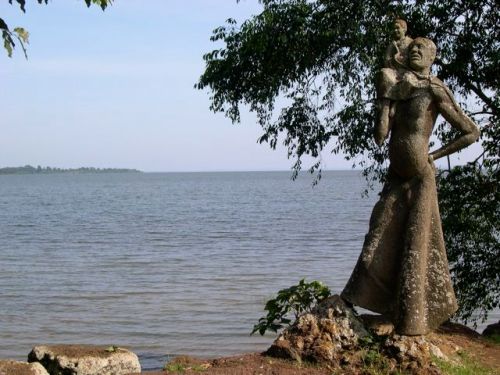
statuesquevictoria

And now, a moment of Zen: goat haggis anyone?

goatguts

6 Comments

Filed under uganda, Uncategorized

To the Village

The village occupies a position in African lore, lore about Africa, African art and music as a place at once idealized and caricaturized by the very sights and sounds that make up its cultural topography and soundscape.  For those of us who consider ourselves to be students of Africa and African music, the village and its inhabitants are libraries on fire.  These are places and people who have much to teach the world when we are willing to listen.  One of the main reasons I have come back to Uganda is to learn what I can about local cultural logic and ontology, what V.Y. Mudimbe called African gnosis, from a specific kind of music rooted in village life.

This music has many names depending on the regional and linguistic context and the instrumentation, but most of the local peoples associate it with spirit mediumship, or kusamira.  I’ve spent the last several years reading and writing about spirit possession and mediumship in Africa with a specific focus on the music of spirit mediumship in East Africa.  In my master’s thesis I theorized this kind of music broadly as a clear manifestation of expressive culture common to the entire Interlacustrine or “Great Lakes” Region of East Africa.  In this context, I used the term kubandwa, deriving from the proto-Bantu root –band– (something pressed or oppressed).  Having read a lot of literature on so-called “cults of affliction,” I later posited kubandwa as a musical habitus (in the Maussian understanding of techniques du corps) that people in this region use to approach common health problems.  In short, people in this region situate kubandwa as a set of bodily techniques within rituals that Victor Turner would call dramaturgies (basically, drama + liturgy = dramaturgy).  This has a lot of other implications, but I’ll save them for more academic forums.  It suffices here to say that kusamira, a local conception of the kubandwa concept, emerges from the same context: a village approach to understanding and solving problems.

In Uganda today, the popular understanding of kusamira practitioners paints them at best as “traditional healers” (whatever that is) and at worst “witch doctors.”  The latter is inaccurate on two counts.  First, there are witch doctors in East Africa who make their living as hired specialists either inflicting harm or removing curses inflicted on their clients by their fellow witch doctors.  In Luganda, these are baloggo.  Secondly, popular parlance filters the term “witch doctor” through a post-colonial Christian notion of evil people who associate themselves with demons and other witches as they carry out their satanic deeds.  That’s quite a stigma to attach to people who, like their parents and grandparents, work to alleviate the most common problems facing their communities.

My trips “up-country,” to the village, to places where kusamira practitioners do their work, paints a much different picture: these people are basawo w’ekinansi (Luganda) or basawo w’ekilugavu (Lusoga), literally meaning doctors of native or local medicine.  They are also basamize (Luganda) or baswezi (Lusoga): those on whom the spirits come, those who samira (the verb is actually transitive, which is significant if you’re into language).  They do this in order to perform a spiritual diagnosis of their clients’ problems, and they use music to call the spirits for the diagnosis.  These people do not choose their profession; the spirits choose them through kusamira.  So among the general purposes for kusamira performance, diagnosis, therapy, and the need for a new basawo in a community are common reasons make this kind of music.

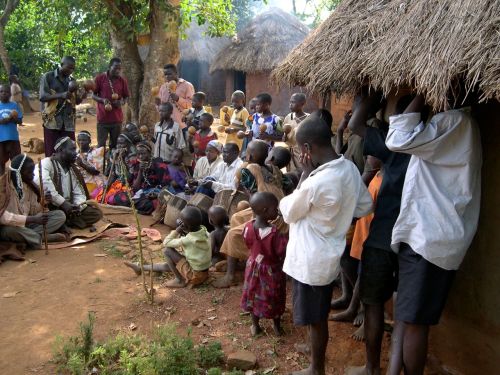
However, I’m noticing a different kind of kusamira performance here.  I’ll call it a kusamira exhibition performance.  It’s the kind of performance that a muzungu like me is most likely to see.  It has the feel of “Look at us—this is how we kusamira—it looks like this.”  It’s present in the culture, however, for other reasons.  It’s a kind of rehearsal of appropriate ritual behaviors.  The performers treat these performances as if the spirits are no less present there than in diagnosis or therapy but things are a bit looser.  Children often learn how to play and sing this kind of music in these exhibition performances.  Adults use them to train young basawo, and they’re common enough that one of my field consultants says “it’s hard to go a day without hearing the drums somewhere nearby.”  The drums he’s referring to are nswezi, the Soga drums for kusamira.getsetup

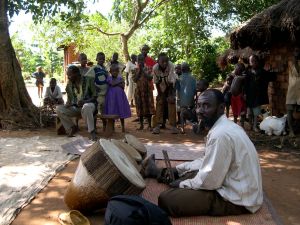
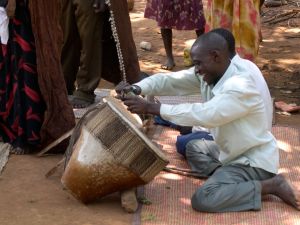
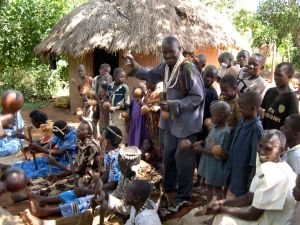
So one day I’m asking questions about these drums called nswezi.  They’re unique to kusamira performances in Busoga, the eastern kingdom/region of Uganda.  They’re hanging above my head in a small hut where a man named Kyambu (pronounced “cha-mbu”) conducts his sessions with clients.  I don’t have to show Kyambu my insatiable interest in these drums for very long before he starts pulling them down and calling in his brother and his sons to play them.  We get them all set up in his little hut, but then it’s crowded and he decides we might as well get them outside really play them. This doesn’t take long to draw a crowd.

awozaengoma

His sons lay them out on emikeeka or palm mats and clean the heads just as they would before any kusamira session: they use a banana leaf drenched with water.

costumeup

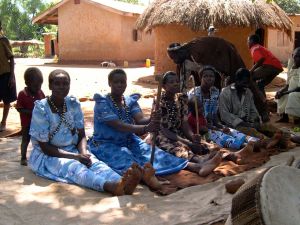
When they hear  the drums, Kyambu’s wives and some neighbors decide that they want part of the action and they start preparing the appropriate ritual accoutrement. They wear lukinga headbands and large necklaces, and the various objects in their hands belong to specific spirits within the regional pantheon.

The children follow suit, displaying a phenomenon of village life crucial to transmitting expressive culture between generations: the process of enculturation in this case literally inscribes tradition onto/into the body through ritual objects and musical behaviors.

enculturatingkid

Kyambu runs back and forth from his hut bringing a seemingly endless supply of these ritual objects.  Soon he comes walking briskly out of the hut with small aerophones made from gourds.

eggwala

At right: these are eggwala, and basamize sing through them like transverse kazoos with either a spider web or a thin piece of paper stretched over the smaller end.  They mask the vulgarities and epithets  common in ritual singing.

The drums start up, and people casually start singing a few at a time.  The whole thing has the feel of a rehearsal—even the spatial arrangement of the musicians, who face each other.

facingdrums

kyambufriends

Below right: the gooddoctor, Kyambu, his many children, and some others from the village, with his wives and other basamize seated in front.

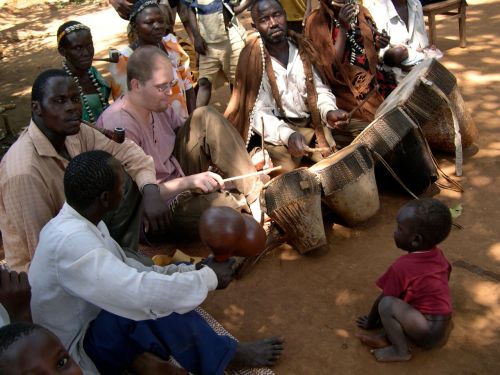
They finish a couple of songs in this arrangement, and then they invite me to try my hand with the drums.  I had hoped things would happen this way.  These are some of the people I want to apprentice as I vacillate between observation and participant observation.  The smallest drum in the set, mugejje, has the simplest part, so I take a seat and play for a while as I observe the more complex four-drum part.

petenswezi

It’s quite a spectacle.  The child in front of me doesn’t want to get within five feet of me without screaming in fear  (he’s literally never seen a muzungu before), but I guess once I start playing he gets to thinking I’m okay after all.  The other drummers agree to teach me to play the lower four drums when I come back, but presently it’s time for lunch.

Earlier in the day, Kyambu’s wives presented me with a live male chicken.  This is a common gift for a muko or male in-law and for honored guests.  I am humbled and honored by the gift, especially because Kyambu doesn’t eat chicken (it’s taboo for some basamize for spiritual reasons).  I don’t seen any chickens around, so they might have gone to some length to procure this one.  I decide to respond as a gracious guest is expected to here: I tell them to cook it and during lunch I share it with the others present—those who eat chicken, that is.  It’s not the first time anyone has ever presented me with chicken as a gift of food when I visited, but it’s the first time that anyone has ever done it the traditional way by presenting me with the live chicken and asking for my instructions.  I’m overwhelmed and humbled by their hospitality.  I can’t escape the irony of negative stigma regarding basawo.  They have in my experience been as kind and hospitable as any of my other hosts and close friends here.

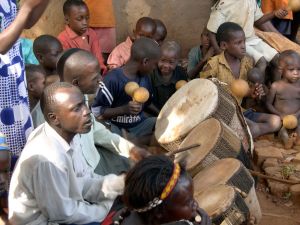
After lunch a very interesting thing happens.  The group sets up again, but this time they put the drums in front of the singers and the basamize adjacent to the drums where they can get up and dance in front of the whole ensemble.  It’s more like…well, more like they’re on stage.

rearrangedThe two men seated on a nearly perpendicular line to the larger group are basamize mediums.  They’re kind of “staging possession” here.  This is what I mean by a kusamira exhibition.  They do all of the things they would normally do in any kusamira ritual: they tremble when the spirits grab their heads/bodies (“kwata ku mutwe”), they shout rhythmically as this is happening, and when they’re possessed their voices sound different, as they are the voices of the ancestors.  The other performers greet the ancestors as they would greet their bajajja (grandparents), and they resume singing songs, now to welcome the spirits who have already come rather than  to call spirits.
kidscamera

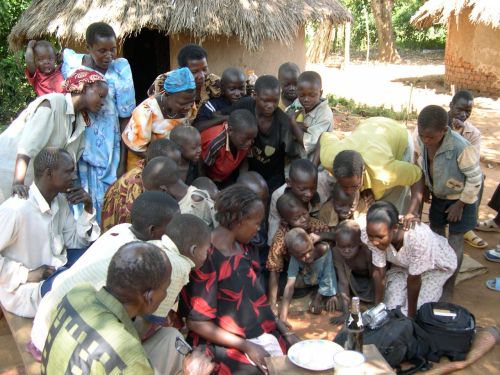
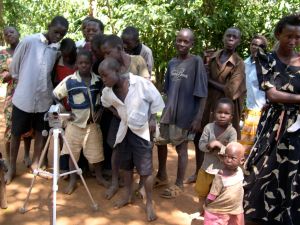
Above, you can see part of an audience under the shade of the hut at the right. The rest of the audience is more interested in my camera and video camera, so they’re standing behind me, something like this:

The youngsters aren’t just watching.  Some of them are also participating and learning.  Others are just getting a feel for a rattle (ennengo) that will have a much different meaning to them in a few short years.

nswezinennengo

Why do I think that this “exhibition” performance differs from a “normal” kusamira performance (whatever that is)?  Spirits can say funny things through mediums, and laughter is a normal part of this context, but people are chuckling for other reasons now.  It’s as if they’re not sure what a muzungu will think of this, so they make it kind of light.  The basamize don’t stay possessed as long as they normally would.  I won’t say it’s because people are eager to see the video I’ve shot, but they certainly are eager all the same.  They’ve cleaned the drums, but they haven’t ritually bathed themselves in the way that Baganda basamize do before such a session.  Maybe Basoga don’t do that?  The basamize (those who get possessed) don’t seem to have the same amnesia about what they did or said under the influence of the spirits.  It’s as if they’re performing what this looks like, but it’s so close to the original, to a “normal” kusamira ritual, that I frankly can’t tell what’s being emphasized for my benefit, what’s being exaggerated for the sake of training young ones, and what’s not being done that might otherwise be done.  The spiritual atmosphere is the same, though: despite a few chuckles, people treat the ancestors with respect just as they always would.  If those ancestors are functioning as they always do, as helpers for the living, then what truly is the difference? Maybe the camera can tell us.

watchingtinycameraNext week I’m going to a different village to work with some of the basawo from this group and some of their colleagues in a different district.  Here’s where it gets interesting from a spiritual perspective: they’re preparing an end-of-year/Christmas celebration for the 23rd and 24th.  Many of the people I work with practice Islam or Christianity, and nearly all celebrate Christmas no matter what their religious loyalties.  It’s plainly not because the kids want presents on Christmas morning (they don’t really do that).  Whatever their reasons, one thing is clear: everything from the rosaries people wear around their necks even as they welcome ancestral spirits to the celebration of holidays in multiple religious traditions indicates a kind of spiritual flexibility, a plurality uncommon in a world of increasing polarization and religious extremism.  This is not merely tolerance; it’s a full-on embrace of two forces that collided head-on through colonization and missionization, and Uganda has the martyrs to prove it.  As I move forward with this work, I wonder what that aspect of the village can teach us about being-in-the-world (as existential phenomenology would have it).  What might these performances reveal about a village African gnosis and its value in the world?

9 Comments

Filed under uganda