Warpaint, having listened thoroughly…

What’s really tragic about freelance critic David Peisner’s review of the new Black Crowes album has nothing to do with his ignorance of the post-review 2.5 stars that Maxim assigned to the album. There’s also less travesty in the fact that he did not hear the album in its entirety before reviewing it than in the reality: this man has absolutely no ears. Here’s what he had to say about what little he heard of the album, probably from the short clips on the Crowes’ website:

Maxim BC Review

First of all, it was a neat trick. So neat, in fact, that every hip-hop artist and acoustic neo-soul act in the record store these days wants to pull off a similarly retro-hip tactic that the Crowes did with their debut. Moreover, Mr. Peisner (boy do I hope you read this), any reviewer worth the bullshit that rolls off his tongue and onto the page next to Maxim’s mindless T and A ought to know that every artist brings a combination of their influences into forming their own voice.

Now, while I have no doubt that Chris Robinson and the gang have as many musical debts as the next artist, those tips of the hat do not and could not sound “pretty much like they always have.” What was clearest to me even after the first time through Warpaint is that these guys have spent the last sixteen years since their Southern Harmony and Musical Companion listening to a lot of classic country and blues records. While some of those were likely the same records that inspired the likes of Brian Jones, Keith Richards, Mick Jagger, and the Allmans, the same could be said of virtually every jazz and blues musician since Muddy Waters.

The opening cut on the record, “Goodbye Daughters of the Revolution,” only seems less likely to be a hit than, say, “She Talks to Angels” because it’s too rock to fit on any country station and too honky-tonk to work very well for straight-ahead rock radio. But by the time the chorus rolls around, the Crowes’ Southern Rock charm is dripping from the speakers. As they follow up with “Walk Believer Walk,” it’s very clear just how much lowdown dirty blues they’ve heard since their last record.

So far as songwriting goes, the heartwrenching “Oh Josephine” works as well as anything else they’ve ever written, including “She Talks…” though it’s sung with a bit more stinging knowledge of love lost and life on the road. As they “let it all ride” at the end of this tune, the guitar vamp and organ solo let you know that there’s still hope out there for a grizzled and tired out lover.

“Evergreen” has the sound of something Cream or Hendrix may as well have written, and its satisfying triple meter chorus more than adequately prefaces a second verse lyric that invites this Evergreen to “come dance in my rain.” “Wee who see the deep” is so clearly indebted to Chicago’s “Twenty Five or Six to Four” in its opening guitar vamp that it brings the Southern into the Psychedelic with an ease that only the Crowes can pull off. The out of tune patina on the string introduction to “Locust Street,” however, reminds a listener that we’re still thoroughly in Southern Rock territory here.

“Wounded Bird,” of all the other cuts on the album, sounds the most like a classic Crowes track with the possible exception of “Oh Josephine.” The upbeat new-jack groove that Steve Gorman lays down on the drums feels great with the guitar/organ anthem that the band lays down for Chris and Rich Robinson to harmonize. As Gorman’s grooves go, only the gospel shuffle of the next cut, “God’s Got It,” can compete.

My only complaint about this record is that “There’s Gold in Them Hills” and “Whoa Mule” make it seem like the Robinson boys are trying too hard to sound country. The sublime “Here Comes Daylight” more than makes up for it, though, and along with the rest of a solid record, it’s tough to be too hard on the Crowes for that. Besides, who knows? Maybe they really are more country than they’ve let on before.

All things considered, the organ and dobro make this record at once as soulful and as rural as Ben Harper and the Innocent Criminals‘ recent Lifeline, and with songwriting that rivals Harper’s as well. I don’t want to take anything away from Harper because I really liked that record, but since it’s been out a while and I probably won’t review it here, let’s just call that a compliment for the Crowes.

Leave a comment

Filed under reviews

Featured Artist: John Lytle Wilson

The Robot’s Disciples

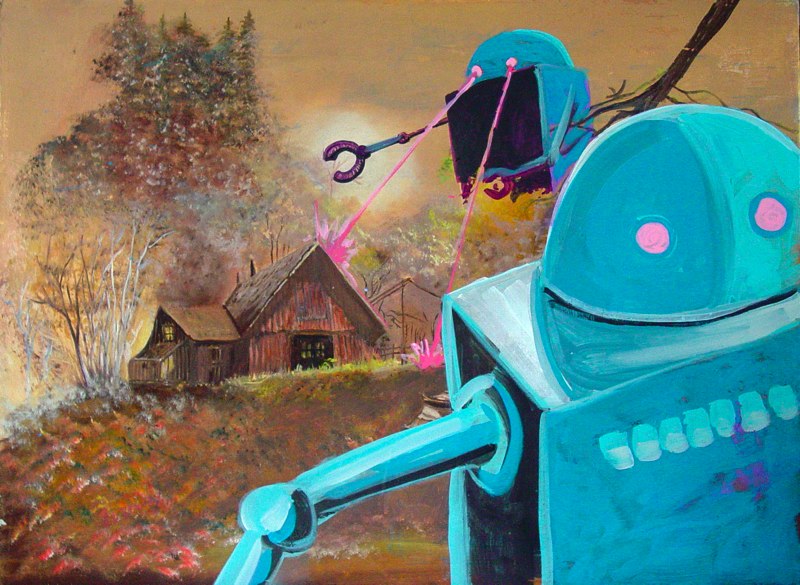
Behold, as John Lytle Wilson makes his grand entrance, you’re sure to do a double-take. Wilson’s recent juxtapositions of robots and monkeys have garnered the attention of more than one hip gallery around the country, and his notoriety doesn’t appear to be waning any. It’s tough to know how to react to his work. If we’re being honest, my gut was first somewhere between rolling around on the floor with laughter and running from the room screaming, but then great art always gets a strong reaction, doesn’t it?

Wilson is artist-in-residence at a little local gallery that sits amidst artists’ studios, other galleries, and small, locally-owned shops. When he’s not painting monkey disciples of giant robots, he’s making disciples of the rest of us with his newest “corrected paintings.” About these, Wilson asserts that “occasonally, an artist will paint something, but neglect to include robots and/or monkeys. When I can, I fix that. The result? Side-splitting renderings of robots and monkeys, usually attacking the subject of someone else’s otherwise rather conservative painting:

Blue Robots Assail the Farmhouse

After you get over the initial visual shock, what’s really refreshing about Wilson’s stuff is that it makes you think . . . about technology, about why you never thought about something before, about a kind of existential blues common to a postmodern technological era, about why the hell much of the population appears NOT to be thinking on a given day . . . you know, lighthearted stuff.

It’s not really that nobody else has ever thought out loud about this kind of thing through their visual art. In fact, Wilson put together an entire show featuring like-minded painters and sculptors, and his work has been featured in other contexts where such juxtapositions formed the shared artistic substance that strung the whole bit together. No, what’s really impressive about Wilson’s work is that he does it so starkly, so convincingly, so laugh-or-cry-out-loud well that you can’t help but love it.

Leave a comment

Filed under featured artists, Uncategorized

First Amendment Blues: Glocalizing Constitutionality

Well, the Black Crowes are set to release their new album about ten hours from now. They say no publicity is bad publicity, even if it does consist of a 2.5 out of 5 star rating from that vacuous tittie/toilet rag Maxim magazine. Apparently Maxim reviewed this record before even hearing it, and while Chris Robinson and the Crowes are livid, in truth they will probably enjoy a few more record sales despite Maxim’s opinion. When confronted by the Crowes’ manager, Maxim replied:

“On the rare occasion that we are not given music because of our lead time or unavailability of the tunes, we make an educated guess…Of course, we always prefer to hearing the music, but sometimes there are big albums that we don’t want to ignore that aren’t available to hear, which is what happened with the Crowes. It’s either an educated guess preview or no coverage at all, so in this case we chose the former.”

An educated guess, huh? Educated by what? Certainly not anyone with ears! Also, nice slap in the face there in the first sentence to a band who made their own decision about whether they wanted to give their new album to your mag. As if it’s impossible to give a new album coverage without reviewing it. That’s telling in terms of Maxim’s capacity for creativity.

John Zorn, on the other hand, asked jazz critic Howard Mandel, among others, NOT to review his season opener at St. Ann’s Warehouse. He offered press passes to those who agreed to comply. One commentator on Mandel’s blog quipped that someone should “introduce Mr. Zorn to the First Amendment,” but doesn’t Zorn have just as much of a right to make this request as Mandel does to ignore it? True, Mandel didn’t actually review the performance (unlike some others), but his commentary on Zorn’s request certainly brings an interesting spotlight to things, doesn’t it?

Finally, these gray areas do not only touch the highly publicized and widely distributed Maxim, the Crowes, or the cosmopolitan sphere of Manhattan. In my own community a current high school visual art competition features a photograph of two people kissing. While I will respect the student’s copy rights (until I get permission to reproduce the photo here), the people in the photo both have facial hair, suggesting that this is an image of two men kissing. One art teacher with students competing in this show complained that the image was offensive and even called for its removal. While the contest bans nudes as subject matter, this image clearly falls within the rules. I find it disturbing that a teacher of art in the public schools would attempt to censor any creative endeavor, especially one as innocuous as this.

This morning I relayed a comment that Robert Christgau once made to my popular music class. He said that punk irony had been “wasted on pinheads” when neo-Nazis saw swastikas among punk regalia and appropriated the music as anthems for their own dubious purposes. Funny thing about that First Amendment. We must simultaneously defend the rights of 1) rampantly idiotic magazines to produce record reviews without hearing the records, 2) artists who try to circumscribe their reviewers, and 3) teachers who try to censor students. But we don’t stop there; fly the flag or burn it as you please. You’re free to do so as the First Amendment guarantees.

Stay tuned for my upcoming review of the Black Crowes’ new album, Warpaint, after I’ve had a chance to actually listen to the record.

Leave a comment

Filed under Uncategorized

Here’s to good musicology

I’ve got three great reasons to celebrate musicology today:

#1: My Colleagues

This weekend my university’s College of Music hosted a joint regional conference between the Society for Ethnomusicology and the American Musicological Society.  Many members of our local professional organization, the FSU Society for Musicology, cooperated to tackle all of the logistics of hosting about 150 musicologists from the American Southeast.  Although I’m the president of this little organization, I feel as though my job leading up to this was incredibly easy.  Yes I had to do some work, send some e-mails, put some press together, and carry a few heavy things.  Yes it involved a 15-hour Friday in the middle of a week in which I was moving into my new house, but these folks are fantastic.  I have the greatest colleagues in the world.  We work too much, we get paid too little, and we have unreasonably high standards, but we always take care of our own.

#2: Professors

We kicked the conference off this weekend with a guest lecture by Professor of Music and Director of the Center for Ethnomusicology at Columbia University, Dr. Aaron Fox.  His lecture on “Country Music’s Late Modern Period” also gave us an interesting perspective on Ethnomusicology’s Late Modern Period.  Fox’s delivery was confidently casual, and the next morning I enjoyed an equally casual breakfast with him as we talked over some more personal career things.  During the morning African music workshop that I ran with my esteemed colleague and dear friend Kafumbe, I re-connected with some other professors whom I really respect.  The workshop only enhanced my respect for these folks, as it gave me an opportunity to observe that these folks can back up their good scholarship with solid musicianship.  But it was that evening that really reminded me how truly fortunate I am to be surrounded by great mentors.  The keynote lecturer centered his talk around making our research really mean something in the lives of our field colleagues.  It was preceded by the warmest introduction from one of his colleagues, an example that left no doubt about why I enjoy such great professional relationships.  Olsen’s remarks left the crowd feeling inspired, and we thanked him for that and his thirty-five years of service with a lengthy standing ovation.  I’ve never seen that happen after a lecture . . . ever.  It was clearly well deserved, and we then had the privilege of moving on to a reception celebrating the careers of two of our retiring faculty members.  One was the keynote lecturer, the other our area coordinator.  The whole thing left me feeling like taking care of our own moves far beyond making sure students’ needs are met.  Olsen and KP, you will be dearly missed.

#3: Newfound support

Well, after numerous grant applications, I was not surprised at the beginning of this week to receive a rejection letter on one of the larger fieldwork grants I’ve applied for.  It happens, and it’s why you don’t count on any grant funding as a sure thing.  But when I heard I’d been denied another local grant through the FSU College of Music after being selected as the finalist from the Musicology area, I was a bit more disappointed.  One panelist reviewing that grant had straight out told me that he ranked my proposal at the top, and another strongly hinted at it.  A few days later, I let go of my disappointment and embraced a new source of support.  I had all but forgotten that I applied for a new grant through the FSU Office of Graduate Studies.  This week, I was awarded a generous stipend and a tuition waiver for the next academic year to embark on a one-year field research endeavor.  With this community of scholars and mentors behind me, I move forward confident that I’ll have all the professional support I need to make the most of this fantastic opportunity.

Leave a comment

Filed under Uncategorized

Let’s start here

Why not start with some musicians for whom I have a great amount of respect. It’s not just because Chris is my brother-in-law. In fact, I knew him before I knew my wife. We were attending jazz camps together in Iowa as teenagers. Now he’s doing his thing in NYC, not only with CPhin but many others. Here’s what I really dig about Chris: he’s not just out there trying to make a living whoring himself out to whatever band will give him the better contract or whatever company will give him the best endorsement deal. He’s got integrity. He is a thinking musician who’s thinking about the future of jazz, of improvisatory music in general, and of American music as a portion of his identity. Every note I’ve ever heard him play, no matter what style, has been one thing that to me lies at the base of all great art: honest.

Leave a comment

Filed under featured artists

Why this blog? Why now?

Pete Hoesing, the Artclectic Academic

I’ve started this blog because the web is one of the most interesting spaces in which to explore art and music. Blogging allows us a kind of instant access to listening and viewing in a public forum where commentaries, cross-commentaries, and meta-commentaries produce the ultimate democratic intellectual environment. That’s what I’m about here . . . art, democracy, commentary, politics, and hopefully along the way, beauty and laughter. Enjoy.

2 Comments

Filed under Uncategorized