Back to Uganda!

It is time to revive this dusty old blog, and a note from a current Fulbrighter in Uganda this morning reminded me of one reason why: it helps to create connections among the people I work with in Uganda (only some of whom use social media tools themselves) and my family, friends, and colleagues elsewhere in the world.

This summer, I’ll embark on an eight week journey back to Uganda with generous support from a UNCF Mellon Summer Research Residency Fellowship. Once there, I’ll be working with Dr. Sylvia Nannyonga-Tamusuza, the founding curator of the Makerere University Klaus Wachsmann World Music Archive and the director of that university’s ethnomusicology program, to reach out to the communities who facilitated some of the recordings that informed my dissertation research. I’ll be working with these communities to see how we might archive some of the audio and video recordings for further access and future research.

The e-mail I got this morning was a great excuse to re-connect with Ssematimba Frank Sibyangu. I had worked previously with him and had contacted him about working together again during this trip. The woman who e-mailed me is teaching on a Fulbright in Mukono District, where Uncle Ssema lives. She had seen my earlier post about him and reached out to see if she might take some lessons with him. Given that her Fulbright has just been renewed, I’m hoping we will all meet up once Ssema and I resume working together.

Meanwhile, I’m also planning visits to some other field sites that I’ve written about here in the past…if you haven’t been back in a while, if you’re taking my online summer course, or even if you’re just discovering this site, stay tuned!

Leave a comment

Filed under Uncategorized

New Position, New Conference, New Friends, New Book!

It’s been a minute since I posted, but I’m at the American Folklore Society’s annual meeting this week. All of the activity on Twitter has inspired me to re-commit to connecting with colleagues and communities via this web presence. This is part of a broader effort to re-connect, post-dissertation, with more popular forms of writing and more diverse audiences than just the academy. However, I do need to start with an important detail: Claflin University has generously provided the necessary leave and support for me to be here. For that and so many other forms of support, I am truly grateful. My first couple of months at Claflin have been fantastic, and my family’s first several weeks in Orangeburg have also placed us in a warm and welcoming community.

I have come to participate in a pre-conference workshop co-sponsored by the university presses at Mississippi, Illinois, and Wisconsin with funding from the Andrew Mellon Foundation. It’s been a very exciting and fulfilling day. The workshop involved six authors this year, all of whom provided meaningful feedback to each other on our respective projects. It also involves senior folklorists as mentors and the acquisitions editors at these three university presses. I am so grateful to the folks at University of Illinois Press for their interest in my project and to the FSMW team for putting on this tremendous workshop. I look forward to our reception tomorrow afternoon as well, which will provide further opportunities to build networks across disciplines.

The new friends, colleagues, and acquaintances include those recently added to my Twitter feed, but rather than creating a chain of suggestions for following, I encourage motivated readers to participate in the conversation themselves.

Ultimately, this workshop and this conference point toward a book project that grows out of my dissertation and the subsequent work that I continue to do on that project. In case you’re new to this forum, it’s all about music and wellness in Uganda. Stick around in the coming months for more as that project and other new interests develop close to our new digs!

Leave a comment

Filed under conferences, travel

Muchomo

The first time Jenn visited me in Uganda, I posted about some of the good things we ate. In fact, many of my ethnographic adventures have been shaped by the gastronomic adventures that have come as an essential part of those experiences. My dear sister in law asked me to write down some of the recipes, and although I did, so many of them cannot be made without locally sourced ingredients, or at least things I can’t get in Tallahassee. This is not the case for muchomo.

Muchomo refers to roasted meat of various kinds: beef, pork, goat’s meat, even chicken. My favorites among these in Uganda were definitely goat and pork, and many a weekend night found me taking a brief break from research to enjoy some of the local delicacy with a cold one. I’ve been working on this recipe for a little over a year now, and I think I’ve got it tweaked to where it tastes enough like East Africa that it’s worth a try on the Blog-b-cue.

This is the basic marinade recipe that could be used with 1.5-2 lbs. of any of the above-named meats, boneless and cubed like stew meat:

1 lemon or 2 T. juice

1/2 c. vegetable oil

1/8 t. cardamom

1/8 t. cayenne

1/8 t. coriander

1/4 t. cumin

2 cloves garlic

1/2 t. onion powder

1/2 t. pepper

1/2 t. salt

Combine everything and stir it up well before pouring it over the meat in a Ziploc bag. Marinate for at least 1 hour (I did 4-5 hours, but overnight would be ideal). Roast the meat on skewers over low flame for as long as possible without overcooking (read: low and slow for that outside crunch with the juicy center). Serve with salt and piri-piri (liquid or powdered hot stuff) on the side, avocado, tomato, and roasted matooke if possible. Otherwise find an appropriate potato to pair it with and put it on the table next to your favorite beverage.

VARIATIONS

In Kampala, people who do this nightly make a living at it, and people who own the operations—often called “pork joints” (not what they sound like)—turn a handsome profit. In that context, the flame comes from wood charcoal. If you’re into that, use it. If not, use store-bought charcoal or a gas grill (I’m using regular old Kingsford this evening). That brings us to the defining characteristic of muchomo: beauty lies in the taste bud of the be(er)holder. Actually, my favorite place in Kampala ended up being this joint where my friend Freddie supervised and instructed the cooks to roast the meat halfway and then fry it up with onions and spices to finish it off. Yum.

This has gone over well with Ugandan palettes. I’m trying it for the first time tonight with a group of Tanzanian musicians. Like the recipe? Try it without the wet ingredients as a rub or send me your variations and improvisations in the comments! I’d love to take a few of these ideas back, as the home muchomo provides as much leisurely fun in Uganda as the backyard barbecue does here.

2 Comments

Filed under uganda

Long Hiatus and the Job Trail

If anyone is still reading/listening, my long, job-trail hiatus might soon come to an end. I have discovered several very cool projects that I want to feature here. Meanwhile most of my writing efforts are going into publishing projects at the moment. More on all of those things soon!

Leave a comment

Filed under Uncategorized

The Moogiest!

Quick, if you haven’t wasted hours on it already, get over to google to check out their Doodle today: a playable Moog synthesizer complete with recording capability. Haven’t found a stable URL for when it goes away tomorrow yet, but hope to soon!

Leave a comment

Filed under Uncategorized

Musica en la Republica

So…remember when I said I’d post pictures when the weather improved? Well, kind of a lot has happened since then. We spent a great deal of time in the Zona Colonial of Santo Domingo, which is beautiful.

Image

…but it’s what I got to do away from the tourist areas that was really fun on this trip.

It rained all Sunday afternoon, so one of the ladies who works at the Academia de Ciencias called her friend to come and pick us up. We went to a grocery store, which is a cultural experience in any part of the world, and sat in the deli for a snack. Then we went to a bar, drank Presidente, and danced a bit of merengue. 

In the afternoon, there was supposed to be a public son dance, but it got delayed by the rain. They didn’t get started until almost 8:00. Since we knew that the other show we were going to wouldn’t start until later, we hung around for the first hour of that. Locals made it sound like it was just going to be a bunch of old farts blowing their horns, but they actually played really well and had a whole sound stage and portable dance floor setup. It was something. Naturally, it wasn’t just son, but plenty of merengue as well.

Sunday night Paul Austerlitz played with his group. On my way in the door, Paul was kind enough to introduce me to his tamborero. “Call this guy tomorrow,” he said. “You should take a lesson.” The guy’s English was good, and since my Spanish is abysmally bad, that’s the only way I knew this could work. Still, if he hadn’t spoken a word of English, I would’ve tried. He and the group played a fantastic concert. Paul was impressive as usual, and he had a really tight band. These were obviously people he’d been playing with for years.

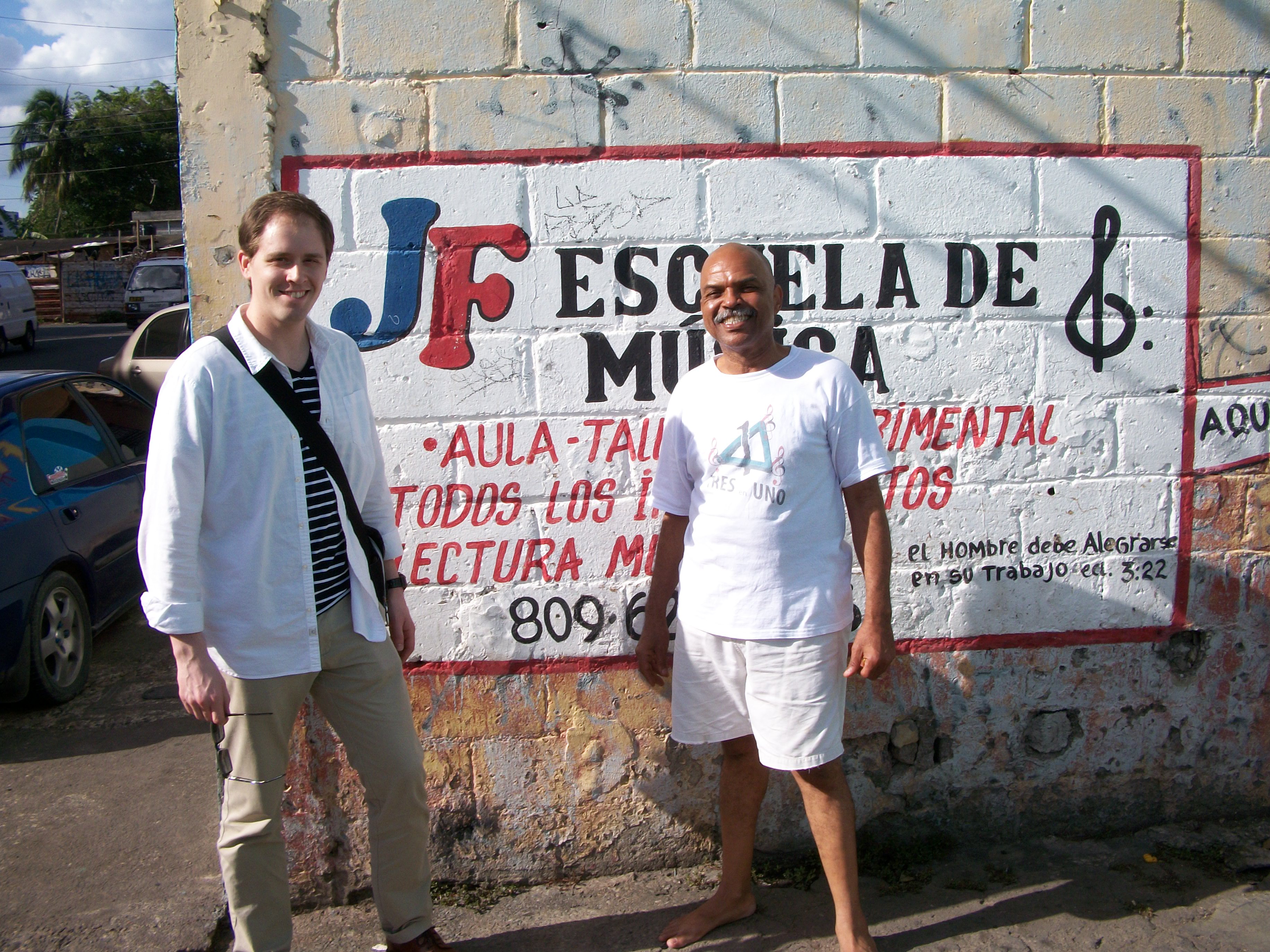
So I did, I called him in the morning. I ended up spending most of my Monday at Julio Figureroa‘s home music studio learning an enormous variety of merengue variations for tambora and congas. He also called a friend over to teach me a bit about playing guira. 

Image

Julito is an incredibly warm and generous individual, and I thoroughly enjoyed my time with him.

Monday night it was a quiet dinner and a bit of rest before an early flight in the morning. So it’s adios to one of my favorite places again for a while. Hope it won’t be too long before we meet again.

Leave a comment

Filed under Uncategorized

Hola Republica Dominicana!

I’ve just arrived at the Acuarium Resort Hotel in Santo Domingo! I’ll give my paper tomorrow afternoon for SEMSEC, but for now it’s a Presidente at the hotel. It’s rainy at present. I’ll post a picture when the weather improves.

Leave a comment

Filed under Uncategorized

Eastman and Mount Holyoke

I was honored to speak last week on the Eastman School of Music Symposium Series, where my colleague and friend Jennifer Kyker invited me to give a talk on my kusamira research. I did an overview of this Ugandan ritual repertory, a talk that I called “Sound Medicine: the Performance of Healing in Post-Colonial Uganda.” Earlier last Thursday, I also spoke to Jennifer’s “Music, Ethnography, and HIV/AIDS” class. At both the Eastman School and the University of Rochester’s River Campus, I received a very warm welcome and encountered sharp, energetic students.

Jennifer and I attended a conference on “Development in Crisis” at Mount Holyoke College. It was interesting, but I found it wanting for a more radical economic perspective from folks working in development.

This morning I spoke in Professor Holly Hanson’s History 101 class at Mount Holyoke: “How Wars End.” In a little over an hour, I’ll give a talk in her History 206 course, “African Cities: Development Dreams and Nightmares,” on the destruction of Kasubi Tombs last year. The students here are truly impressive, and I look forward to more time with them this evening.

Leave a comment

Filed under Uncategorized

Monheit was magnificent on Valentine’s Day

My wife is the coolest. Monday afternoon, she calls me and says, “hey, want to see Jane Monheit tomorrow night?” I had totally written off going to the performance for the usual reasons: too much to do, not enough money for a ticket, we’ll put the baby to bed and have a nice dinner at home, etc. I’m the worst kind of romantic: between workaholic tendencies and not wanting to rock the boat of routine, my good intentions rarely turn up something this exciting. She knows this about me, so it’s the exact swift kick I need to enjoy Valentine’s Day on an actual date with my wife.

We’ve been listening to Monheit since she released her second record, and we loved her third, In the Sun. Last night she delivered the kind of totally unsurprising brilliance that we’ve come to expect from her. She punctuated with honest humor, and she allowed a sizable audience into the rather intimate musical interaction that she enjoys with her backing trio.

These are marks of musical refinement that come from her total dedication to practicing the craft of song interpretation. Monheit has a huge instrument, but most of the time she manipulates it with such great care and restraint that it makes the larger swells all the more exciting. Her technical mastery feeds the tremendous musicality that she demonstrates in every interaction with her sidemen.

On that score, she surrounds herself with a totally capable trio. The pianist, Michael Kanan, shows both sensitivity to Monheit’s every ornament and flexibility to her stretch of phrase. Neal Miner lays down a solid foundation for the group and throws in a few tasty bass solos in the mix. Rick Montalbano holds his own on drums, emulating his wife’s vocal restraint with a rather unorthodox cymbal technique. Montalbano plays through the cymbals, both lengthening and softening his attack. Much as it contributes to the overall finesse and restraint of the group, the very same technique leaves his sound on the skins rather flat. In his louder punctuations, these sounds blurt outside the otherwise tightly controlled sound envelope. These profane interjections don’t detract terribly from the gestalt songcraft in which this ensemble engages. The group is comfortable together: Monheit extends her family affair through the musical and personal closeness she clearly feels with the other musicians. They’ve cultivated this kind of proximity on her latest record, Home.

Guest trumpeter and FSU faculty member Scotty Barnhart stepped in for a couple of tunes last night, giving Monheit’s group opportunities to shine with one of the best soloists of his generation. Barnhart put is usual sensitivity and musical tact on display, and Monheit’s group responded both musically and respectfully.

These were the rules of the evening: restraint, respect, and musical sensitivity. Monheit sets that tone from note one as a strong bandleader. Some of the most aurally delicious moments of the whole show derived from the trio and Scotty’s decisions not to play something, instead staying out of Monheit’s way to let her vocal explorations flourish. That particular brand of classy taste proves rare, and it endowed Valentine’s Day in Tallahassee with a healthy dose of romance.

1 Comment

Filed under featured artists, reviews

Saying goodbye to old friends

This season of hope and expectation has also been for me a time for grieving and for celebrating the lives of ordinary people who did extraordinary things. May our ancestors smile on these celebrations as they rest in peace.

My wife’s grandfather James Smith was a dearly beloved Irishman, small in stature but enormous in personality. We remember him as the patriarch of a family whose musical roots predate him in fascinating ways. His mother accompanied his sister and him on piano at the Chicago World’s Fair in 1933, where their Vaudeville act called “The Smith Kiddies” enjoyed a short run. They won a talent competition at the Orpheum Theater in Sioux City that facilitated the trip. His son Steve, who frequently comments here, is a tremendous musician in his own right. A church organist since age 8, he has also played  saxophone since his secondary school days with the late  veteran Iowa Jazz Educator Marty Crandall. He also played with Iowa Rock ‘n’ Roll Music Hall of Famers The Cellophane Spectacle. Steve studied music at Iowa State University. There he wrote arrangements for the marching band. He returned to Marcus to join his father’s insurance business, a county mutual and independent agency that thrives to this day. Steve married Linda Lott (Smith), a design specialist and drummer. Their act, Gentle Persuasion, played dance jobs well into the 1980s. He continues to play jazz standards, adjudicate high school band competitions and collaborate with young musicians exploring their solo talents.

Steve’s eldest, my wife, studied music at Luther College, where I met her in 1999. We have traveled the world playing music together and we came to grad. school together at Florida State in 2003. She now works as an arts consultant and continues to play clarinet and saxophone and sing in our church choir. I met Steve’s son Chris at a jazz camp in Creston, Iowa, where we both played drum set in the same big band. Chris also went on to advanced studies in music at the Manhattan School of Music. There he studied with John Riley, who plays with the Village Vanguard Orchestra, among others. He then worked as a drummer in New York for a couple of years before going on to further studies at Northern Colorado, where he will soon finish a doctorate in music with his research on Mel Lewis. These, Jimmy’s survivors, carry on the Smith family legacy of musicianship and community.

I just received word last night that my Ugandan host father’s neighbor died. I knew him only as Hajji, the friendly Mzee (venerable elder) to whom my host family brought dinner each night. His name refers to the pilgrimage that Muslims take to the holy cities of Mecca and Medina. Hajj lost his wife over ten years ago. After that time, Mr. Magoba (my host father) instructed his children to take Hajj a portion of their family meal every day. On the Muslim holiday Iddi and other Islamic feast days, Hajji would reciprocate by sending special foodstuffs and prepared meals to his neighbors. Now Mr. Magoba’s family are committed Catholics. Having grown up to see the hostility between Christians and Muslims in the U.S. and around the world, Magoba and Hajji represent for me an inspiring example of neighborly love and peacebuilding. Let me say to the community of Ntinda-Kiwatule and all of Hajji’s family, friends and neighbors, nga kitalo: what a tragedy his loss is to us and to all lovers of peace. We shall miss him and remember him fondly as we do all of our ancestors and neighbors.

To other friends and family in the U.S., Uganda and around the world: Merry Christmas, Ssekukkulu amakula, Happy new year, kulika omwaka, and may peace be upon you, as-salaam aleykum!

2 Comments

Filed under Uncategorized