Change of Pace: Archival Research in Jinja

Most of the time I’m out in the “field,” somewhere in a village, finding shrines, attending rituals, and playing and singing with field collaborators. My recent work has given me opportunities to transcribe recordings from those outings and interpret their meanings. Even more recently though, I have been digging through an archive in Jinja that holds many materials written by others who have done work similar to mine.

Welcome to the Diocese of Jinja’s Cultural Research Centre.
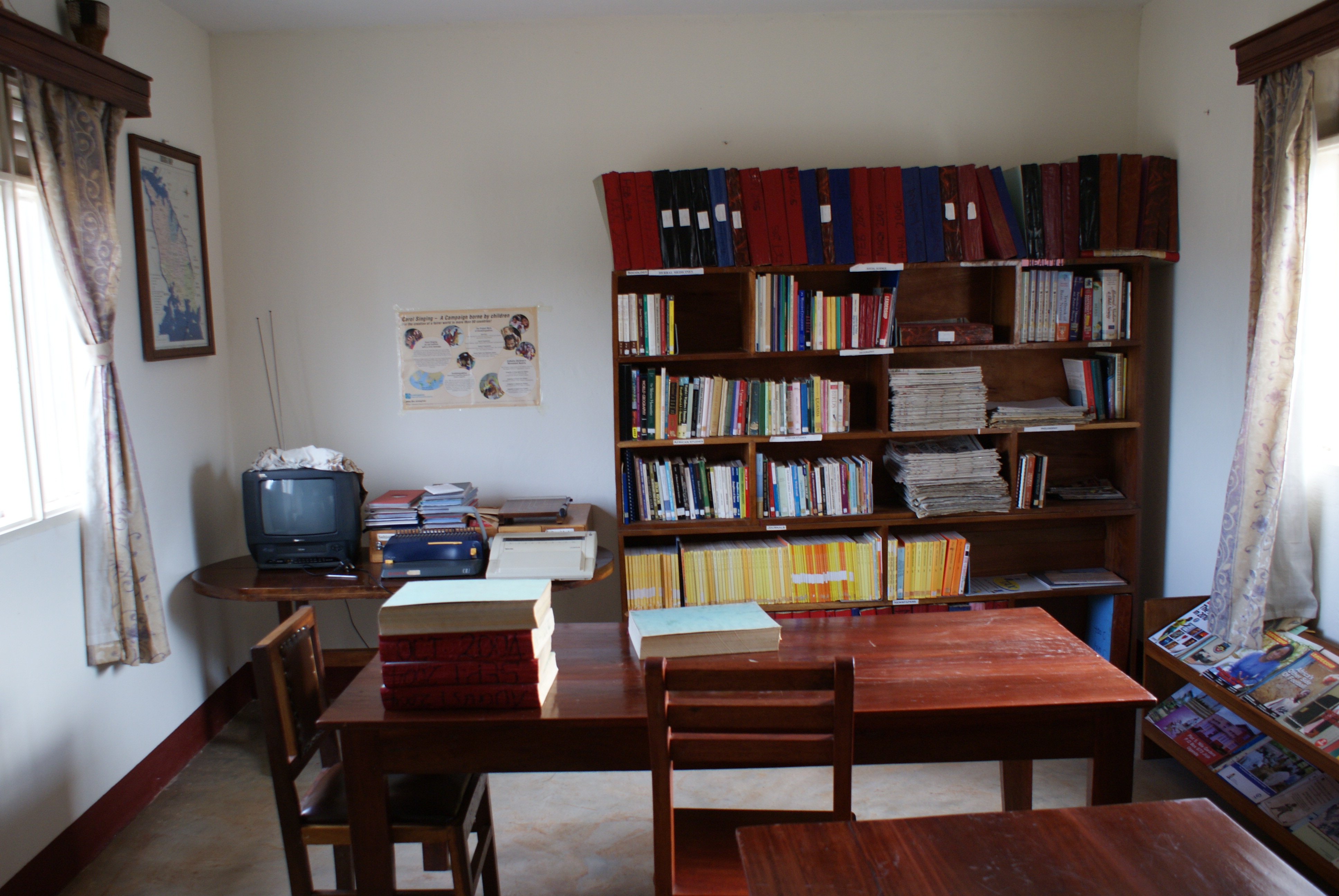
The lion’s share of the relevant materials I am finding in this archive are undergraduate or masters’ theses by students at various seminaries around Uganda. Because these students were interested in religion, I have found a wealth of materials on traditional religion or comparing traditional religion and Christianity. Over the last couple of weeks, the staff has graciously allowed me to take over 1500 photographs of these documents, which I have subsequently compiled into pdfs for later reading.

The variety of materials is fascinating: they have everything from hand-written final essays for undergraduate courses to sophisticated theses complete with photographs. There’s quite a bit of overlap in the subject matter, but not in the precise locations of study. This gives me all kinds of ways to compare what I’m seeing with what others are seeing now and have seen in the past.

I also secured permission to get inside one of the display cases to take pictures. Most of these are things I’ve seen elsewhere, but they’re nicely labeled and displayed here.

It was some kind of sign that these are the things I saw when I walked into the front lobby of the CRC! Moreover, the staff is wonderful, and I have been so productive in this place. Thanks to the Diocese of Jinja for one of the best-organized library/archive facilities in the country.

1 Comment

Filed under uganda

Back on BlackGrooves

This week over at the Indiana University Archive of African and African American Music review blog, check out my review of Erykah Badu’s latest offering, the hotly anticipated New Amerykah, Pt. 2: Return of the Ankh. Then go out and pick up this record. It’s vintage Badu at her best.

2 Comments

Filed under reviews

Back to Busoga

One of the challenges of doing work in two regions is that I’m constantly torn between where and how to spend my time. It’s not just about how much time; it’s also about the quality of the time and the nature of the work done and the people I do it with. Well, last year I had some extraordinarily productive weeks in Busoga, the eastern region of Uganda. I wasn’t there for that long, and at the time things seemed to move slowly. However, I got some of the most intriguing footage, the most informative interviews, and most importantly, some great opportunities to step outside Buganda in order to better understand what I was seeing. Therein lies one of my best reasons for continuing to work in two regions: I gain valuable perspective from seeing cultural and ritual similarities and differences.

I had been anticipating this return to Busoga for some time. I had important follow-up questions after reflection on the materials from last year’s trip. I also really wanted to see my friends. Sadly, my first visit was already overshadowed with bad news. A dear friend, the first muswezi healer I met in Busoga, had lost his wife several months ago. When I got to his place, he added that he hasn’t been able to work outside his compound much lately because his legs have been bothering him (presumably arthritis–he’s 85). Nevertheless, Kabindi greeted me warmly and was happy to talk follow-up to the rituals he took me to last year.

Following our reunion, Kabindi asked me a favor. He had left a bag behind at the compound of a drum-maker whom we visited last year. Although he’d acquired a car in the last year, he hadn’t been able to make it over there, or use it much at all for that matter, because of his legs. I couldn’t have been happier to have some way to help him after nearly four years of really instructive interactions with him. I brought the bag back and even got to replace a damaged piece from my drum collection while I was at it!

My next trip took me to another group of friends in Nawandyo who really took me places last year. Kyambu and his family showed me amazing hospitality, complete with milk tea fresh from the cow, and weeks of fascinating ritual last year. Naturally, I had some follow-up questions after having been home to try to understand my materials and present them to a couple of different audiences. Mzee Kyambu invited me to take a seat next to him in the small shade of his eissabo (shrine).

There he and his son, Andrew, gave me a ninety minute interview of extraordinary value. Two days later, they followed it up with another, shorter session. I’ve been so grateful to meet with hospitable kindness in Busoga, and those who have shown it to me have become truly valuable teachers. This latest body of work helps me to clarify some lingering questions and more effectively compare Soga ritual with what I’m seeing in Buganda. Now it’s about continued access to really solid language experts who can help me analyze and interpret these materials!

1 Comment

Filed under uganda

The Work of Fieldwork

My recent silence has been a symptom of the nature of the work I’ve been doing here. But just because I’m not collecting recordings of ritual music or intriguing pictures to post here doesn’t mean that this part of the work isn’t important. In fact, it might be the most crucial part. Over the last several weeks, I have been spending time with a few key colleagues–experts on the music of kusamira spirit possession–who are helping me to transcribe and interpret ritual song. It’s not as exciting in quite the same way as all the travel and activity of going up-country to attend all-night rituals, but it’s facilitating a deeper understanding of this music.

What is very exciting about it is unpacking the multiple meanings of song texts, putting myself back in the spaces of events I only understood on a superficial level the first time, and trying to re-interpret those events based on local understandings of symbols and songs. This, for me, is the true work of ethnomusicological fieldwork; it’s the most challenging part, which also makes it one of the most rewarding parts.

Above: My good friend and teacher Ssematimba, or “Uncle Ssema,” listens to a field recording with me.

4 Comments

Filed under Uncategorized

Buganda Moving

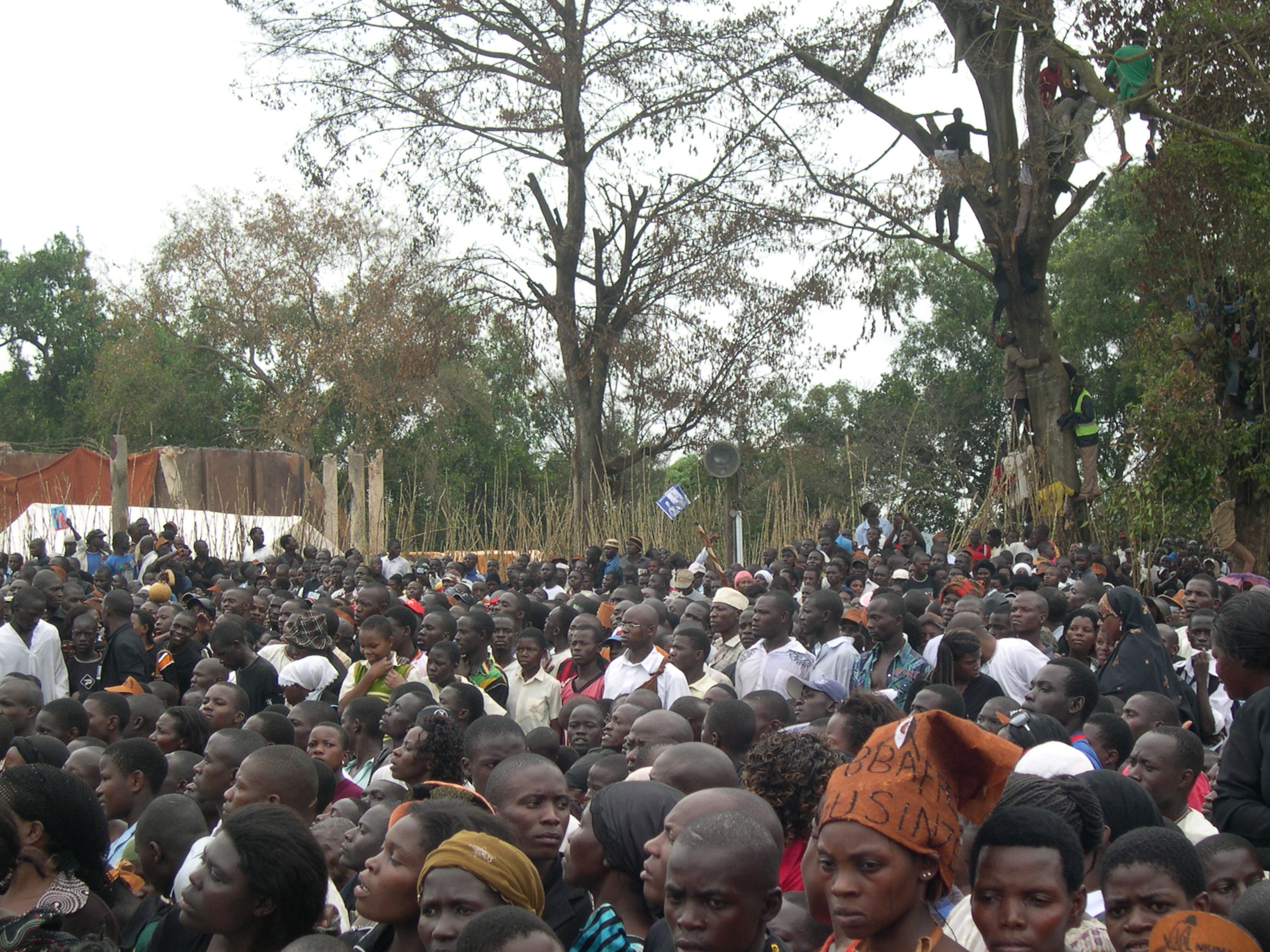
Yesterday I witnessed the largest display of public mourning I have ever seen. Thousands gathered at Kasubi, the burial site of four Buganda kings, to mourn the fiery destruction it endured last week. The New Vision printed estimates of the crowd at 100,000, but I’ve been in a crowd that large before and this was much bigger. There had to have been 100,000 in and around the Kasubi quadrangle alone.

Although both the Vision and the Monitor printed stories this week on the kingdom and the government beefing up security for the Friday prayers, the last day of mourning and the most public commemorative event yet at Kasubi, these forces managed to keep the situation just barely within control. Two died and more than 150 were injured, but considering what I saw yesterday, these numbers represent security blessings.

Along with three friends, I weaved through the crowds up toward the front near journalists and ministers of parliament.

There people pushed, shoved, shouted, sweat, fainted, climbed the trees, mourned and sang as security guards from both kingdom and government blew futile whistles and waved threatening batons at the throng. When the Kabaka showed up, it was difficult enough simply to stand up, much less see him and his entourage. The lucky few who caught a glimpse spurred a huge roar from the crowd before succumbing to waves of rowdiness and returning to the task of avoiding a fall.

What I didn’t realize until after the Kabaka left was that the logistical problem with this crowd was singular and fairly simple: this was a parade forced into a space where it could not realize its desire to move. The crowd cleared out of the enclosed stagnation to march through Nakulabye back to Mengo, where it eventually dispursed.

This physical expression of political desire for movement and change has people talking. For now I think we can simply be happy that, for the most part, things didn’t get too out of control.

Leave a comment

Filed under uganda

Buganda Mourning

No pix on this yet, but mourning has been ongoing in Buganda. People continue to visit Kasubi and tomorrow will bring more functions there. Meanwhile, the whole city seems to be attired in some manner of bark cloth, and the Kabaka cries in unison with his kingdom.

Leave a comment

Filed under uganda

Buganda Burning

Close on the heels of September violence in Uganda, fresh fears of conflict between Buganda and Uganda’s central government now dominate the evening news on every channel here in Kampala. It’s not clear how the enormous blaze began at a UNESCO World Heritage Site called Kasubi Tombs last night, but the Daily Monitor reported this story on the front page today, quoting officers and other people who suspected arson.

Of course people suspect arson. Of course they want to start rumors about how the central government maliciously burned down their ancestral burial place. These things are not surprising in a country where the president has been in power as long as Museveni has, especially if that country also has politically flaccid monarchies jostling for prominence. But realistically, Kasubi residents kept fires dangerously close to an enormous grass-thatched hut, so accidental fire is also a distinct possibility here.

What concerns me much more than the cause of this fire is the willingness of Museveni’s goons to use whatever violence they want to when someone gets in their way. Mourners at Kasubi apparently crossed the wrong boundaries, resulting in the shooting deaths of two people today when Museveni went to survey the damage. Is this a foreboding image of things to come in 2011 elections?

Or is it simply another symptom of the violence that bubbles just below the surface of any politically charged situation? If the riots at Makerere University are any indication, it’s more likely the latter. A colleague and fellow scholar of Uganda suggested in November that the September rioting was more economically than politically motivated, and she showed convincing evidence to support that theory. Regardless, the availability of violent means and the willingness to use them, particularly on the part of security forces and presidential guard types, remains of grave concern.

For more on these and related stories, see my Delicious links (in the sidebar).

Leave a comment

Filed under travel, uganda

Obama’s Chapatti

I have recently had great opportunities to learn from a really good drummer in Nakifuma. His group, the Nakifuma Super Dancers (love that name), won a local competition to get on the stage of a larger program run by a Kampala vernacular radio station, Bukedde FM. I was thrilled when group asked me to join them for the big show! The event is called Embuutu y’Embuutikizi, and this time it was held here:

This is Mandela National Stadium, locally glossed as Namboole, as that’s the area where it’s located. I had never been inside before this event, so it was kind of a cool opportunity to see Kampala’s largest stadium.

This isn’t a one-time thing–Bukedde puts them on from time to time. But it is one of the biggest I’ve ever noticed. It starts with a traditional music competition in the morning, and that’s the part we played for. By the time we took the stage, there were about 300-400 people down on the field in front of the stage. Other fun and festivities throughout the day include performances by kadongo kamu players and big pop musicians. I think Bobi Wine was the headliner, but I didn’t stay around for 14 hours after we played to check it out.

As with any big event, the people-watching and the food options are really interesting. I especially enjoyed the Obama Mobile Takeaway.

Brilliant.

In the end, the competition was cut short because it got started late and took too long. So the judges arbitrarily chose some finalists and wrapped it up. I think I was the least disappointed in the group, though. The competition wasn’t the main event of the day, and I got to play with some of my favorite musicians in front of a whole bunch of people. Plus, Obama’s chapatti is delicious.

3 Comments

Filed under travel, uganda

A Wedding of Spiritualists

This weekend, I had the privilege of witnessing a wedding of two spirit mediums, embaga y’abasamize. I have spent over a year now working with spirit mediums, observing their rituals, and trying to learn about how and why they perform those rituals. This is the first opportunity I’ve had to see this particular function.

With about two dozen other spirit mediums in two vans, I headed down to Rakai District in the southwest part of Uganda. We didn’t arrive until very late in the night, but we were greeted with warmest hospitality upon arrival. Matooke and binyeebwa, the traditional food of the Baganda, greeted us with a nutty scent over warm banana mash. I can’t say I’ve ever been anywhere else in the world where people show up that late in the day and receive the same amazing hospitality that they would had they arrived at lunch time.

The next day, everyone put on their fanciest barkcloth garments, along with some of the accoutrement that they would normally use in the ssabo or shrine where they work as basawo baganda, local healers. Jjajja Jjumba presided over the whole function:

If cowrie shells used to be used as money and as a symbol of wealth, then that symbol is still very much alive in Uganda today. Jjumba is an extraordinarily successful healer who normally sees upwards of forty clients in a day.

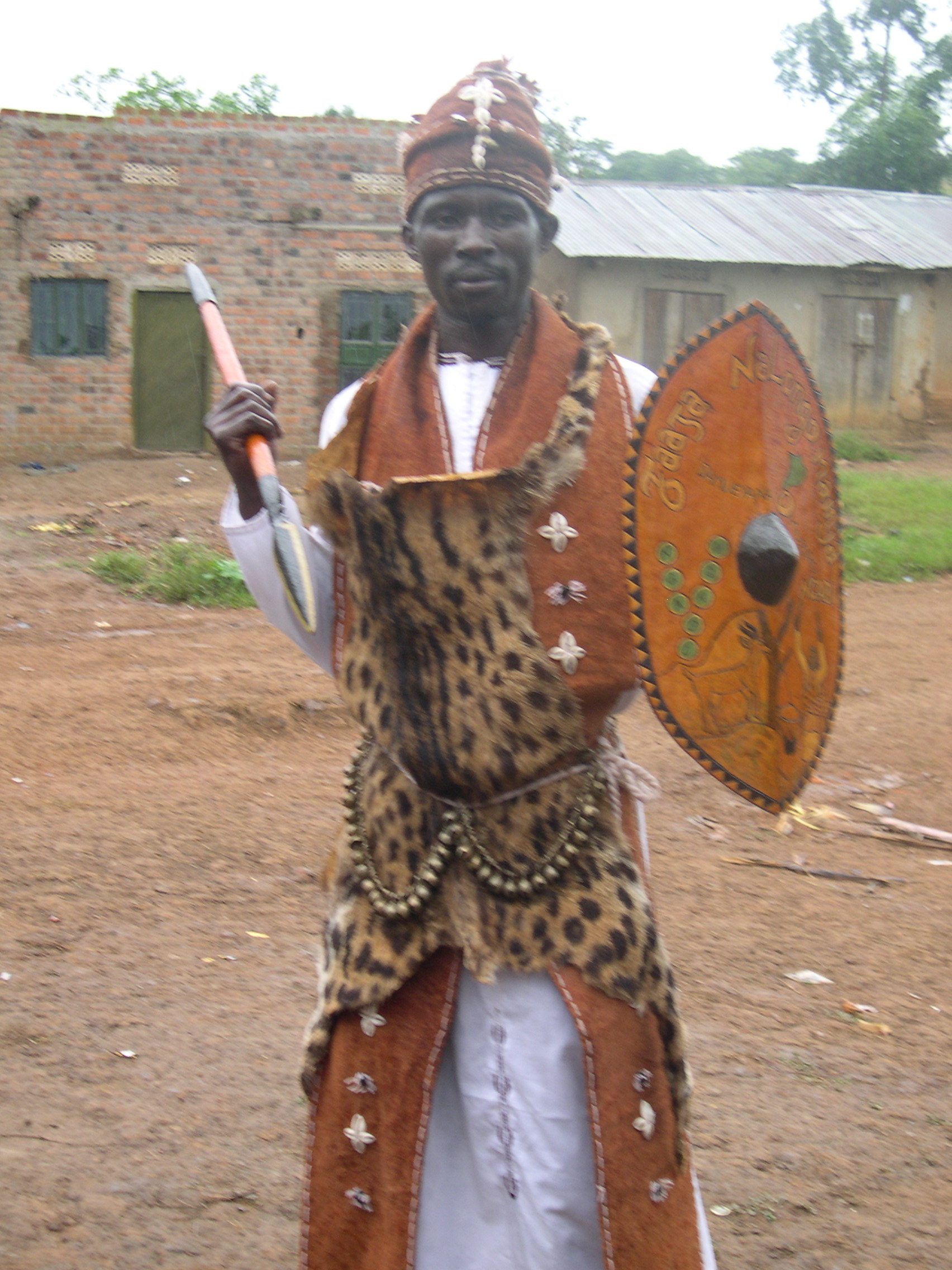
The procession of Bakabona, those chosen by their ancestors to be healers in their communities, was led by this muserikale, a soldier/guardian who also works to move the logistical elements of the function along during the day:

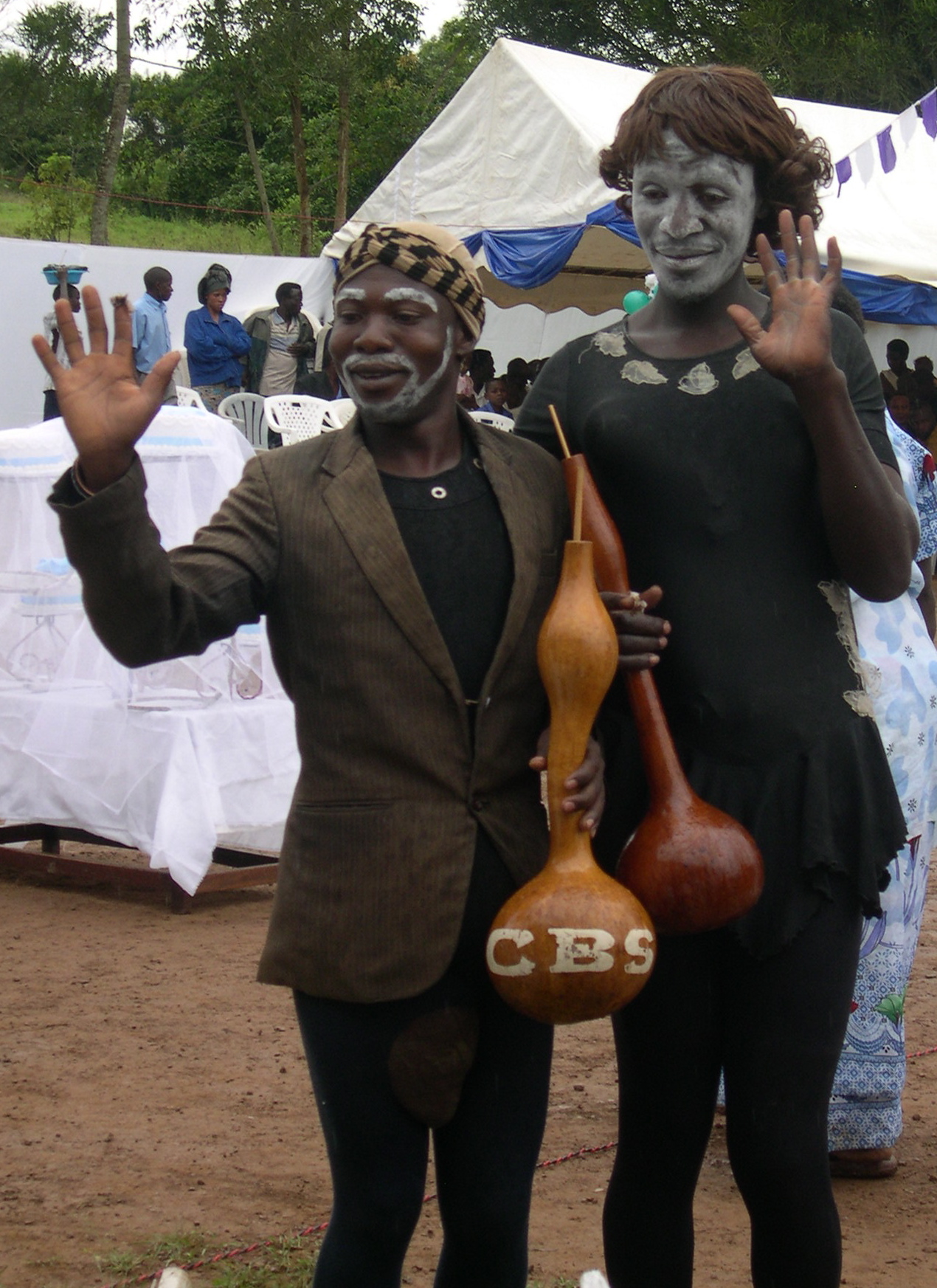
Once inside the huge circle of tents where this function would be held, I was shocked to find something I’ve never seen in Uganda before: a cross-dressing clown with a partner who rode a unicycle!

What a fascinating irony in light of Uganda’s recent discomfort with diversity in sexuality!

Once all of the Bakabona were seated, it really was a beautiful site to see. All that barkcloth, all those cowries, all the time people have spent making these things look so sharp…what a spectacle!

Some of the music was in the vein of a relatively recent trend at all kinds of Ugandan weddings that resembles karaoke. This gentleman, one of five or six performers of this type throughout the evening, is singing live over a recording…though some sing more than others, he was actually singing the whole time.

Many up-and-coming singers do this as they are working to become popular musicians. This guy, on the other hand, just happened to be a friend to some of the people who helped make this function happen, and he’s a good singer.

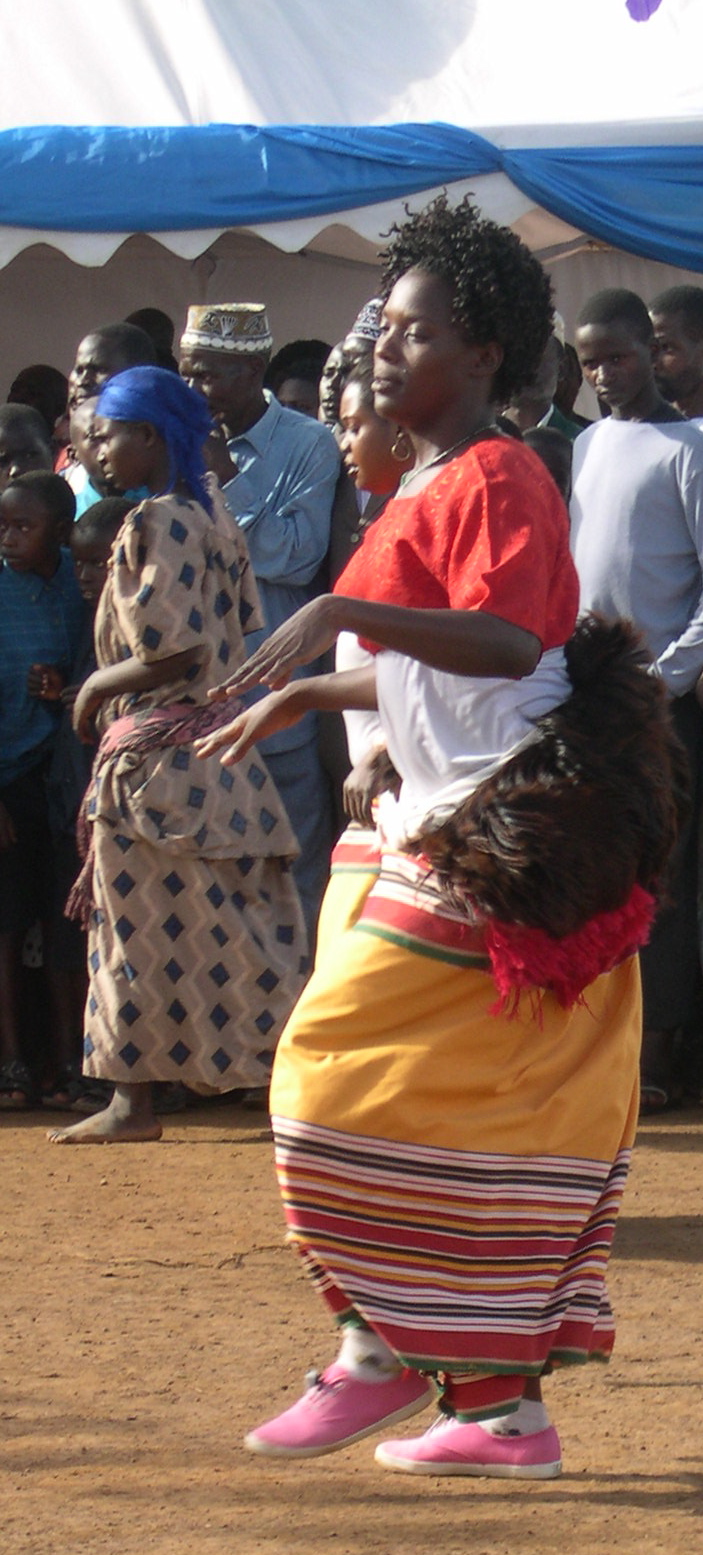
Other music was more like what I’d expect to see at a pair of traditionalists’ wedding: mbaga dance. It was provided by none other than Nakayima and her group, Tebifaanana Abifuna.

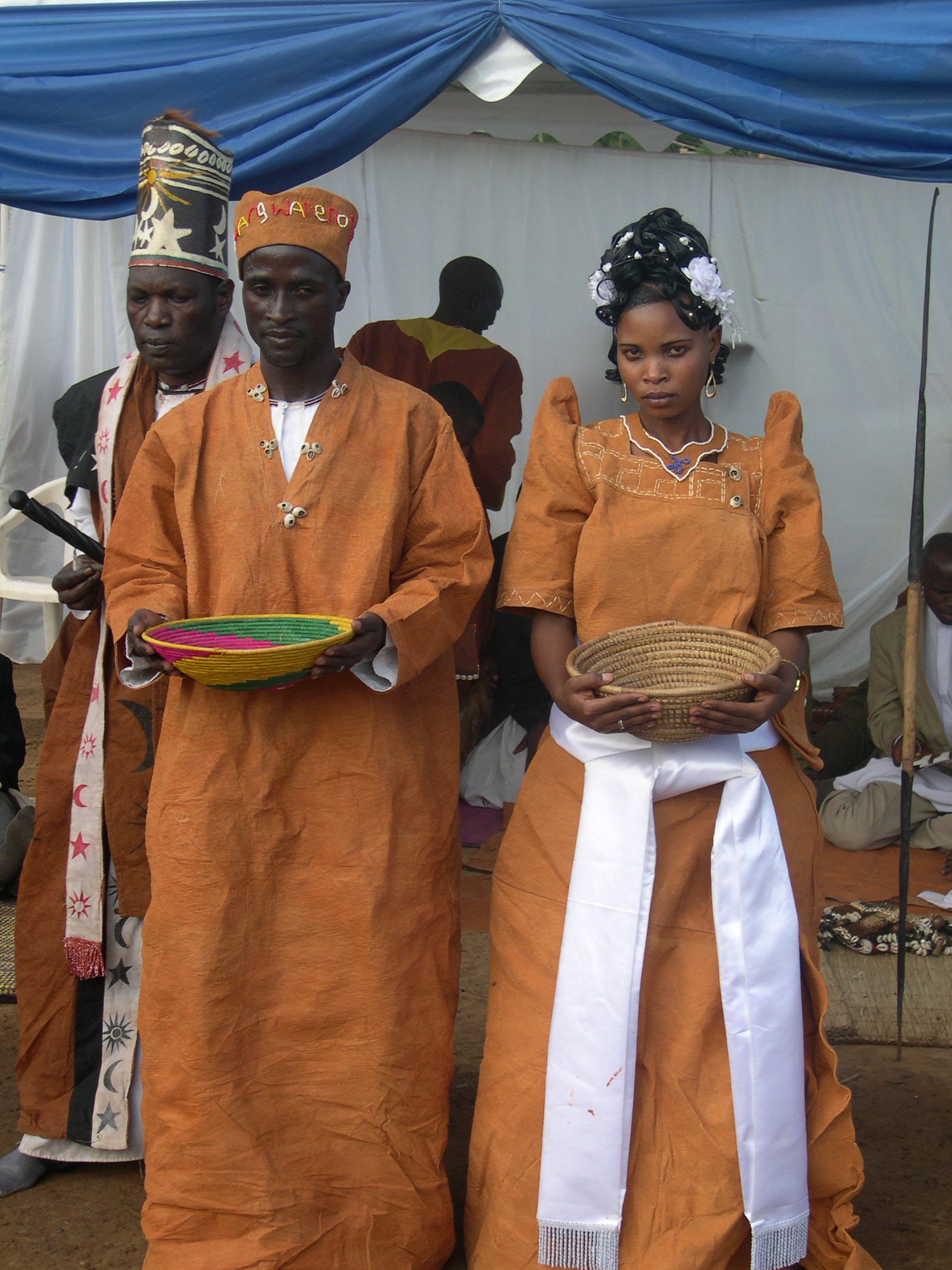
And, of course, the lovely couple was looking very smart in their barkcloth gear.

If they don’t look pleased here, trust me, they did after those baskets were filled with monetary contributions to their newlywed life!

I’ve never seen a wedding this large, even in Uganda, where weddings routinely involve 400 guests. This was more like a thousand people before the whole day was said and done. The cast of artists who performed was itself very large: about a dozen musicians in Nakayima’s group, and another five or six doing other things throughout the day. What can I say? What’s good for ritual is good for working musicians!

4 Comments

Filed under travel, uganda

To the Village!

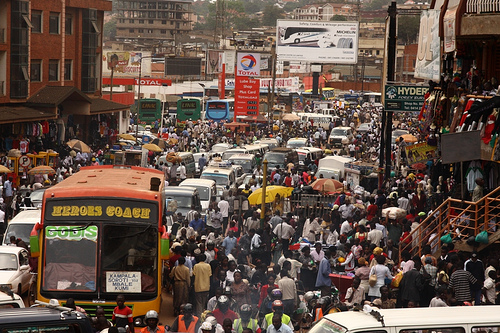
Today I’m off to Masaka for a wedding of two spirit mediums. This is a truly rare event, so it’s really exciting from a research perspective. But if you need other reasons to get excited about leaving Kampala…

But for something much more exciting than Kampala congestion, see Sean Cooke’s other gorgeous photos. The wildlife stuff is particularly good. He’s captured some of the most popular reasons for people to visit Uganda. Enjoy!

1 Comment

Filed under travel, uganda