Boston, Baby!

I’m not a Daddy Blogger, if there is such a thing. Maybe that’s why I don’t write too much these days: it’s challenging enough to balance Daddy time, research time and other work time, so reflecting and writing about all three often seems overwhelming. These experiences so rarely coalesce or even overlap in smooth ways; like many people, I find it easier to compartmentalize. Less messy in so many ways, but we pay a price for that. The last weekend of September, I had the pleasure of traveling with my family to a quasi-working environment in a potential new field site where we celebrated life with extended members of my adoptive Kiganda family. And yes, it sort of felt like that much of a mouthful, but in a good way. My spouse was here in the U.S. during my extended field research in Uganda, so this was a new combination for all of us.

Several things amazed me:

1) I have the world’s coolest family. Yes, I’m biased. Deal with it.

2) The terms Daddy, husband, and researcher do not represent mutually exclusive categories of people. Hopefully my family will confirm this observation. Compartmentalization might be convenient at times, but it’s not near as much fun as coalescence.

3) Ugandans in the Diaspora are as warm, polite and welcoming as their counterparts Over Home. This didn’t surprise me in the least, but the kindness of relative strangers (or is it strange relatives?) never ceases to humble and amaze me.

So, let me start at the beginning: several months ago, I got a call from my Ssenga (literally, paternal aunt), the sister of my Muganda host father. She invited my family for a betrothal ceremony called okwanjula, meaning “introduction,” which would take place in the city where she works, Waltham, Massachussets. My initial response was wholly and irresponsibly American: I was too busy, had too little money for travel and did not know either of the bagole (bride and groom). Ssenga Babirye persisted, calling a month later and adding calls from her sisters two weeks after that. It is rude to refuse someone’s hospitality. Even just dropping by a proper Kiganda home requires the consumption of tea, or at the very least a glass of water. An old proverb that my dear brother Ssetimba taught me states this unequivocally:

mu nju, temuli kkubo

in the house, there is no road

The bassenga demanded satisfaction in their own way, and we acquiesced, making plans to attend this family event as a family. Moreover, they insisted that we stay with one of them, just as we would if we went to visit our own biological families.

So to my first point: coolest. family. ever.

Our son got through the TLH-ATL-BOS leg of the trip like a seasoned traveler. This was his first air travel, and we couldn’t have been happier with that. Meanwhile, my spouse demonstrated the same patient resourcefulness that has become her hallmark in our home. The trip back was no different. Okay, realistically, we all get tired/hungry/annoyed/irritated and just plain want a minute to ourselves – we’re real people. This family of mine is great for their efforts to keep cool heads despite all of that. Moreover, the folks who invited us to Boston have given us the privilege of calling them family as well.

When I first started studying Luganda, I had two teachers. One was a fantastic young linguist named Deo Kawalya, the other a tutor for practical application. The latter, named Waalabyeki Magoba, became my dear friend and host father. He used to take me around to markets, taxi parks, and other public places to practice what I had learned in the classes. After a few weeks, he took me to his family home, where his aged parents gave me a Kiganda name.

Over the next two trips in 2008-2009 and 2009-2010, Mwami Magoba took me to several kwanjula celebrations. These were family affairs: Kiganda kinship makes no distinction between daughters and nieces, so anyone who shares our kika or “type” also shares our totem animal, Ffumbe (a civet cat). Those in my age group are therefore my sisters (bannyinaze) and daughters of Magoba and his generation. One of the things I learned from a host brother very early on in this process was the clan slogan (omubala):

Galinnya, galinnya e Bakka,

They are climbing, they are climbing [the hill] at Bakka,

Basengejja, banywa omwenge!

They are brewing, they are drinking [banana] beer!

Kasolo ki? FFUMBE!

Which small animal? FFUMBE!

Kakozaakoza – Tolikoza mu lw’Effumbe!

Let food be dipped [in sauce] – you shall not dip in the sauce of the Ffumbe!

This slogan outlines both the geographic history of ekika ky’Effumbe, those who share the Ffumbe as their totem animal, and the principle of kin avoidance in marriage as it applies to this kika. In other words, anyone who shares the Ffumbe totem animal, whose ancestors were born and lived at Bakka, shall not marry another person from that group. Reinforcing this notion of avoidance at kwanjula – the first public, official event recognizing a couple’s intent to marry – perpetuates strongly held beliefs about eligible partners for any given Muganda.

Americans define family in terms of various shared substances: blood/biology, residence, extended time in armed combat together or even pet ownership. Baganda use some of these same markers for kinship, but sharing blood or other biological symbols proves secondary to other elements of and symbols for shared substance. Avoidance of a totem animal provides the basis for an enormous number of extended kin relationships and for adoption of outsiders into the cultural fold. Sacrificing time and resources in the name of sharing food and other resources builds community fellowship in both contexts.

When I consider what my family has sacrificed in order to facilitate my research, and in turn what my host Ugandan host family has given in order to create lasting bonds with us, I am truly humbled and amazed. I left Boston feeling like I would miss it even though we had never been there before. We left Waltham, which my wife dubbed “Little Buganda,” knowing it was only a matter of time before we would return. We carried our son back through airports and trams to our home with gratitude for the enormous privilege we enjoy in knowing and loving our African family and our new relatives in the Diaspora. Overwhelmed? Maybe, but joyfully so.
1 Comment

Filed under Reflection, travel, uganda

Zakir Hussain and Rakesh Chaurasia at FSU

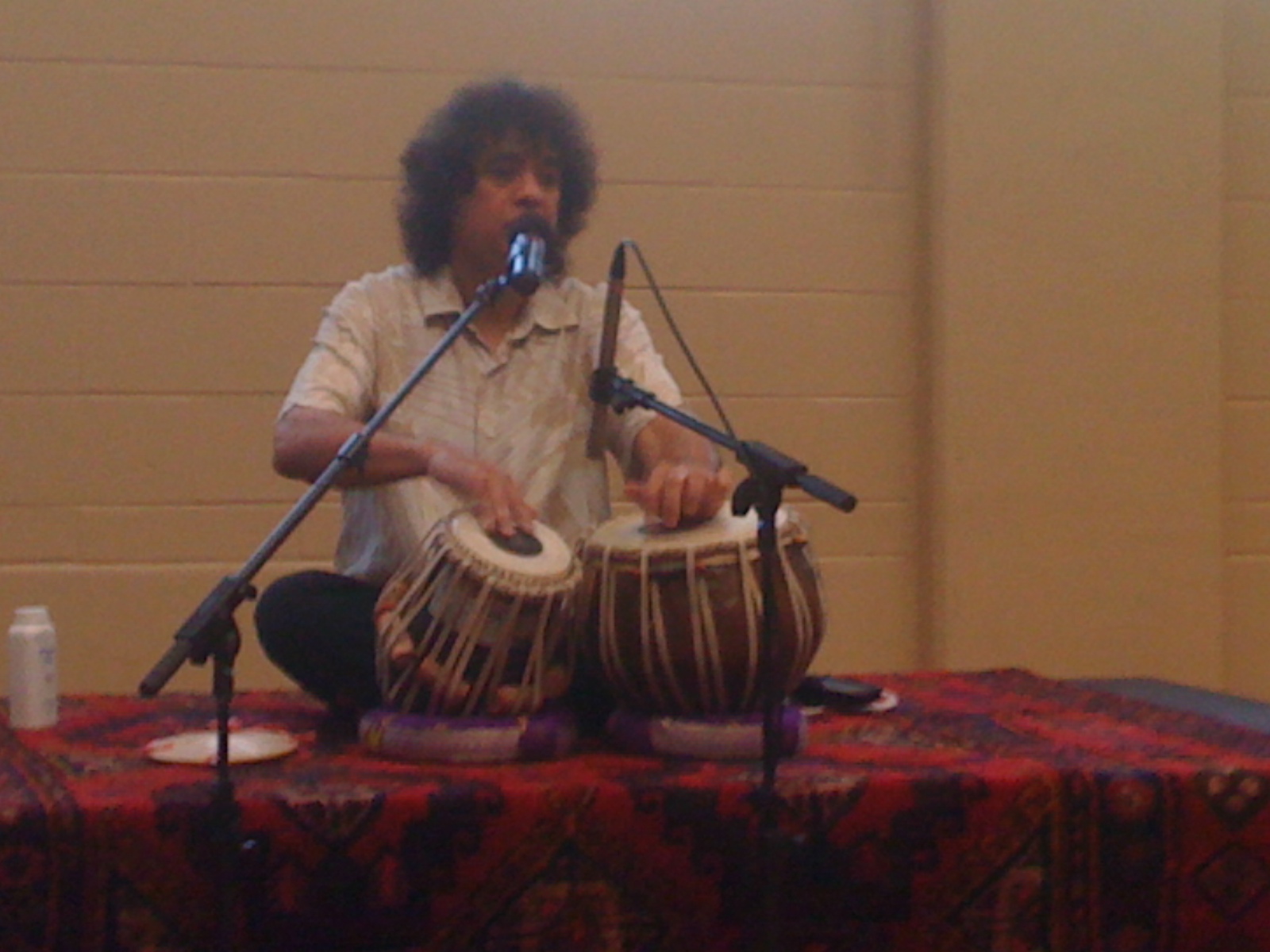
Rarely have I ever seen live the unbridled virtuosity that Zakir Hussain Alla Rakha Quereshi and Rakesh Chaurasia demonstrated last Wednesday night in Florida State University’s Opperman Music Hall. They played to a hall so packed that people were hanging from the rafters, most of whom understood Hussain’s international reputation and his status as a world music demi-god. To say that these players were amazing would be a disservice. No one familiar with Hussain’s musicianship was surprised in the least with the dexterity, precision, and sensitivity they heard from either musician. The pleasant surprise here – thanks to Seven Days of Opening Nights and their Director, Steve MacQueen – was to see such a global drumming giant diversify the fall concert lineup at FSU. A sizeable Indian/Indian American sector of the audience expressed delight not only that Hussain was here in Tallahassee, but also that he played with the nephew of the great flute maestro Pandit Hariprasad Chaurasia.

During their whole visit, Hussain and Chaurasia demonstrated a forward looking approach to the contemporary practice of Indian “classical” music. During the concert, we watched sons of masters, two musicians who had never played together, meet each other musically. They communicated clearly according to the systems they had learned so well as younger men. They improvised within those boundaries, at once honoring their gurus and pushing the envelope with tremendous technical prowess.

Hussain explained the next day during a masterclass that he had played with Chaurasia’s uncle and teacher. Chaurasia, for his part, had watched the tabla player onstage with his uncle for years before playing with Hussain. The pair sounded as if they had been born playing together. At other points in his masterclass, Hussain emphasized that “the purists in India” had little to do with the kind of musician that drummers like Airto Moreira, Babatunde Olatunji, and Giovanni Hidalgo inspired him to be. His reverence for Indian masters paralleled this respect for other virtuosi. His comparisons of Indian musical systems to jazz made perfect sense of the fluidity he had with Chaurasia onstage.

Starting with the long view – a historical backdrop about where tabla music had come from – Hussain explained how relatively new it is and how the instrument is still changing and developing in terms of its technique. He made crystal clear that he strives to stay within the musical and theoretical boundaries that his musical pedigree demands while simultaneously revolutionizing tabla technique.

In both the concert and the masterclass, these technical elements surfaced in the complex counterpoint not only between raga and tala or between tabla player and flutist, but also between right and left hands. What Hussain plays with either hand could be food enough for even the most sophisticated ears; what we hear when they play together is something that neither hand plays on its own. The ears respond with similar mesmerizing bewilderment as when listening to good Indonesian gamelan music, a pointillistic string quartet, or the intricacies of Kisoga embaire (wood slab idiophone) music from eastern Uganda. Unlike these, however, Hussain and Chaurasia’s collaborations are so highly improvised as to be fleeting, leaving the feeling that even if precisely the same combination of sounds was never made again, we became somehow more enlightened having heard them at all.

It was also no surprise then that two musicians with this ability to affect audiences so profoundly proved to be so personable and kind. People think this doesn’t matter, but the truth is that it reflects a kind of social intelligence consistent with these artists’ highly developed musical sensibilities. For what is music if not a social experience, and what is performance but the demonstration of thorough competence and elegant improvisation within particular social spheres?

Leave a comment

Filed under featured artists, reviews

R.I.P. Amy Winehouse, 1983-2011

Today an artist who showed such luster in her early career has been found dead at much too young an age. No doubt people will speculate about the cause of what London police are calling her unexplained death. Given her history, they’ll probably be right, but now is the time for mourning the loss of a tremendously talented woman. Amy Winehouse did what so many notable British artists before her have done: she began her career by imitating the best, she quickly grew into her own creative voice, and she found appropriate producers and other allies to amplify it.

Few obituaries do justice to the late Winehouse. JazzTimes certainly doesn’t sugar coat anything. The CBS News version rightly questions which was more tragic–her struggle with substance abuse or the resulting freak show that too many people too frequently made of it. Meanwhile, her adoring fans have already meticulously curated her wiki.

Sure, she had a few too many parallels with Billie Holiday, as with so many other great artists who had habits, but take a moment to remember her doing one of the things she did best: reinterpreting a standard.

4 Comments

Filed under featured artists, obits

A year ago, I had just left Uganda when

A year ago, I had just left Uganda when 76 people were murdered in cold blood while watching World Cup finals. Nga kitalo nnyo: http://ow.ly/5BpC5

Leave a comment

Filed under Uncategorized

Federal Research Dollars: Bailed Out By Philanthropy?!

In the wake of highly controversial bailouts aimed at bolstering our struggling economy over the past few years, I found it bitterly ironic that news of this year’s cancelled Fulbright-Hays DDRA funding precipitated this move by the Andrew W. Mellon Foundation. Now some of the world’s most heavyweight philanthropists are bailing out the federal government? Strange days indeed. It’s been a week since I heard this, and still I’m not sure what to think. Is it yet another move toward the privatization of virtually everything? Can it be as temporary as Mellon and IIE claim it is?

One thing’s for sure: I couldn’t agree more with the Mellon Foundation that international language and area studies funding constitutes “an important investment in the nation’s intellectual infrastructure.” With that in mind, let me put forth some unabashedly partisan encouragement on this matter. I hope with these benevolent grant makers for wiser decisions in coming years, I urge readers to contact their relevant representatives urging them toward the restoration of Fulbright-Hays programs, and I applaud the Mellon Foundation’s efforts to mitigate the devastation that these cuts foist upon doctoral candidates whose research promises a brighter future for the nation and the world. Given the federal government’s recent heavy investment in “critical languages,” this about-face for grant funding comes as a shock. Here’s hoping the cuts can be perceived as a senseless deviation from smart policy and swiftly corrected for the 2012-2013 funding and subsequent cycles.


Leave a comment

Filed under art & politics, Reflection

The Cost of a Good Education

NPR’s Morning Edition ran a story yesterday that has generated lively debates on their website, on Facebook, and on professional listservs. Much of this debate centers around comments made by Steve Inskeep’s guest on an ongoing NPR series concerning young people and financial literacy. The guest was Mark Kantrowitz, publisher of the websites FinAid and Fastweb. For musicologists, one of his more contentious statements was the assertion that ethnomusicologists’ only career options involve joining the professoriate or becoming music librarians. Plenty of people took issue with that part, and rightly so, but plenty more are beginning to delve into the deeper issues that this piece failed to examine.

The comments on the NPR site have centered primarily around economic issues and the financial viability of ethnomusicology and other fields in the humanities and social sciences. That’s a perfectly smart conversation to be having, particularly given that those of us who choose to pursue careers in these fields need to seriously consider how to be financially solvent. But where and when is that not the case? In what field do people not need to consider these issues? As long as lotto winners remain a small sector of the population, these are rather quotidian considerations for everyone.

One stream of argument in particular is important to highlight in this debate: the notion that arts, humanities, and social sciences place people in financially unstable positions or miserable careers of destitute poverty and starvation perpetuates the already rampant undervaluing of these fields. The idea that one cannot have a career or a fulfilling life unless pursuing a corporate life or a field of study in the so-called “hard sciences” remains not only completely untrue but also thoroughly detrimental to the continued development of a diverse and robust economy. As one Facebook commenter put it, “Innovative thinkers and a creative class will be an important part of American economic recovery and building a better future for all of us.” As many others expressed on the NPR site, the very journalists bringing us these stories often come directly out of the fields of study that Kantrowitz’s commentary degrades by encouraging “fall-back” double majors or minors. In fact, one savvy comment on their site quoted the first part of the NPR mission statement, which stands in direct contradiction to the thrust of this piece: “The mission of NPR is to work in partnership with member stations to create a more informed public – one challenged and invigorated by a deeper understanding and appreciation of events, ideas and cultures.” I find it extremely hard to believe that such and understanding would not be enriched by more enlightened reporting on this issue.

Want to defend Steve Inskeep? Think Mark Kantrowitz is right? Hit me in the comments. This lively discourse lies at the intersection of academics and culture in this American moment. AND, lest anyone buy into the bunk notion that careers in arts, humanities, and social sciences are dead ends, this just in from the American Academy of Arts and Sciences. Be sure to note Philip Bohlman, Sarah Fuller, and Thomas Forrest Kelly on this list–all are musicologists, and Dr. Bohlman is the former president of the Society for Ethnomusicology.

6 Comments

Filed under Reflection

Dr. Hiatus

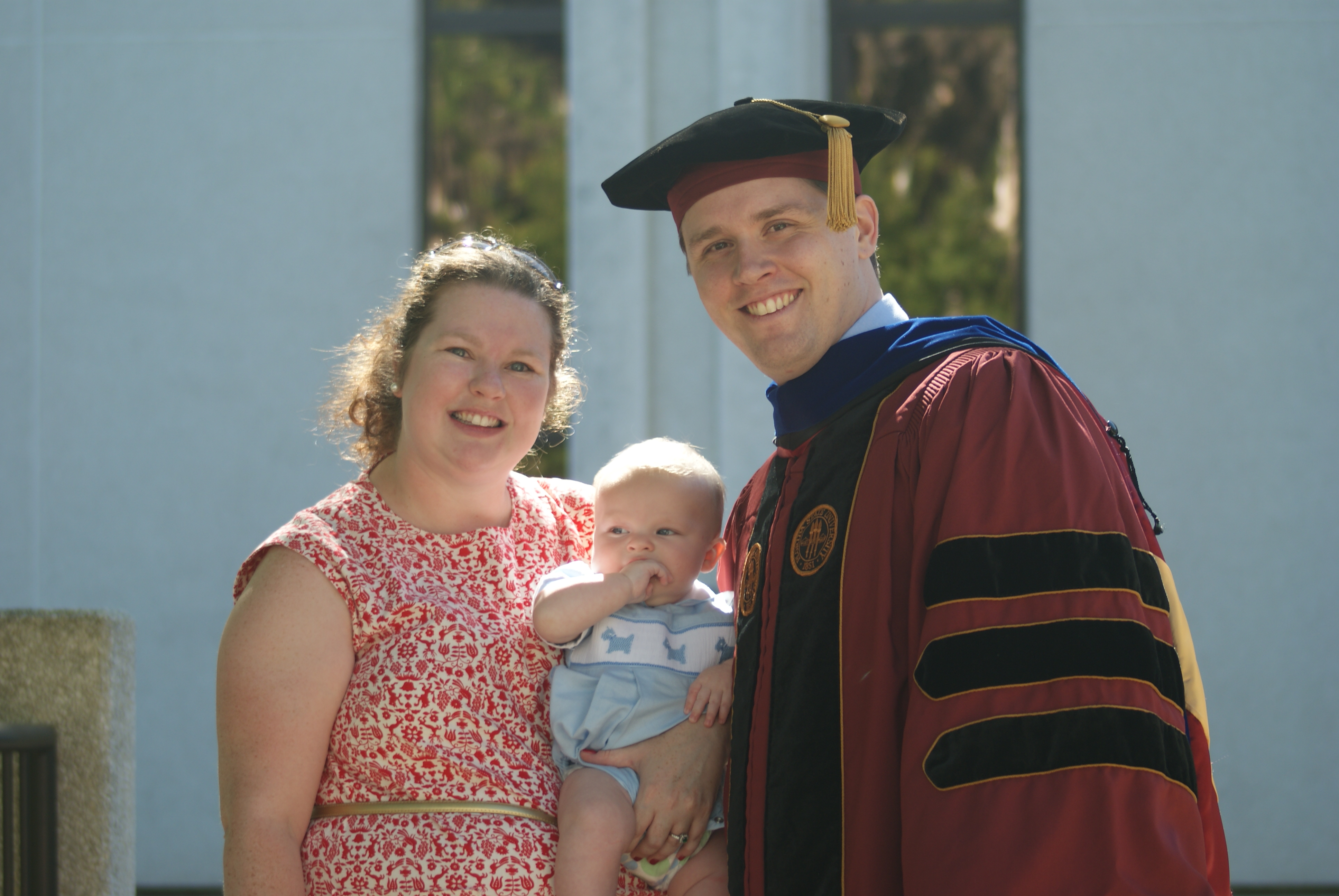
Frequent readers of this blog (all two of you) would have noticed the long hiatus I took while writing up my dissertation. Well, that’s done. Last weekend, my folks and my brother were in town, I had a bunch of people over for a beer, and we all celebrated the completion of my Ph.D. Now all I need is a job. In the mean time, I have these pretty pictures to look at. Bully for me!

My brother took some great pictures at the graduation ceremony. Here’s one from just after that in front of the building where my wife works.

We also took a few that morning before the festivities. It was good to see my folks again–it had been several years!

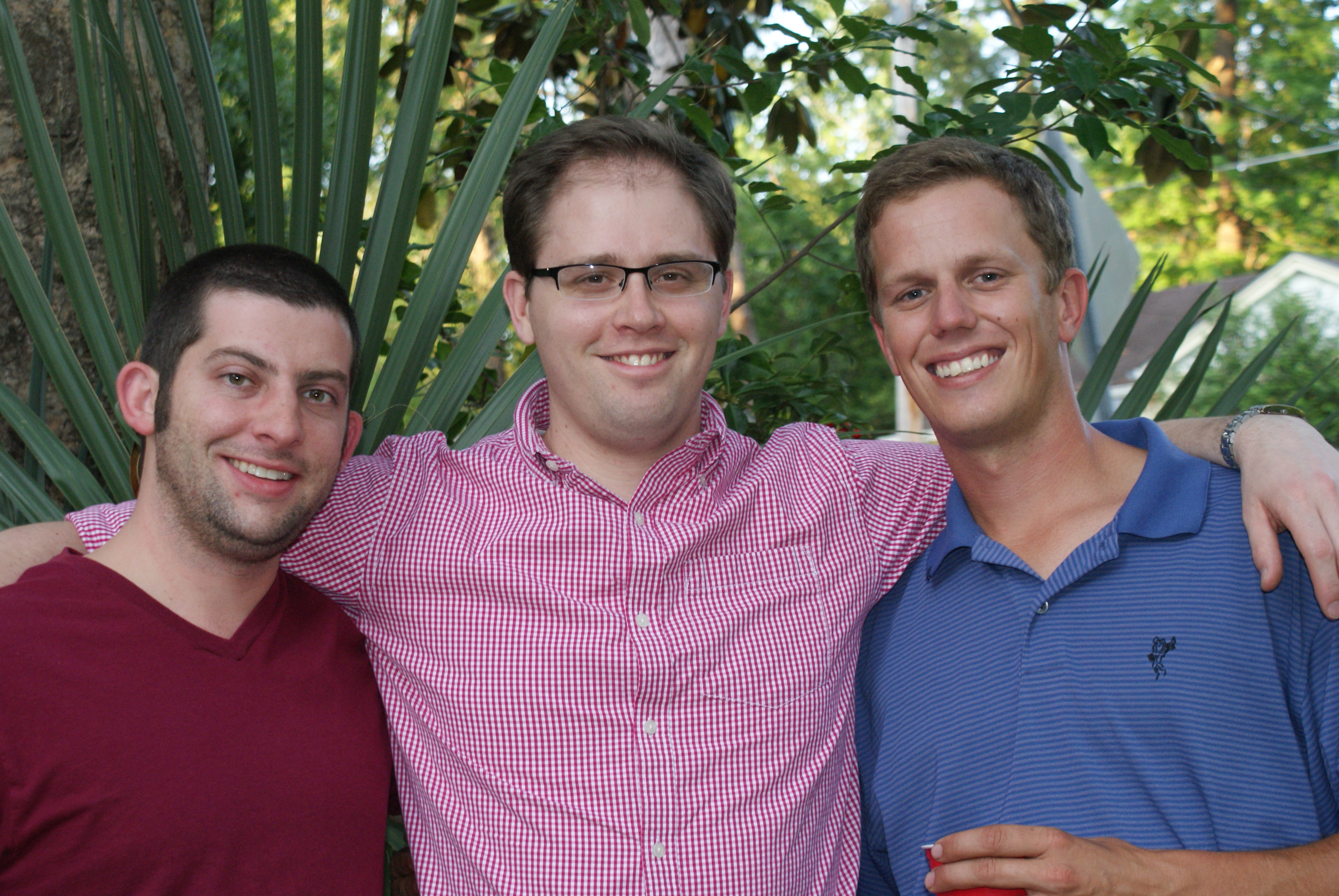
The boys…

Jenn planned a fantastic party to which this cake was a popular addition.

Many friends joined us. Among them, here’s Dale Olsen. The Distinguished Professor Emeritus was one of the reasons I came to FSU, and I spent my first three years here working very closely with him. We shared many wonderful moments onstage and in conversation, and I’m glad to call Dale a friend.

We had so many friends there that day. Deep thanks to all for the warm congratulations. These are merely highlights from an unforgettable weekend.

Leave a comment

Filed under Reflection

Villages in Action

@ethnicsupplies, @projectdiaspora and others who make and sell art for social change in East Africa are today attending Villages in Action! Project Diaspora’s collaborative effort with Business Fights Poverty and Orange Uganda just opened in Kikuube Village, Masindi District, Uganda. Join ’em wherever you are and see what villagers have to say about the UN’s Millenium Development Goals and other issues. Follow the stream on Twitter under the hashtag #VIA2010.

Leave a comment

Filed under art & politics, uganda

Dylan Rolls Through Tallahassee

So this afternoon my wife calls me at work. At first I’m worried, because she rarely calls me at work. She gets right to the point:

“Do you want to go see Bob Dylan tonight?”

Now, we have other plans–family plans that we have every Monday night–but the way she asks, I know there’s only one answer, and it’s the one we both want:

“YEAH!”

We walk into the Civic Center to hear Dylan’s aging voice scratching out one of his more recent tunes, but the night turns out to be a mix from his whole songbook. It doesn’t seem to matter much what he’s singing: his delivery tells listeners he’s as sure of who he is and what he wants now as when he set out to make Woody Guthrie his guru.

When he’s not behind the keyboard, Dylan creeps up to the mic like some old man around a campfire getting ready to frighten the bejesus out of some unsuspecting grandchildren. His voice ghastly and only rarely with any pitch at all, he spins his tales as a master storyteller. He smiles with the awareness that his audiences know all the tunes, but his poetry does not suffer a lack of urgency for it.  In his encore performance of “Like a Rolling Stone,” as Dylan asks his old question again–“How does it feel?”–we wonder if we should have kept the part of those frightened grandchildren the whole time. The tune has as much haunting resonance now as it always has.

It comes as no surprise that a man who’s been on the road as long as Bob Dylan has this kind of creative command over both audience and band. A tiny nod cues enormous tempo changes, his subtle squint a complete change in lyrical mood. At seventy, the textual and visual poetics of his performance still satisfy with all kinds of relevance for a generation still in the midst of discovering him.

On top of all that, my spouse still has the ability to surprise me with a totally unexpected gift: a soulful dinner with friends, a fantastic show, and all on a Monday night! What a gem.

3 Comments

Filed under reviews

Fear Itself

Sunday evening I saw the season premiere of 60 Minutes, the television news magazine that has provided some of the most even-handed reporting in American mainstream media for over forty years. Scott Pelley’s feature piece covered the controversial Islamic community center two and a half blocks from “9/11 ground zero.” Pelley began by interviewing Sharif El-Gamal, the developer who has plans to tear down a dilapidated Burlington Coat Factory to build the center. It was important to see that this man is an American citizen, born of a Roman Catholic mother and an Egyptian Muslim father. He’s a quintessential New Yorker who modeled this project on the Jewish Community Center in Manhattan.

Then they moved on to Pamela Geller. To date, Ms. Geller has been the most outspoken opponent of what she calls the “Ground Zero Mosque.” Her blog frequently mentions the project, and she organized an enormous rally in opposition to it. Geller was unequivocal, and made it clear that her supporters are as adamant as she is that there be no Islamic cultural center anywhere near the 9/11 Memorial in New York.

Here’s the thing: that’s not the only “ground zero” site from that day. The other one is in the Pentagon, where high ranking military commanders defend the rights of employees to use interfaith prayer room no matter what their faith. Muslim faithful already use the prayer space of the Islamic Community Center in New York, too. Given that many people first came to this continent seeking religious freedom, do those who oppose this community center risk the label “UnAmerican?”

Pelley’s interview with Imam Feisal Abdul Rauf, the spiritual leader of the center, was perhaps the most telling of all. Rauf sees himself standing as a buffer between radical Islam and American non-Muslims. He says is dedicated to the kind of mutual understanding that will prevent another 9/11. Still, he seems to be the most controversial figure in this whole debate, particularly after his reactions to political pressure that asked him and others to move or give up the project.

These are not problems that go away simply by moving them around. Americans are not children who push their vegetables around instead of eating them. No, Pastor Jones, burning the Qur’an won’t help, either. Pelley didn’t bother interviewing the Gainesville pastor, and other Gainesvillians are probably just fine with that. However, refusing to deal with their most difficult aspects won’t rid us of these problems either.

Jones’s failed campaign in to stage a veritable hatefest in Gainesville echoes an emotion common among many Americans: xenophobia. We talk about it far too little, but we feel it all too often. In polite circles, we deny ever having felt it. Irrational fear never appears very sophisticated. If Terry Jones’s displacement of xenophobic energies on a holy book reflects his deep-seated fears of Arabic text and Islamic education education (among other things), what other, subtler fears might other Americans harbor daily without really acknowledging them?

Take a step toward understanding how you really feel toward your fellow Americans and how they sometimes sound. If you’ve read this far, take the poll. Maybe you’ll learn something about your own fears. Maybe, as FDR famously said, the only thing you’ll have to fear is fear itself.

When I hear Qur’anic recitation or a Muslim call to prayer, I feel

(polls)

Not familiar with the Cordoba Initiative, the project behind this project? Check it out.

2 Comments

Filed under art & politics, Reflection