Quick, if you haven’t wasted hours on it already, get over to google to check out their Doodle today: a playable Moog synthesizer complete with recording capability. Haven’t found a stable URL for when it goes away tomorrow yet, but hope to soon!
Category Archives: Uncategorized
Musica en la Republica
So…remember when I said I’d post pictures when the weather improved? Well, kind of a lot has happened since then. We spent a great deal of time in the Zona Colonial of Santo Domingo, which is beautiful.

…but it’s what I got to do away from the tourist areas that was really fun on this trip.
It rained all Sunday afternoon, so one of the ladies who works at the Academia de Ciencias called her friend to come and pick us up. We went to a grocery store, which is a cultural experience in any part of the world, and sat in the deli for a snack. Then we went to a bar, drank Presidente, and danced a bit of merengue.
In the afternoon, there was supposed to be a public son dance, but it got delayed by the rain. They didn’t get started until almost 8:00. Since we knew that the other show we were going to wouldn’t start until later, we hung around for the first hour of that. Locals made it sound like it was just going to be a bunch of old farts blowing their horns, but they actually played really well and had a whole sound stage and portable dance floor setup. It was something. Naturally, it wasn’t just son, but plenty of merengue as well.
Sunday night Paul Austerlitz played with his group. On my way in the door, Paul was kind enough to introduce me to his tamborero. “Call this guy tomorrow,” he said. “You should take a lesson.” The guy’s English was good, and since my Spanish is abysmally bad, that’s the only way I knew this could work. Still, if he hadn’t spoken a word of English, I would’ve tried. He and the group played a fantastic concert. Paul was impressive as usual, and he had a really tight band. These were obviously people he’d been playing with for years.
So I did, I called him in the morning. I ended up spending most of my Monday at Julio Figureroa‘s home music studio learning an enormous variety of merengue variations for tambora and congas. He also called a friend over to teach me a bit about playing guira.
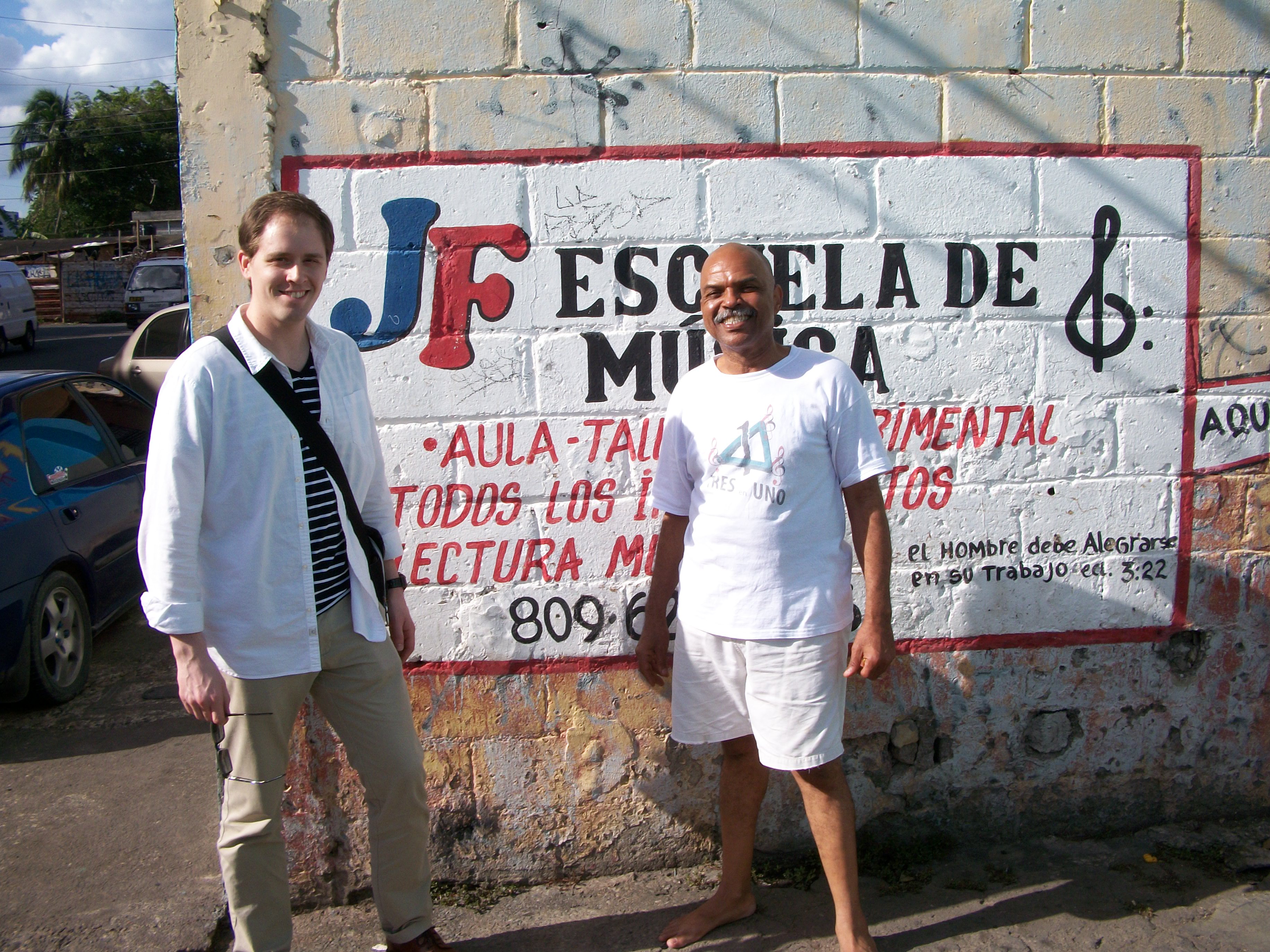
Julito is an incredibly warm and generous individual, and I thoroughly enjoyed my time with him.
Monday night it was a quiet dinner and a bit of rest before an early flight in the morning. So it’s adios to one of my favorite places again for a while. Hope it won’t be too long before we meet again.
Filed under Uncategorized
Hola Republica Dominicana!
I’ve just arrived at the Acuarium Resort Hotel in Santo Domingo! I’ll give my paper tomorrow afternoon for SEMSEC, but for now it’s a Presidente at the hotel. It’s rainy at present. I’ll post a picture when the weather improves.
Filed under Uncategorized
Eastman and Mount Holyoke
I was honored to speak last week on the Eastman School of Music Symposium Series, where my colleague and friend Jennifer Kyker invited me to give a talk on my kusamira research. I did an overview of this Ugandan ritual repertory, a talk that I called “Sound Medicine: the Performance of Healing in Post-Colonial Uganda.” Earlier last Thursday, I also spoke to Jennifer’s “Music, Ethnography, and HIV/AIDS” class. At both the Eastman School and the University of Rochester’s River Campus, I received a very warm welcome and encountered sharp, energetic students.
Jennifer and I attended a conference on “Development in Crisis” at Mount Holyoke College. It was interesting, but I found it wanting for a more radical economic perspective from folks working in development.
This morning I spoke in Professor Holly Hanson’s History 101 class at Mount Holyoke: “How Wars End.” In a little over an hour, I’ll give a talk in her History 206 course, “African Cities: Development Dreams and Nightmares,” on the destruction of Kasubi Tombs last year. The students here are truly impressive, and I look forward to more time with them this evening.
Filed under Uncategorized
Saying goodbye to old friends
This season of hope and expectation has also been for me a time for grieving and for celebrating the lives of ordinary people who did extraordinary things. May our ancestors smile on these celebrations as they rest in peace.
My wife’s grandfather James Smith was a dearly beloved Irishman, small in stature but enormous in personality. We remember him as the patriarch of a family whose musical roots predate him in fascinating ways. His mother accompanied his sister and him on piano at the Chicago World’s Fair in 1933, where their Vaudeville act called “The Smith Kiddies” enjoyed a short run. They won a talent competition at the Orpheum Theater in Sioux City that facilitated the trip. His son Steve, who frequently comments here, is a tremendous musician in his own right. A church organist since age 8, he has also played saxophone since his secondary school days with the late veteran Iowa Jazz Educator Marty Crandall. He also played with Iowa Rock ‘n’ Roll Music Hall of Famers The Cellophane Spectacle. Steve studied music at Iowa State University. There he wrote arrangements for the marching band. He returned to Marcus to join his father’s insurance business, a county mutual and independent agency that thrives to this day. Steve married Linda Lott (Smith), a design specialist and drummer. Their act, Gentle Persuasion, played dance jobs well into the 1980s. He continues to play jazz standards, adjudicate high school band competitions and collaborate with young musicians exploring their solo talents.
Steve’s eldest, my wife, studied music at Luther College, where I met her in 1999. We have traveled the world playing music together and we came to grad. school together at Florida State in 2003. She now works as an arts consultant and continues to play clarinet and saxophone and sing in our church choir. I met Steve’s son Chris at a jazz camp in Creston, Iowa, where we both played drum set in the same big band. Chris also went on to advanced studies in music at the Manhattan School of Music. There he studied with John Riley, who plays with the Village Vanguard Orchestra, among others. He then worked as a drummer in New York for a couple of years before going on to further studies at Northern Colorado, where he will soon finish a doctorate in music with his research on Mel Lewis. These, Jimmy’s survivors, carry on the Smith family legacy of musicianship and community.
I just received word last night that my Ugandan host father’s neighbor died. I knew him only as Hajji, the friendly Mzee (venerable elder) to whom my host family brought dinner each night. His name refers to the pilgrimage that Muslims take to the holy cities of Mecca and Medina. Hajj lost his wife over ten years ago. After that time, Mr. Magoba (my host father) instructed his children to take Hajj a portion of their family meal every day. On the Muslim holiday Iddi and other Islamic feast days, Hajji would reciprocate by sending special foodstuffs and prepared meals to his neighbors. Now Mr. Magoba’s family are committed Catholics. Having grown up to see the hostility between Christians and Muslims in the U.S. and around the world, Magoba and Hajji represent for me an inspiring example of neighborly love and peacebuilding. Let me say to the community of Ntinda-Kiwatule and all of Hajji’s family, friends and neighbors, nga kitalo: what a tragedy his loss is to us and to all lovers of peace. We shall miss him and remember him fondly as we do all of our ancestors and neighbors.
To other friends and family in the U.S., Uganda and around the world: Merry Christmas, Ssekukkulu amakula, Happy new year, kulika omwaka, and may peace be upon you, as-salaam aleykum!
Filed under Uncategorized
A year ago, I had just left Uganda when
A year ago, I had just left Uganda when 76 people were murdered in cold blood while watching World Cup finals. Nga kitalo nnyo: http://ow.ly/5BpC5
Filed under Uncategorized
London and Oxford
Not surprisingly, I’ve enjoyed a bit of quiet time following my return home to be with my wife, decompress, and spend time with friends. Before I got here, though, I had several wonderful days in London. Three research endeavors long in the making came to fruition for me. Several British museums have impressive collections of Ugandan musical instruments, some of them with considerable historical significance. I got a chance to see objects relevant to my research from collections at the Horniman Free Museum and the British Museum in London, and the Pitt-Rivers Museum of Anthropology and World Archaeology at Oxford University.
Having flown into London on Tuesday afternoon from Uganda, I began on Wednesday morning with the Study Collections Center for the Horniman. The staff there had generously pulled about a dozen instruments from their shelves that I selected from a list prior to arrival.
I went from there to the Hackney area for a visit to the British Museum’s similar offsite facility. Again, there were only a handful of the instruments I asked to see that directly related to my work in Buganda and Busoga. Others, however, piqued old interests from my master’s thesis on possession music in the broader Interlacustrine (i.e. between the lakes) region of East Africa. This was very exciting because the objects took on new significance for me after having seen so many rituals since that research.
On Thursday, I made the trek up to Oxford University to the Pitt-Rivers Museum. Right off the train, I got directions from a student who was directing prospective students and their parents to various destinations. Although I cannot include my research photographs here (the copyrights belong to these museums), I must include a few of the colleges at Oxford. The whole place was buzzing with the touristy atmospohere of people walking on the streets (no doubt much to the chagrin of local drivers, who have a hard enough time parking here anyway) and taking tours of the various colleges. 
Here’s beautiful Trinity College, which I passed by on my way to the way to the museum. 
When classes are in session, crossing the lawn like this would, for most people, be met swiftly with bulldogs and police with batons. I guess they’re more lenient on visiting days.
Here’s the building that houses the Oxford Natural History Museum and the Pitt-Rivers Collection.

I walked through the natural history section to get to the Pitt-Rivers, and I could have stayed there all day. This guy greeted me just inside the door:
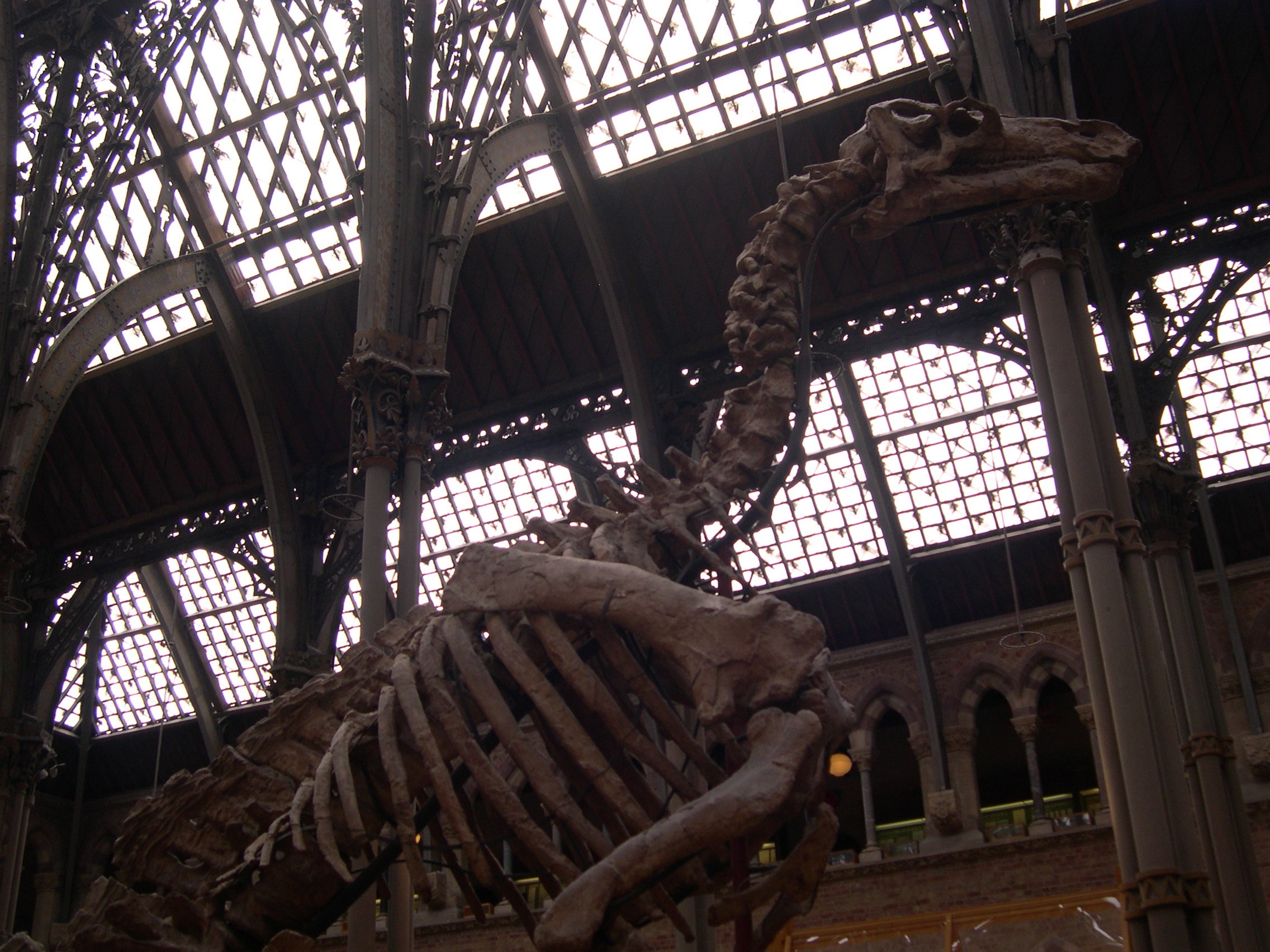
followed by his even larger friend, T-Rex. Just adjacent to them were the Oxford Dodo and the rabbit of Alice in Wonderland fame.
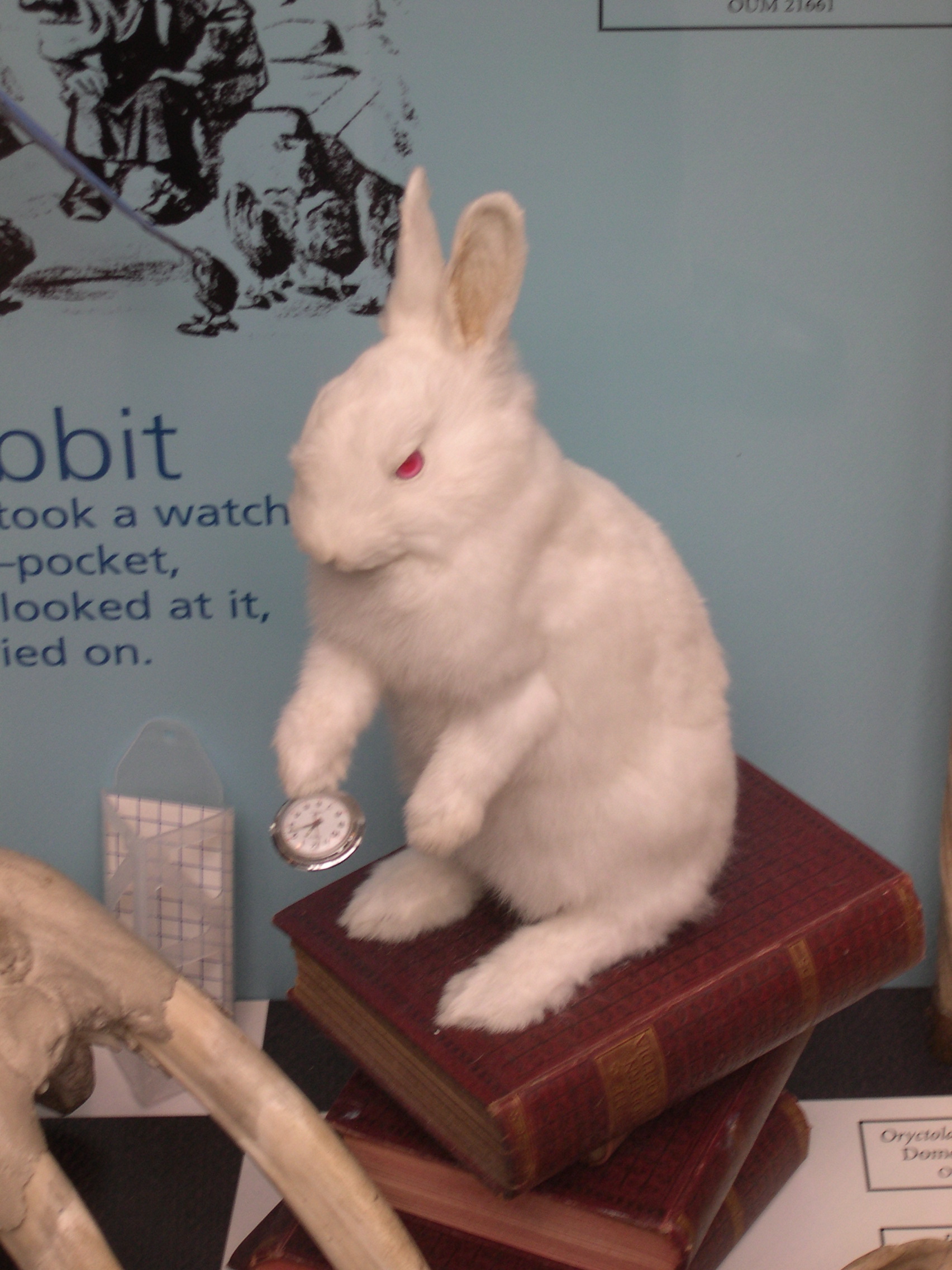
(Sorry folks, the T-Rex and the bird didn’t come out. I had some unfortunate data loss problems with a camera that I’m afraid has gone the way of the Dodo.)
Upon entering the Pitt-Rivers Collection, I asked at the front desk to see my contact. As they called her, I feasted my eyes on this enormous collection of artifacts:
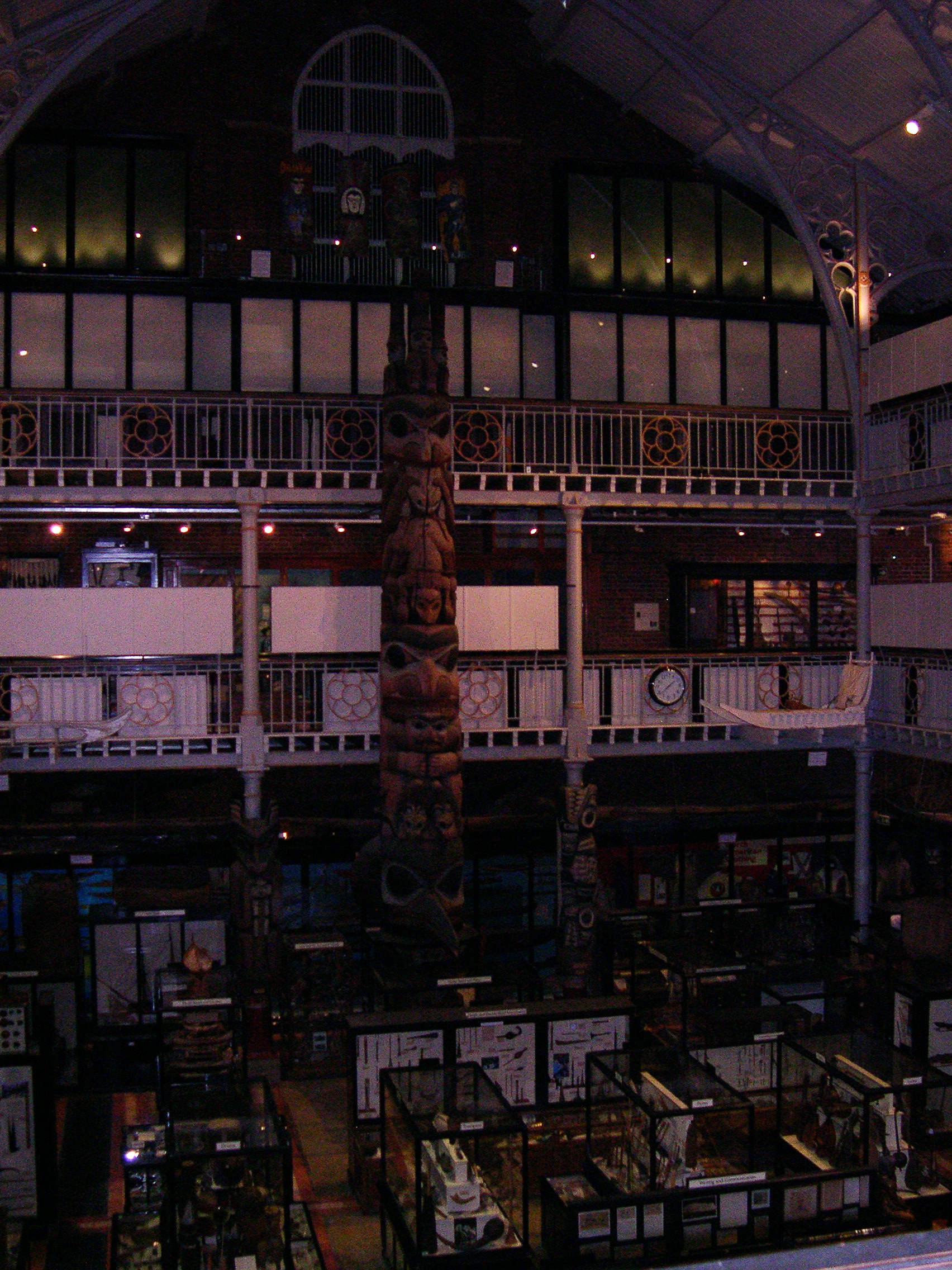
(Dork-out time.) It was almost sad to leave all of this in favor of an upstairs examination space where I would view some of the objects in closer detail, but I got over that when I got there. Through several secure doors and a final attractive sliding glass door into a newly remodeled ultra-modern study facility, my selections awaited under near-perfect natural light from the ceiling windows above. There was a royal drum from Bunyoro along with several ritual rattling idiophones from Bunyoro and Ankole in Western Uganda.
(Seriously, it only gets dorkier from here, but I can’t resist.) I had cited drawings of these rattles in my master’s thesis, but I had never seen them in use, on video, in pictures, or in person. Even more exciting was the realization that many of these objects had been acquired for the museum by none other than Reverend John Roscoe, an important early twentieth century missionary ethnographer of Uganda (the click-through on that one is worth a chuckle at some of his other “discoveries”). Even his original letters about the objects to Henry Balfour, who was in 1921 and for a long time the curator of the Pitt-Rivers, were there with typed transcriptions! What else should I expect for the museum that houses all of Radcliffe-Brown’s fieldnotes and symbols of Lewis Carroll’s Alice?
After photographing and taking notes on these instruments, we headed down to the music storage area to see some more. Fun as it was to examine these materials in the comfort of a well-lit study facility with large tables, it was equally fun to go into this dungeon of storage to dig out a few more treasures. Royal trumpets, ritual bells and horns awaited me there.
When we finished, I had a chance to go out on the display floor and poke around a bit. It’s quite 19th or early 20th century in its presentation. This museum and the research that fueled it for a long time were founded upon the principle that if we could collect objects from various cultures, they might be able to tell us something about the various stages of evolution in which those cultures simultaneously existed. Phrenology and unilineal evolution are dead now, but the organizaitonal method remains: these objects are grouped not by culture or region, but by type.
Out the back door of the museum and a short jaunt around the corner lies Rhodes hall (yes, that Rhodes).

All my research wrapped up, I decided it was time to enjoy some good old English fish ‘n’ chips with a pint. I purposely got off the beaten path, where this simple fare all too often gets exoticized to the tune of 10£ or more. I found a pub with outdoor seating on Turl street, where I got my wish, along with the first beer I’ve had in months that wasn’t a lager. There I got exactly the experience I was looking for: Old Hookey Ale.

Filed under Uncategorized
On the Road Again…or Is This A Rollercoaster?
Leaving Uganda is more bittersweet than ever this time around.
I have been homesick for weeks and really wanting to be with my wife again. She’s three months pregnant with our first child, and I absolutely cannot wait to see her, share this joyful anticipation, go to appointments and classes, and prepare our home for a new addition to our family. It has been nothing short of heartbreaking to be so far away during the early part of this time, but I must say that she has been an absolute star. She has made every effort to include me in everything that’s going on despite the distance. With everything that has transpired in the last couple of weeks in Uganda, this is the face that keeps me striving homeward bound:

Jenn at Cape San Blas last July
It is depressing to know that when we return to this beach, it will soon be ruined by tar balls and other oil damage. I remember when we could stand up to our chins in the water and still see our toes. We have great memories of this and so many other places along the Gulf Coast. The spill will put a damper on the heart of beach season and far beyond, but our stolen liesure remains insignificant in the face of the enormous environmental, economic, and emotional devastation all across the Gulf Coast.
Although this can never detract from the excitement of a return home, I am also leaving a place I love and people who have become my dear friends, hosts, and adoptive family in Uganda. So many amazing events and happy times filled this research stint. We broke bread, danced together, and said goodbye to friends at Backpackers’ Hostel, my half-time campy home over the last six months:
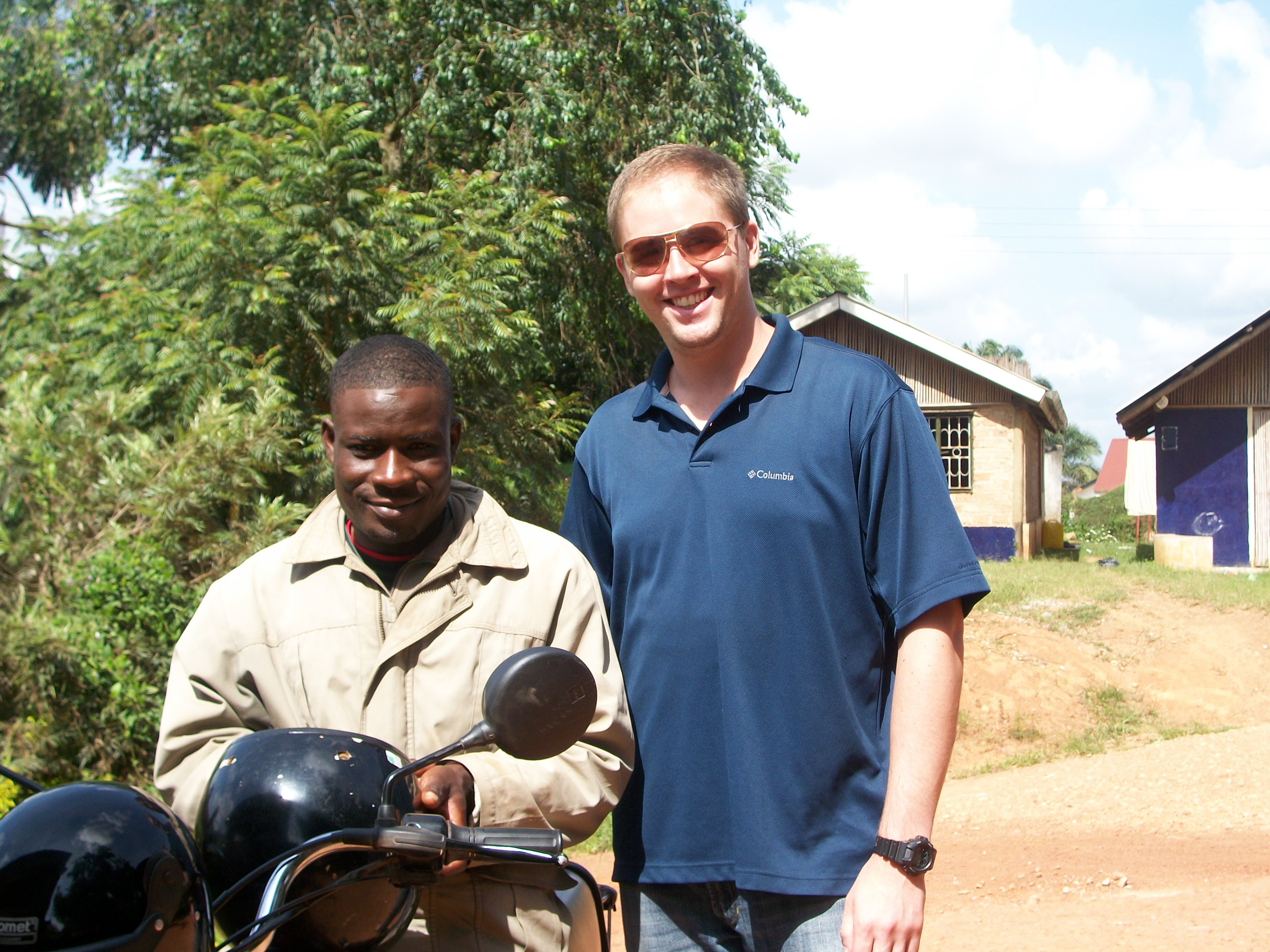
Me with Marco, Boda Concierge Extraordinaire
We met new family members and blessed them to take our Ffumbe sisters into new homes:
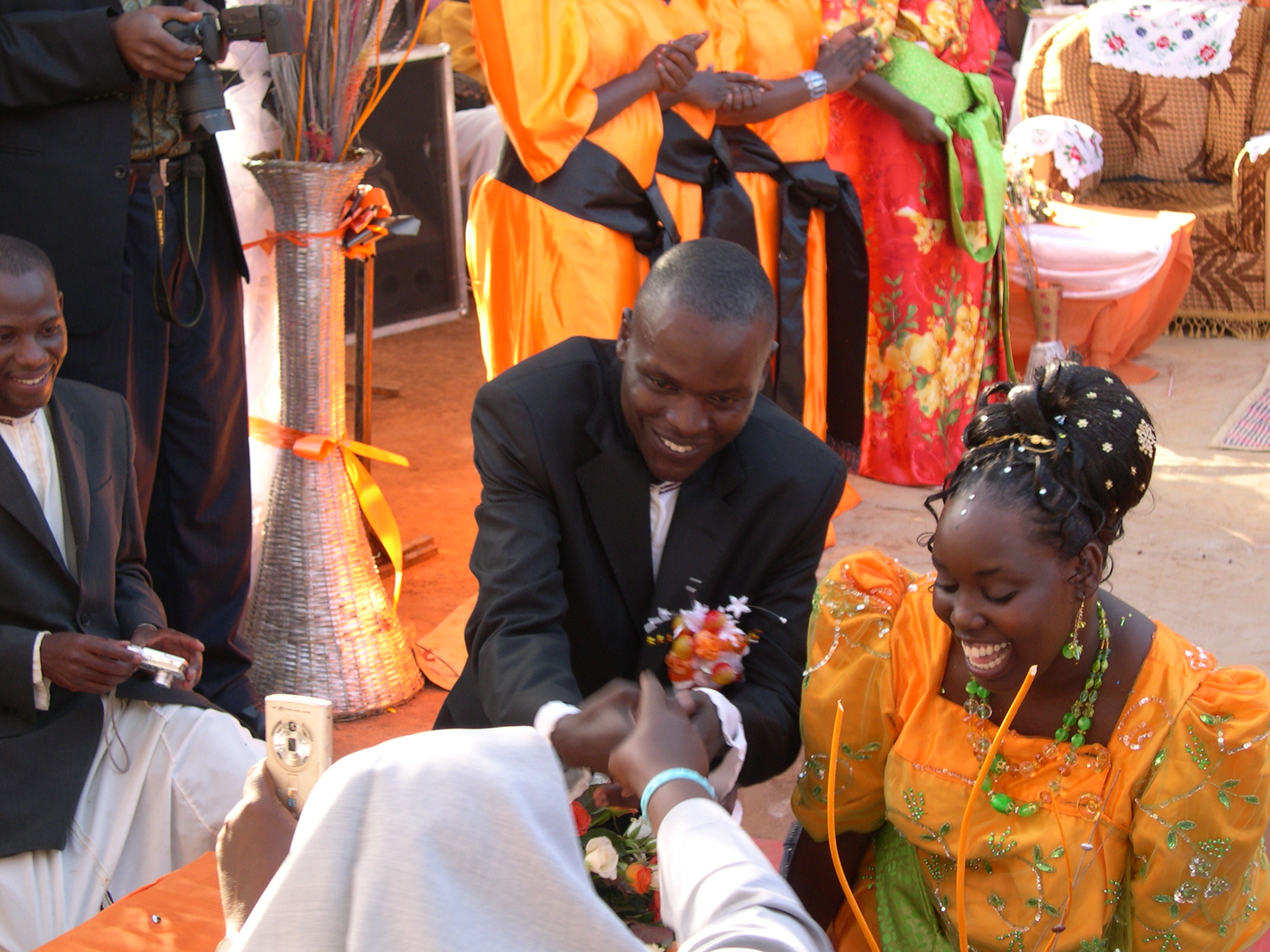
Christine Zawedde introduces her soon-to-be husband to her family
We marked these occasions, identifying with drum and song who we are and where we have come from:
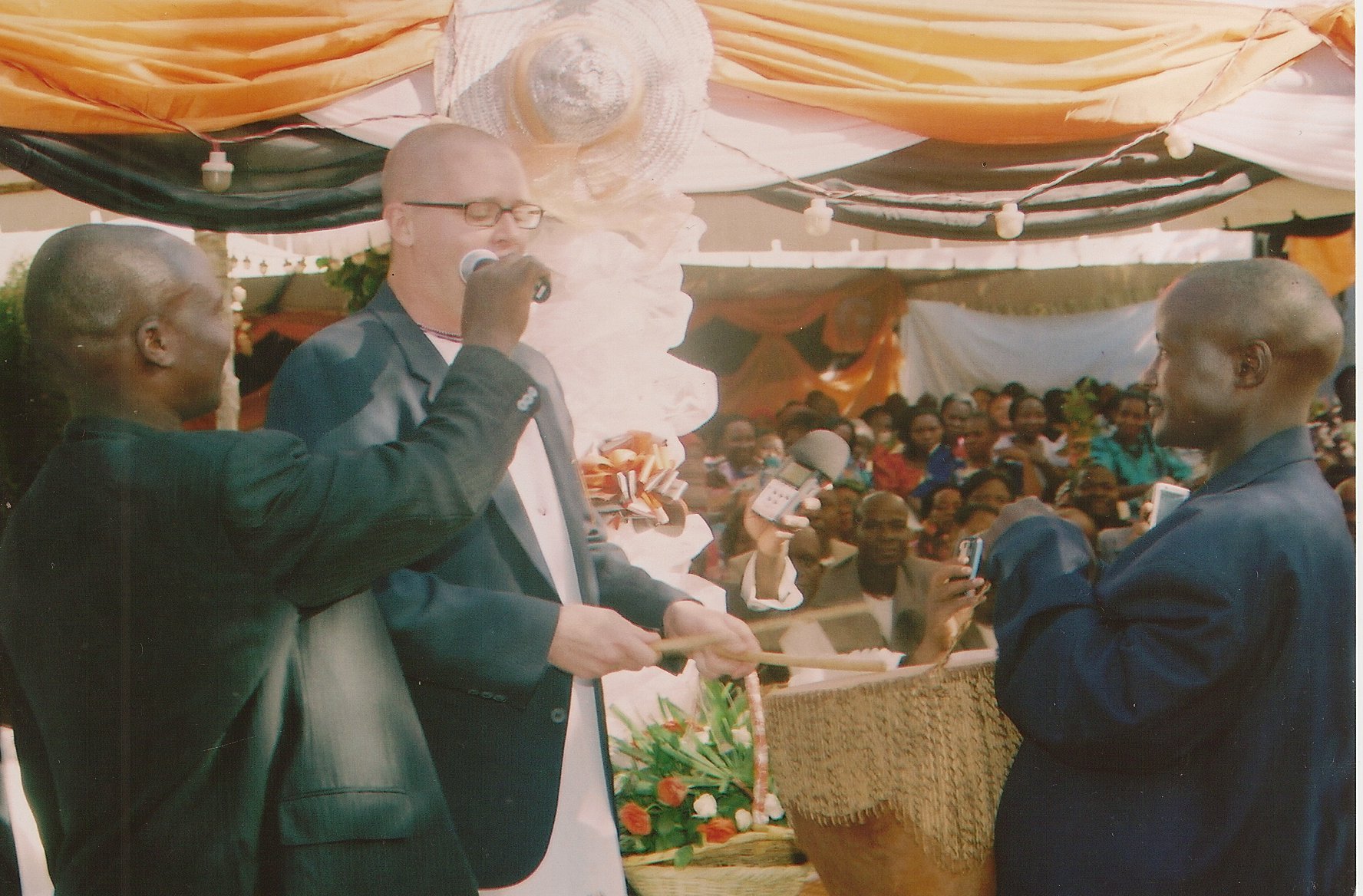
Me, playing the mubala (slogan) of Ffumbe clan
We saw beautiful places together and learned of their significance to locals:
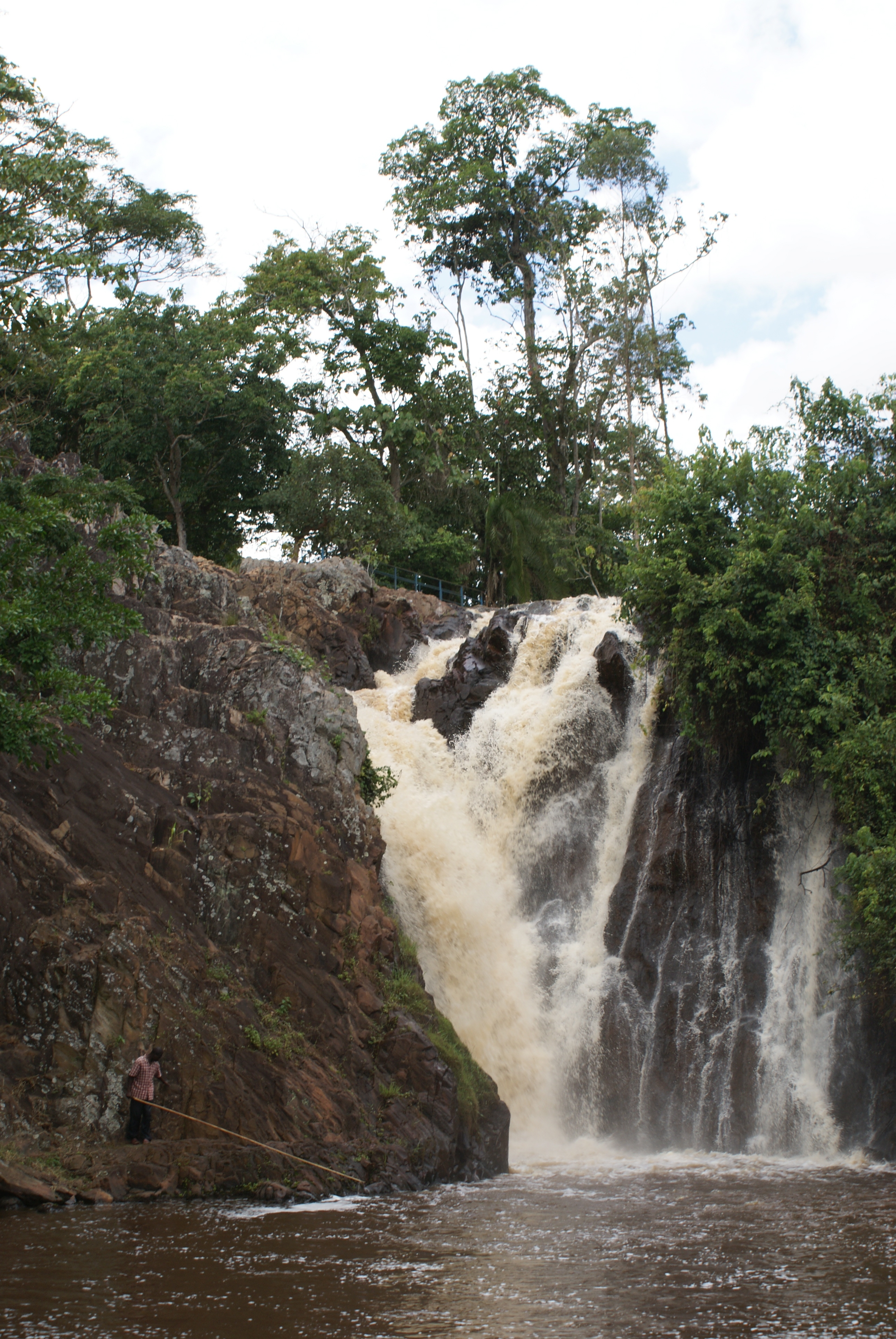
Ssezibwa Falls from the bottom and the top

We refreshed our bodies and souls in the natural beauty of Uganda.
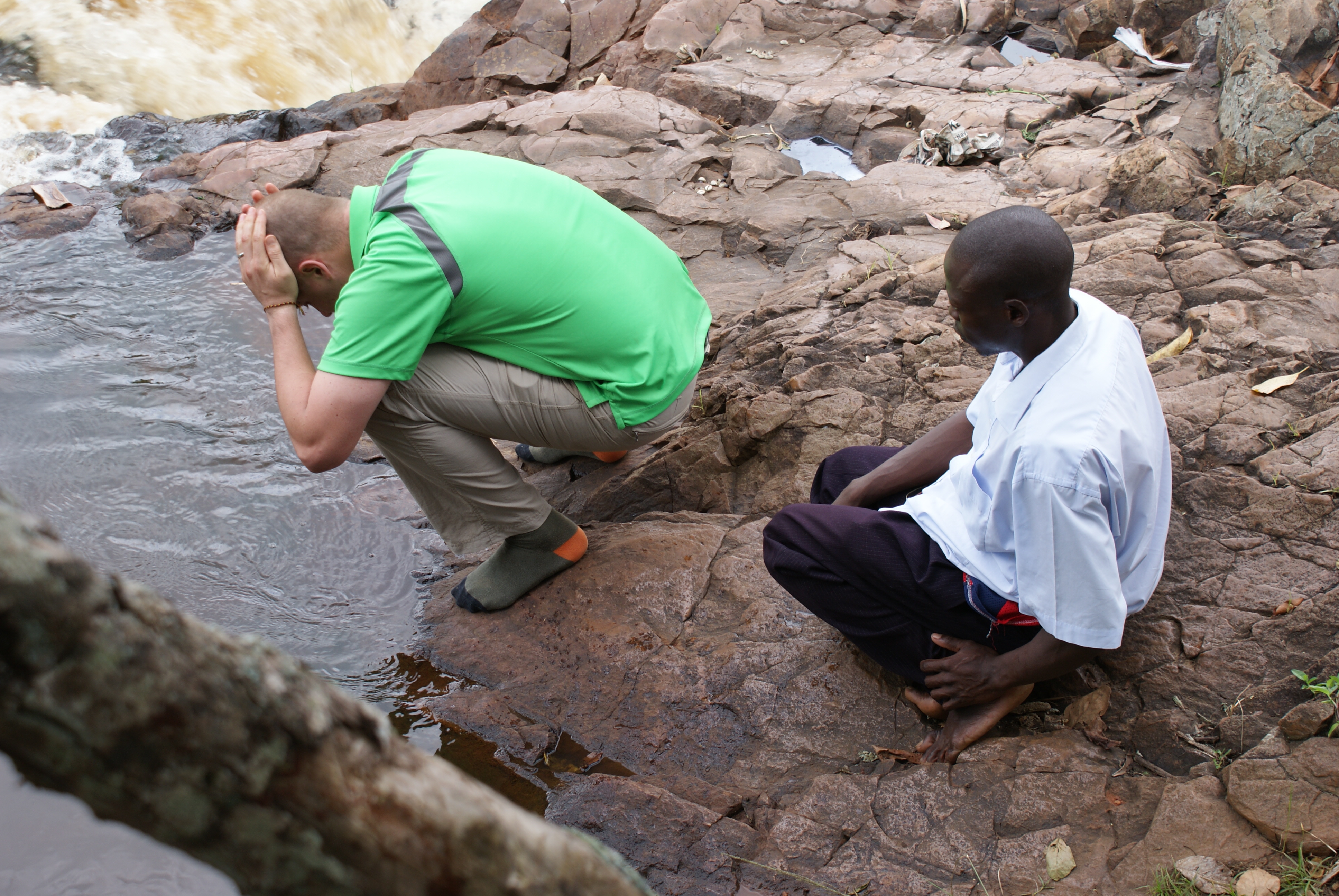
Ssematimba and me cooling off in the Ssezibwa River
I have many stories to tell since I last posted, and those will come as I gather my notes, photographs, and recollections of this place. For now, this montage only scratches the surface of a deep and soulful journey that, like all others, must now come to an end. The return home is always a happy thing, particularly as I am returning to the excitement of new life and the promise of more interesting changes to come. So I know it will be a long time before I can return to Uganda, but I must say goodbye for now, fair friend.
Filed under Uncategorized
The Work of Fieldwork
My recent silence has been a symptom of the nature of the work I’ve been doing here. But just because I’m not collecting recordings of ritual music or intriguing pictures to post here doesn’t mean that this part of the work isn’t important. In fact, it might be the most crucial part. Over the last several weeks, I have been spending time with a few key colleagues–experts on the music of kusamira spirit possession–who are helping me to transcribe and interpret ritual song. It’s not as exciting in quite the same way as all the travel and activity of going up-country to attend all-night rituals, but it’s facilitating a deeper understanding of this music.
What is very exciting about it is unpacking the multiple meanings of song texts, putting myself back in the spaces of events I only understood on a superficial level the first time, and trying to re-interpret those events based on local understandings of symbols and songs. This, for me, is the true work of ethnomusicological fieldwork; it’s the most challenging part, which also makes it one of the most rewarding parts.

Above: My good friend and teacher Ssematimba, or “Uncle Ssema,” listens to a field recording with me.
Filed under Uncategorized
A Giant in African Music Falls
Sometimes a scholar of African music has such a profound effect on the field that when we hear people mention his name, there’s a certain reverence to it. Sometimes I see a presentation that shows such humble respect for the musicians and such dedication to understanding their artistry that it makes things seem as if they should always be that way. Every so often, I encounter a scholar of such generosity as to show deep care for a student whom he has only just met. This past year, that was Dr. Willie O. Anku.
I had the distinct pleasure of presenting a paper on the same panel with Dr. Anku at the 3rd Annual Festival and Symposium, Dialogue in Music Project: Africa Meets North America. He gave the most inspiring 30-minute breakdown of West-African rhythm that I have ever seen. Although he’s been studying and writing about this material–what he called “circles and time”–for years, he presented it with almost child-like fascination in an analysis completely devoid of ego. Following the panel, there was no question he didn’t have time for, and he went out of his way to complement and question my work. As the conference went on, our interactions only became warmer. I had found a fast friend in this brilliant man. It was truly a privilege to enjoy his company and learn from him.
Dr. Anku earned an M.M.E. from the University of Montana at Missoula in 1976. In 1983, he founded the African Music & Dance Ensemble at the University of Pittsburgh. He went on to earn an M.A. in Ethnomusicology from the University of Pittsburgh in 1986 and and Ph.D. from the same institution in 1988. He returned to his native Ghana to teach in and then head the Music Department at the University of Ghana, where he eventually headed the entire School of Performing Arts. He was also a visiting professor at the Simon Fraser University, Burnaby, BC, Canada (2004), Portland State University (2003), and at California State University-San Marcos between 1994 and 1996.
On January 31, 2010, Dr. Anku was in a serious car accident. No doubt he would have contributed many more years of brilliant scholarship to the study of African music. Willie Anku died on Monday, February 1, 2010. I mourn his loss, even as I know the lasting legacy he left for the next generation of African music analysts. Willie, you will be missed.

Filed under Uncategorized


 Peter Hoesing