Category Archives: Uncategorized

Avatar and the Misunderstood “Clash”

My wife and I just saw Avatar.  When the movie first came out, we both heard the “All Things Considered” interview with James Cameron and the one with the linguist who wrote the Nav’i language and we both saw some mainstream press.  The reviews have not been surprising: in the tech-happy camp, excitement about the special effects overwhelms, and among self-fashioning sophisticates the characters are too one-dimensional and underdeveloped. In retrospect, it seems strange that it took some convincing for these two art and music enthusiasts to make this our holiday trip to the theater.  In the end, the good stories could be rented, but this one had to be seen in the cinema.

Okay, so the special effects were great.  James Cameron is the reigning king apparent of 3-d cinema technology.  Good for him, and even better for his studio, because that stuff is nearly impossible to pirate.  Hope you can send your great-grandchildren to college, Mr. Cameron.  With due respect, though, I thought there were many more interesting features to this film.

Avatar offers a commentary on the nature of conflict in a context that holds up particularly uncomfortable mirrors to human nature in particular.   Says the admittedly flat “noble savage leader” to Jake Sully, the human protagonist: “We shall see if you can be cured of your insanity,”

In this picture, Sully’s perceived insanity is borne of the peculiar marriage between military structures and corporate goals.  Whereas Joel Bakan and friends insinuated of the corporate collective personality in The Corporation,” Avatar proposes something even crazier: a virtueless corporate machine with serious military artillery.

Far from one-dimensional, Sully can see this insanity plainly, even as he matter-of-factly explains its ethical inconveniences to the bleeding-heart scientists.  “That’s how this works,” he shouts.  “Somebody’s got something and you want it, so you blow the hell out of them and then justify it.”  It’s ambiguous where the corporation in the movie is from beyond being earthlings, and the script never clarifies what country all of the former military personnel served.  I don’t think it’s a stretch, however, to assume that this American movie with American accents comments on American realities both historical and present.

For nearly a decade, the Bush administration justified oil and control-seeking behaviors in the Middle East with phrases like “defending liberty,” “promoting justice,” and “delivering freedom to oppressed people.”  It’s no coincidence that Hollywood continues to call them on it.  At present, the world struggles to understand the paradoxes of a wartime president receiving the Nobel Peace Prize and reflecting on human conflict in his eloquent acceptance speech.  It’s no accident that despite some looming threats to human survival, the theater should offer a forum for critical thought on these issues.

A few years ago, the infamous political scientist Samuel Huntington suggested that the coming conflicts in the world indicated an inevitable clash of civilizations.  Academics and diplomats have rejected this notion outright.  In fact, Florida State University is (was once?) the flagship institution for a multi-lateral cooperation among universities and governments called Alliance of Civilizations.  Still, the ideals of scholars and kings are nowhere near as accessible as the silver screen.  If the characters in this drama have been flattened for the sake of exaggeration, then it serves a purpose: it forces us to recognize the most crass and heartless of human tendencies.

This film has done well and will continue to do well for many reasons.  It offers action for the thrill-seekers, new linguistic puzzles for the self-consciously dorky polyglots who are tired of speaking Klingon, and even some romance (uh, especially if muscular blue alien is your type).  It is visually stunning in 3-D, and would no doubt be even more so in IMAX 3D.  The best reason to see this film, however, is because it makes sci-fi relevant to a broader social discourse on conflict.  When the artistry of a piece in any genre comes together this tightly, when it can make people think after they leave the theater, then it’s a film truly worth seeing.

1 Comment

Filed under Uncategorized

The Hang

Do you know this man?  A friend sent me his video recently, and I’ve never seen anything quite like it.  It’s like steel pan meets tabla, but with rather guitar-like harmonics and an apparently unique technique.  The wiki on it is pretty informative, and I thought this was a nice break from some of the heavier issues I’ve dealt with lately here.  After a work-induced absence, I hope readers will enjoy checking out Dante Bucci.  If you find other players of the Hang, please let me know!  In the mean time, enjoy…

1 Comment

Filed under Uncategorized

Staging African Music

This afternoon, I’ll embark on a new endeavor that I’ve been looking forward to for a long time: leading an African music and dance ensemble.  This is a near-inevitable feature of academic life for many ethnomusicologists, particularly in North America.  I just had no idea it would happen for me at FSU.  The ethnomusicology program here places heavy emphasis on integrating performance and scholarship and using performance in scholarship.  That’s a major reason why I came here for a master’s degree and stayed here for the Ph.D.  However, a good friend and colleague from Uganda usually directs the ensemble, and when he doesn’t do it, my major professor does.  Needless to say I’m thrilled to have this opportunity.

Ever since I read Kofi Agawu’s book on Representing African Music, I’ve been trying to get my head around what it means for a white guy from Iowa to engage in scholarship on Africa and African music.  This isn’t the first opportunity I’ve had to do that through performance, but I certainly have more creative control over performative representations now.  It’s a challenge I’m looking forward to.

One thing that playing in “academic” ensembles has made me think about is the notion that we’re putting folklore on stage.  That can be a problematic experience in many ways, but it’s not a phenomenon entirely unique to academic culture.  In his dissertation, Welson Tremura proposes the term “stage lore” to describe the peculiar effect that commodifying folkloric music has on festival and other staged performances.  Philip Bohlman and others have also commented on this effect, especially as it relates to festivals.  If creating a public spectacle for nation building or staging folkloric performance as a form of respect to indigenous peoples have potential to artificially standardize or “freeze” music (Ted Levin’s term), academic ensembles ought to give us more controlled opportunities to avoid getting locked into myopic caricatures of the cultures we study.  Unfortunately, these “frozen” images of Africa are all too common to the college world music ensemble.

Florida State has broken the mold when it comes to African music and dance.  To my knowledge, it’s the only ensemble in the country that has focused primarily on East African music over the last five years.  (Please, correct me in the comments if I’m wrong about that; I’d love to know about others.)  Fortunately, we’re not tied into that permanently because we have an instrument collection and teaching resources to perform music from all over the continent.  We have had good luck focusing on music from a single country or ethnic group for a semester or a year, and in that way the ensemble has been a good laboratory for students and professors to teach performance skills related to their research interests.

I plan to begin this semester with this kind of lab tactic, but then expand our repertoire to develop a kind of Pan-African performance consciousness among the students.  I’ll begin by bringing in music from my field research: songs of the Baganda and Basoga.  While FSU has plenty of Ganda instruments, I’m excited to diversify our ensemble’s Ugandan offerings with my new Soga skins:

nswezi

You might remember seeing some of these here.  I had the pleasure of learning to play them as I learned songs from several different teachers in Eastern Uganda.

A colleague here at FSU recently went to Morocco, picked up some new instruments and took some lessons, so we’re excited to have a North African component.  However, since we’re both still relatively new to our recently acquired instruments and skills, we want to incorporate some people, sounds, and skills that have a bit more longevity in this ensemble.  One guy has been playing with the FSU group as long as I have and with other groups even longer.  He and I will work with another colleague who has experience teaching Ewe music.  We also hope to collaborate with other local groups on some Guinean music.  Finally, I’m hopeful for a reprise of a performance at last year’s SEM annual meeting: who’s ready for some Bolingo?

I hope to convey to students and audiences that Africa is a big, diverse place.  I hope to give them some idea of what that means with regard to the boundless variety of musical and dramatic expressions found across the continent.  I’ll continue to update here as we schedule more performances, but for now plan on getting your seat early at our biannual College of Music show: this fall it’ll be on November 16 at 8 PM in Dohnányi Recital Hall.

2 Comments

Filed under Uncategorized

Travels With Nakayima, Part 5: Kitala, Uganda

8 April, 2009

Today we’re going the opposite direction from our previous trip to Buyego and Kungu; it’s south on Entebbe Road to Kitala.  We’re going to meet another of Nakayima’s friends.  When we get there, the protocol is similar to our previous site visits.  We must first ritually bathe before entering the ssabo (shrine).  Once inside, we meet Kabona Wamala Mugalula.  He’s younger than some of the other mediums we’ve met (maybe 35?) and he’s very interested in current affairs related to traditional healers.  For that reason, it takes him some time and questioning before he’s willing to trust me.

We talk at length about the current state of traditional religion and healing in Uganda.  We’ve crossed paths before: Kabona attended meetings of traditional healers at the Ministry of Culture meant to deal with the issue of imposters and charlatans sacrificing humans in this region.  He has strong opinions, but he’s not one to share them in such public forums.  Here in his home shrine, however, he sits comfortably in a kelly green kkanzu (a type of very long shirt for men) smoking his ornately decorated tobacco pipe and speaking freely.

Turning from newspaper headlines to more immediate concerns, he turns to me and asks what I am doing here.  With Nakayima’s help, I explain to him in Luganda that I am a researcher, that I’m interested in the music of these massabo shrines and how music functions in mikolo (functions or rituals).  He understands, but clearly still does not trust me.  He asks if I’m working for the Ugandan government.  When he’s satisfied that I’m not, he asks a question I don’t really understand.  Nakayima helps explain that he’s concerned about the notion that when bazungu (Europeans/white people) first came to Uganda, they did research with the people in order to improve administrative policy and eradicate cultural practices that they saw as potentially threatening to those policies.  After reassuring him again that I do not work for the government, I tell him that I’m interested in learning these songs, teaching them to my students, and learning why they are important for people here.  He smiles.  “Osobola kukuba eŋoma eŋanda?” (Can you beat Ganda drums?) he asks.
Yee, ssebo.”  He smiles even wider.
Osobola kuyimba ennyimba eŋanda?” (Can you sing Ganda songs?)
Nkyayiga okuyimba, mukama wange” (I’m still learning to sing [in Luganda], master).
By this time, Kabona has already motioned to his sons and the other young boys around the compound to organize some drums.  He invites me to join them in beating drums, and Nakayima takes this as her cue to begin singing.

Consistent with custom in many massabo shrines, she begins with songs for the balongo (twins).  She follows these with a song about a person who walks like an ostrich.  Satisfied that my intentions are good, Kabona invites his son to relieve me of my drumming duties (he’s excited to play as well).  The songs don’t go on for very long after that, and it’s clear that this little performance has been primarily for my benefit.  It also does something for Kabona though: in his estimation, a researcher who wants to actually play the instruments and learn the songs cannot threaten his shrine or his ritual activities.

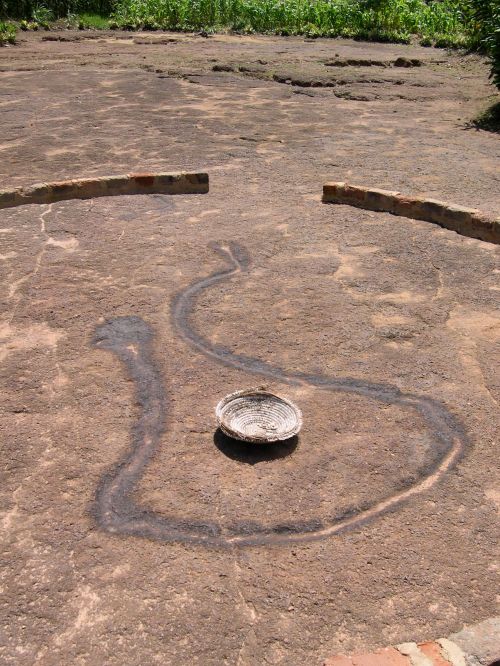
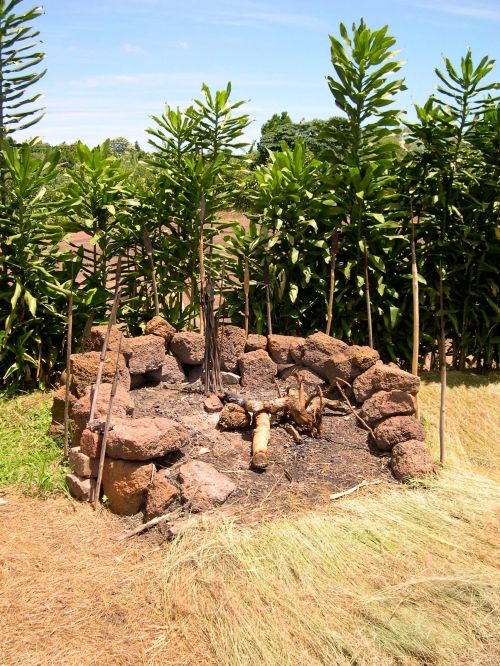
I have never had anyone question me as rigorously as Kabona has today.  Now satisfied that I have only good intentions, he warms up considerably.  He decides to show me around the compound.  Nakayima and I go outside, following one of his sons past a row of distinctive trees that form a high wall around the shrine.  Beyond those trees, there’s another enclosure of trees.  I see a large stone circle in front of a big kyoto (fireplace) that looks like this:

BembaEkyoto

This is the shrine for Bemba Omusota, one of the former Kabakas (kings) of Buganda.  People make burnt offerings for Bemba in the fireplace, and he has left his mark on the ground inside the large stone ring.  We enter the ring, and one of Kabona’s sons gives me permission to photograph what I see inside.

Bemba@Kitala
This is the marker of Bemba’s place.  Just as spirits have specific songs and demand specific clothing or pipes or spears or walking sticks, they are also connected with specific places in Uganda.
In my next post, I will connect another significant site with the oral traditions that refer to the spirits who, according to Baganda, once lived and now still reside there.

Leave a comment

Filed under Uncategorized

And now, a word to my sponsors…

20 March 2009

In the introduction to a book that’s now standard reading for most ethnographers, Fieldwork, Bruce Jackson wrote, “Only a fool or someone with an endless supply of disposable income would attempt to undertake fieldwork without some concrete plans about what to do in the field.”  Lucky for me, my concrete plans have been funded by generous support from the Florida State University Office of Graduate Studies (OGS).  As part of a new program, I have enjoyed funding from an International Dissertation Research Fellowship for the 2008-2009 academic year.  This is the first internal FSU program to specifically fund international research on this scale.  Along with the Global Pathways Initiative, this program shows FSU’s promising commitment to actively developing a global profile as a Carnegie Doctoral Research institution.  I am extremely grateful to the Office of Graduate Studies for this support.

I had originally planned to write a post that would both thank OGS and encourage an expansion of this kind of support.  FSU has literally hundreds of students whose graduate work depends on overseas research.  Predictably, funding is constantly in short supply.  Even as I was composing this post, my advisor received a letter from OGS.  I did not receive the e-mail copy until a couple of days later, but that letter gave official notification that OGS has agreed to extend my fellowship through the summer term.  This willingness to see a project through to its full potential is consistent with FSU’s other fellowship programs, all of which reflect a commitment to high-quality research.  In a national financial climate of budget cuts and layoffs, and especially considering the tragic cuts proposed by FSU’s budget crisis committee, I am humbled by this continuing support.  I thank the FSU Office of Graduate Studies, and I commend them for the example they are setting for other programs around campus and around the country.  With so many students in need of support for overseas research, it is wonderful when a program supports students as well as OGS supports me.

This next term of the fellowship will support follow-up research with many of the contacts and friends I have made over the last few months and years.  It will also pay for crucial language assistance for transcription and translation of song texts and interviews.  These activities will launch me into the write-up phase with all of the support I need for continuing analysis and a successful wrap-up of the field research.  I humbly thank the Office of Grad. Studies for this generous funding.  Stay tuned for more updates on my continuing research activities!

Interested in Grad. School?  Check out the Florida State University Office of Graduate Studies.
FSU grad. students: need funding for field research?  Check out the OGS Fellowship programs.  Need funding for other research?  Check out the other fine OGS programs and the Office of National Fellowships.  That one’s under the Office of Undergraduate Studies, but from there both undergraduate and graduate students can link to a number of other useful sites for information about scholarships, fellowships, and other merit-based funding.

2 Comments

Filed under Uncategorized

Featured Artist: Kabindi

dscn9795

Today I’d like to introduce an artist I’ve known for a few years through my research in Uganda.  He’s unlike any musician I’ve ever met, even those who share his profession and specialization.  The story of his initiation as a particular kind of healer reveals volumes about his profession and his personality.  I offer a brief version of that story to honor a musician who has dedicated his life to his family and community.

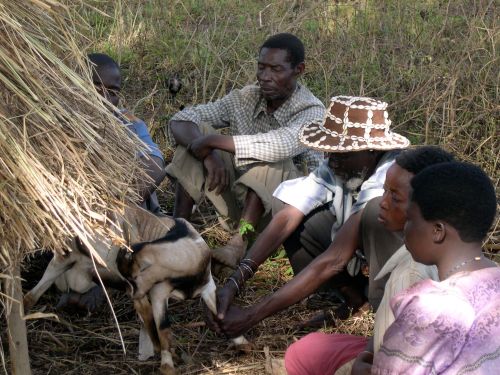
When Mzee Erukaana Waiswa Kabindi was seventeen years old, a wave of illness swept through his village, and it was particularly harsh on his clan mates.  The elders, having watched their parents draw on local wisdom to cope with their problems, knew what this meant: the ancestors were discontent.  Their task was to call them into their midst and know their demands that they might be placated and restore health to the community.  This required a ritual called nswezi in which ab’ekika, those of the clan, came together, beat the drums, and called their ancestors through song.  When they came, they possessed some of the clanmates, speaking through them to tell the rest of the clan their desires.  On the day of that ritual, young Kabindi was possessed for the first time.  The spirits made their demands, the clanmates offered an animal sacrifice, and the ancestors restored health and order to the community.

oldandnew

Above: Mzee Kabindi playing nswezi drums with his son, Kyona.

This is a common pattern for many communities throughout Uganda.  Along with sacrifices, clanmates will frequently have to build small houses in which the ancestors can dwell.  These massabo shrines form an integral part of many compounds in the communities where I study.  When they are ill kept, the spirits demand their repair or replacement, and that work must be done before a clan can offer a proper sacrifice.  This tells us a lot about an ontology or worldview situated in indigenous religion here.  People see ancestors as active forces within their lives.  They must take specific measures to give voice and place to these respected members of the community.  When they don’t, they suffer the consequences through various forms of affliction: muteness, temporary insanity, persistent fever, headaches, or stomach aches, none of which can be treated using allopathic means (hospital medicine).  That places spiritual experts in a category somewhere between indigenous clergy and medicine men.

kabindiasenga

Mzee Kabindi offering a goat for sacrifice.  Directly in front of him there’s a new mini-hut that the clansmen have erected for the ancestors.

Like many who get possessed during an nswezi performance as youngsters, Kabindi continued after this ritual by studying the craft of spiritual healing with elders in the profession and becoming a full-fledged muswezi.  Now a veteran muswezi with over sixty years of experience, he has returned the favor by tutoring numerous other baswezi.  I was fortunate to be introduced to several of these students, which gave me the advantage of instant trust and solid rapport with those people when Mzee Kabindi introduced me as his “son.”  This ethic of generosity guides everything he does, how he spends his time, and how he has built his practice.

These practices raise interesting questions about indigenous music and healing.  If those illnesses can’t be treated using allopathic medicine, does that mean they only occur in communities that deal with them in this way (i.e. can ancestors cause problems outside their clan or tribe)?  Is it more a matter of people not being open to healing that is inconsistent with time-honored community-based healing?  I propose answers to these questions in my developing dissertation based on the cultural logic of musical healing, but for now, I’d like to know what you think!

3 Comments

Filed under Uncategorized

Victorian Holiday

thelookout

I’m just back from a few days of much-needed R&R at Lake Victoria.  My dear hosts, members of the Ffumbe Clan all, took me to Nalubaale (the Luganda name for the giant lake that feeds the Nile).  We had a really nice dinner on Christmas day and then left the following day for Nabinoonya Beach.  Incidentally, 75 degree weather by the lake isn’t that much different from sunny Florida this time of year.

We do Christmas dinner Kiganda style: on the floor with banana leaves for a table.  Here’s Maama and her house girl, a clanmate whom Maama and Taata took in as part of the family.  Her name is the female version of mine—Nakigozi—but I nicknamed her Nakinyonyi (basically meaning “Big Bird”) because she smiles a lot.  Oh.  Except in pictures.  People seem to have an aversion to smiles in pictures here unless prompted.  xmasdinner

Anyway, dinner on the floor makes a fantastic mess.  Fun for the kids and all, but probably not so for Maama and Nakinyonyi, who might not be smiling because they put all of this together AND clean it up.  Three cheers for them!  I generally have two roadblocks to helping with such things: I’m a man and I’m a guest, and neither of those people usually helps out in the kitchen or with cleaning.  Still, I try to do what I can when nobody is looking.  Nakinyonyi still scolds me for it.
sunnynalubaale

winkdoug

The beach is beautiful as we arrive.  Douglas Mugumya is pretty stoked up for several days of nonstop soccer (and I do mean nonstop).

Gloria just got her hair done before Christmas.
gloriabeach

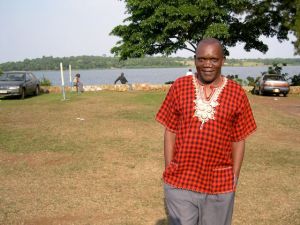
Mr. Magoba is in good spirits, wearing what I deem to be a typical “Dad” shirt: red plaid, but African style.  What a combination!  He wears it when he’s in relaxation mode.  Maama is decked out in her day-glo green quasi West African garb as she kneads dough for chapatti and the men sharpen sticks to roast meat.  Yum!

magobabeach

chapattimama

That’s my muganda (brother) Frank on the left and my kojja (mother’s brother) Vincent on the right.   frankvincemeatFor a boy who’s allergic to meat, Vincent sure does like to butcher animals and roast meat.  I don’t get it; maybe he can sort of live vicariously through smell or something.  Maybe he doesn’t miss it at all.  I don’t get that either. Vegetarians escape my understanding.  I’m an omnivore (excluding readers, of course).
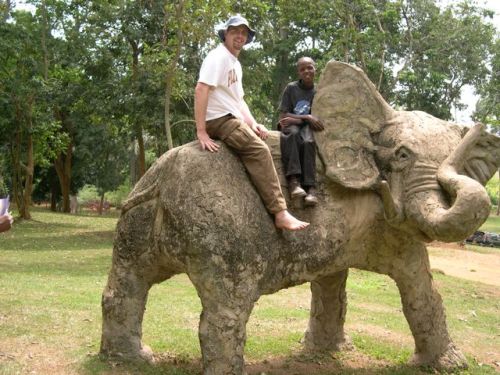
The rest of the weekend is totally fun.  There’s a dance party (meat-in-hand! What?)

danceparty

An elephant ride (well, sort of)

elephantride

goatslaughter

We butcher a goat (yes, that’s me stringing up a headless goat) and have a feast:

And there’s ample time to enjoy the lake (I insist on lake instead of beach and my Florida readers understand why, but it is truly beautiful here). We even see a couple of monkeys!  No good pix of that; those suckers are hard to capture on film!

rockysunnybeach

statuesquevictoria

And now, a moment of Zen: goat haggis anyone?

goatguts

6 Comments

Filed under uganda, Uncategorized

Be a good neighbor

shelving

This photograph might not look like much, but it depicts some of the results of a beautiful collaborative endeavor.  It’s completely unclear at this point where and when the main collaborators will be recognized.  I want to use this forum, small as it may currently be, to publicly recognize those people.

Two years ago, while I was on a three-month stint in Uganda for language training and preliminary dissertation research, I met a colleague named Suzanne Wint.  She was in Uganda on a Fulbright-Hays Doctoral Dissertation Fellowship.  From the first day we met, I noticed that Suzanne reaches out to colleagues across disciplines to engage in scholarly discourse and undertake interesting projects.  On previous trips to Uganda, she had met Drs. Justinian Tamusuza and Sylvia Nannyonga-Tamusuza, both professors of music at Makerere University’s Department of Music, Dance and Drama (MDD) here in Kampala.  Both Suzanne and I had met some of their best students, no fewer than three of whom are now pursuing terminal degrees in music.  She noticed, however, that preparing these students for graduate programs had been unnecessarily difficult.  These fine professors had been lending from their personal libraries so that eager students could work with essential literature.  The main library has a negligible music collection, and at the time MDD had virtually no collection of its own.

Suzanne paired her status as a Fulbright-Hays Scholar with her network of colleagues at the University of Chicago to build a music collection for MDD.  She had hundreds of pounds of books sent to Uganda to build the initial collection.  Meanwhile, Dr. Jane Clendinning, Professor of Music Theory at Florida State University, came to Uganda that summer for a short visit.  She and I both saw what Suzanne was doing and decided that we had to find a way to help.  When I got back to Florida State after that summer, I linked up with Dr. Clendinning and we used our departmental listservs to request that our colleagues donate their desk copies of textbooks and as many monographs as possible.  We received an overwhelming response, and Dr. Clendinning paid out of pocket to ship books from Florida State.

Now Dr. Nannyonga-Tamusuza had been receiving books from another professor from Pittsburgh University for some time.  Now there are three separate universities concentrating their efforts on building this collection.  On the Ugandan side, Dr. Nannyonga-Tamusuza has been very busy ensuring that these books have a secure home.  The new MDD reading room features locked shelving, a large table for reading and small seminars, and some more efficient shelving for instrument storage.  I’ve had the privilege of visiting that space on several occasions already, and it’s wonderful to see students there using the materials and enjoying a quiet space to study.

What you see in the photograph above is only the beginning of these efforts.  Dr. Nannyonga-Tamusuza has worked with the main Makerere library, the American Embassy and two Norwegian grant makers to build a new listening lab.
walkinview2completestation1

Dr. Clendinning is currently organizing several more boxes of donations from Florida State students and professors.  Now that the reading room has been stocked with basic texts for undergraduate curricula, I hope to work with Suzanne and other American colleagues to secure continuing donations of monographs and biographies for historical and ethnomusicological research.  Meanwhile, scholars working on music in Uganda know that their theses and dissertations will have a home at MDD, where we hope that students will read and critique them as we continue to foster discourse and interaction among American and Ugandan music scholars.

Suzanne really taught me a great deal about overseas field research during that first summer in Kampala.  Whereas an old paradigm in anthropological and ethnomusicological research used “informant gifts” and even direct payment, these methods seem to pay our field consultants to be silent after we return home and write up.  This is the worst kind of field exit.  Being nice to consultants, buying gifts and paying for transport is still important.  Paying transcription assistants an honest day’s wage is still an honorable and necessary protocol.  However, Suzanne’s dedication to this project reflects a spirit of fully engaging local scholars and field consultants in intellectual discourse.

Our work will be richer for this kind of interaction, but that’s not even the best reason to do it.  Now there’s a whole new generation of African ethnomusicologists who will make meaningful contributions to the field.  Working to ensure their access to resources isn’t a way to “pay” people.  Trite as it may sound, being a good neighbor just makes the world a better place.

Can’t wait to see an offering from this generation of African ethnomusicologists?  Here’s a preview.  Artist feature coming soon . . .

2 Comments

Filed under Uncategorized

Road to Uganda: Good Friends and Good Food

Dubai was wonderful for all of twenty hours, where I enjoyed the hospitality of a couple of fellow Luther College alumni. Thanks for a soulful stay, Adam and Allison! They took me to this swanky beach bar to stretch my legs from the long plane ride and drink a beer:

What can I say about Dubai?  It’s the next big thing on this side of the globe, and it’s getting bigger every day.

Despite the lack of sleep resulting from three days of on-again-off-again travel, the African landscape had me feeling really good as soon as we departed from the airport.

Thanks!  Think I’ll stay a while…My ssenga (father’s sister*) picked me up from the airport.  She’s a nun who works at a school in Entebbe.  She took me back to the convent, gave me a much-needed place to bathe, and fed me a delicious first taste of Ugandan deliciousness: ekyenyanja.  Yum.

Ssenga Nakato (Auntie Nakato) and I then drove toward Kampala to meet up with Taata wange (my [Ugandan] Dad], Mwami Magoba Waalabyeeki.  We picked him up from his job at CBS, which is the Central Broadcasting Service, Buganda kingdom’s main outlet for Luganda vernacular news and entertainment in both broadcast and print media.  By the time we got back to Mwami Magoba’s place, it was about 9:15 or 9:30: time for supper!  Warm greetings preceded a feast prepared by the gracious Ugandan host family I have come to love.  They prepared a very special luwombo.

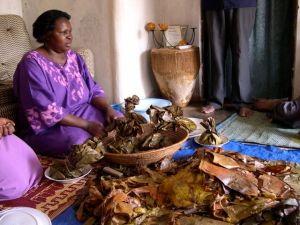
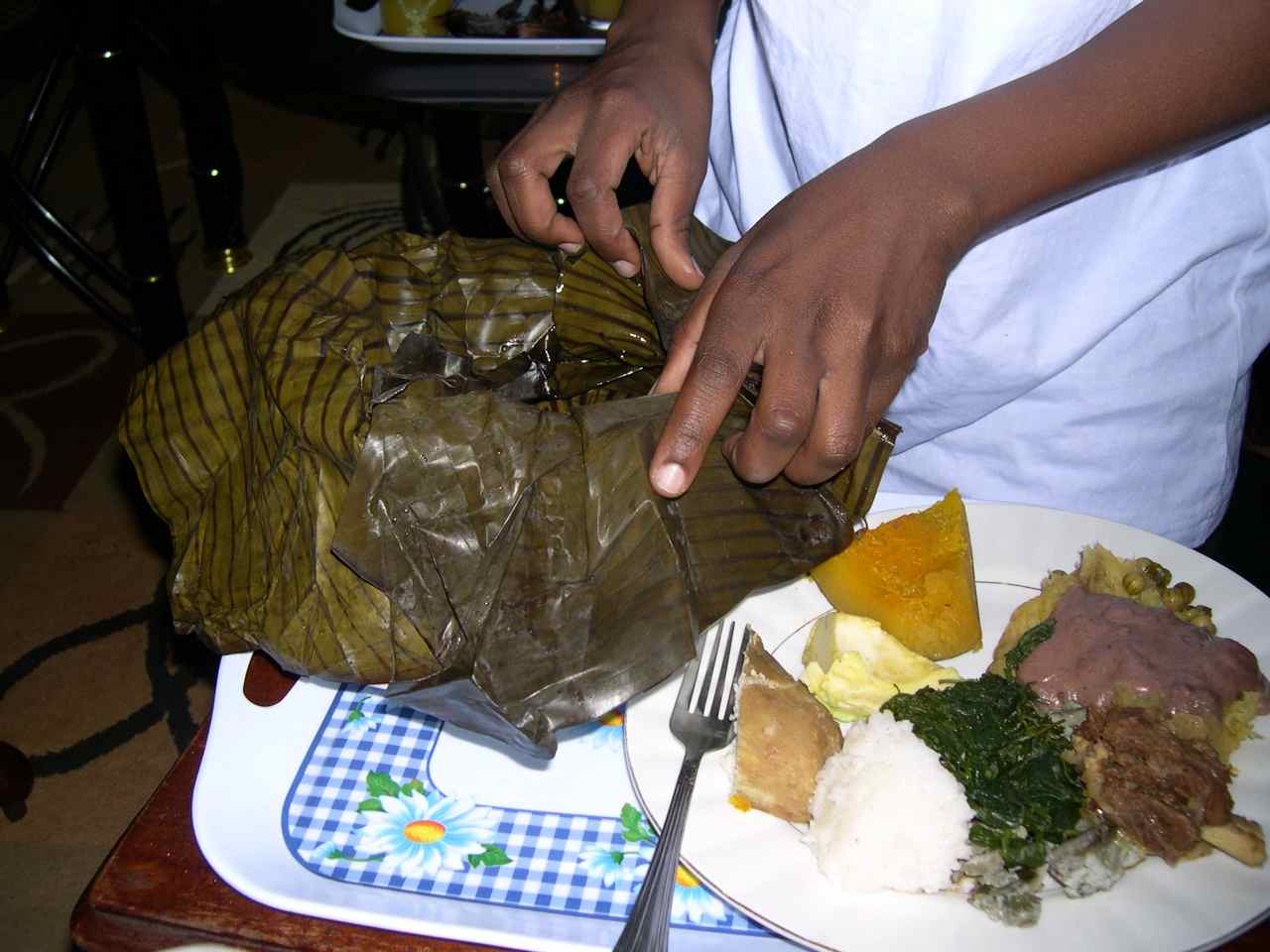
Luwombo is the thing on the left there.  On the right, there’s matooke (banana mash) with binyeebwa (peanut sauce), squash, rice, posho, greens, potatoes, etc. Luwombo is like a little crockpot made of banana leaves.

In this shot, mwannyinaze (sister/cousin) Anna ajjula–she’s uncovering the luwombo:

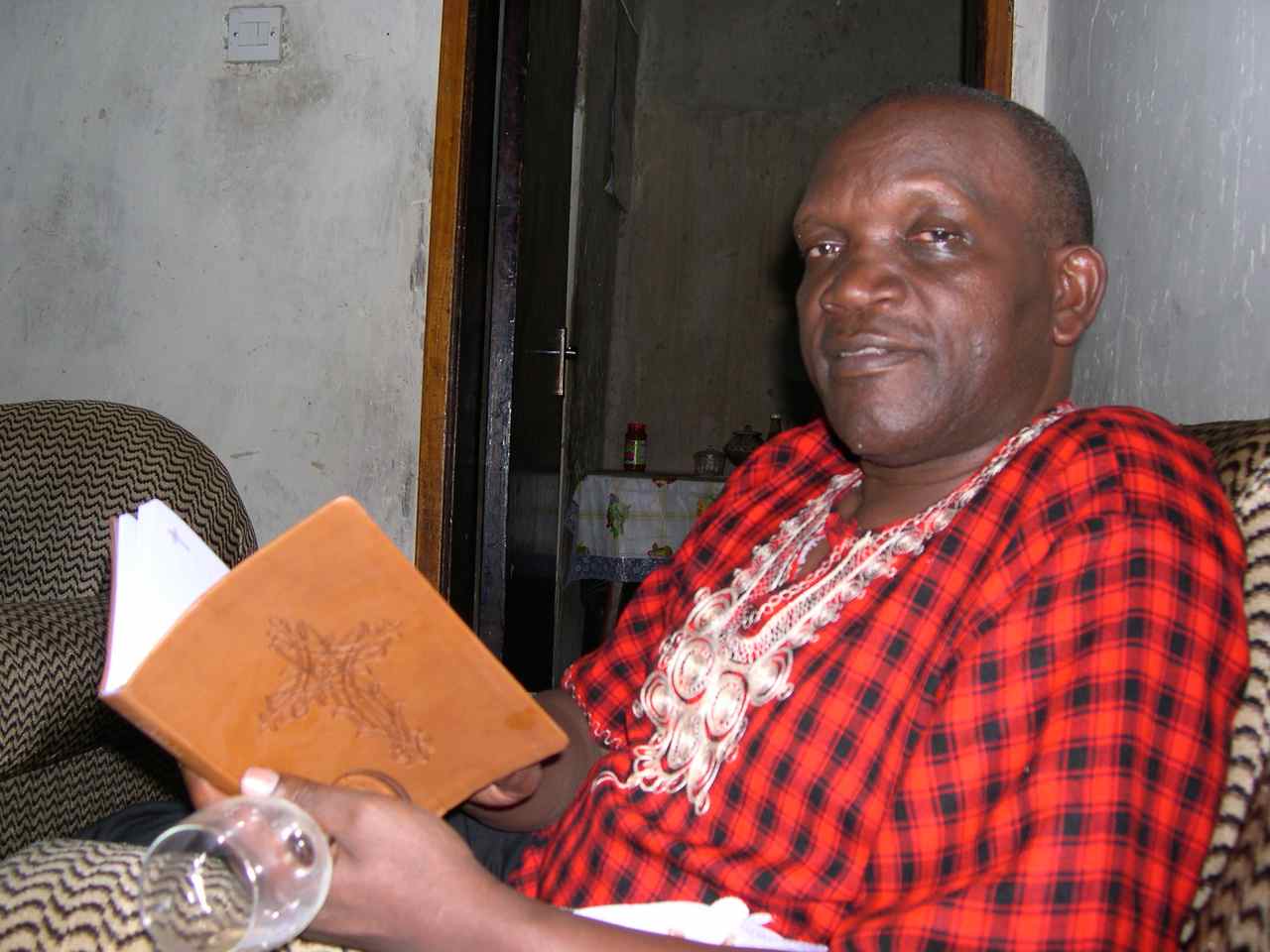
I gave Mwami ne Mukyala Magoba (Mr. and Mrs. Magoba) some small gifts after dinner.  Mr. Magoba is a writer, so he got this book for jotting ideas:

Jenn was kind enough to get a gift together for Mrs. Magoba. Here she is in her new necklace:

For the others, I had to find something light weight that would go over well with the whole clan (literally).  They enjoyed some fresh dates from Dubai.  Dad, if you’re reading this, remind me to get you some on the way back through there:

Finally, I must thank Settimba Charles Lwanga (pictured here sporting his daily sleeveless swagger).  He’s the household-appointed “Ghetto Prezident.”  There’s an artist here called Bobbi Wine who has dubbed himself in similar fashion, but I doubt his good humor and hospitality can compare with that of Settimba and the rest of the Ffumbe clan.

*Nota bene: Throughout this blog, I use Kiganda terms for kinship to refer to those who have made me part of their family here. This helps me keep track of kin relationships and how they work in Uganda. For you, dear readers, I will try to use the English terms in parentheses as I have here.

10 Comments

Filed under Uncategorized

Quiet Ironies en route to Africa

Today this blog takes a different turn.  If you missed the first installment of Kigozi’s adventures in Africa, I hope you can join the fun here and refer to it as necessary for background information.  If you’re returning with interest in my travels, thanks for reading and please don’t hesitate to comment, challenge, contradict, argue with, encourage, or make fun of me.  I welcome your reactions.

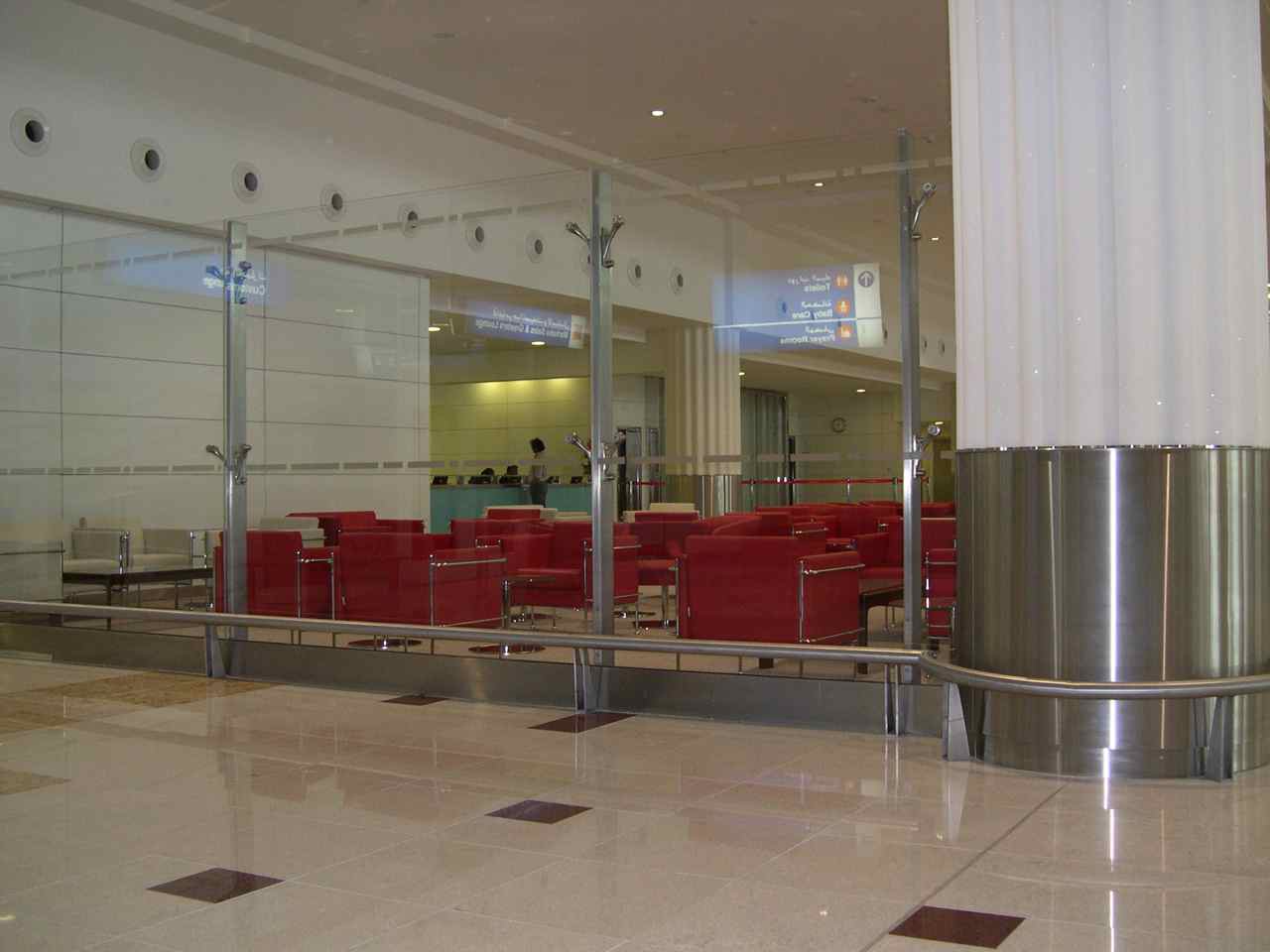
I’m taking a break from academic work for a bit to smile at some of the quiet ironies that make us forget the mundane indignities of travel.  Observe: the “first class” and “business class” lounge:

Wow, isn’t that great? Mr. International Business Traveler will think: “Nice chairs, very quiet and comfortable…Emirates Airlines sure did build a nice terminal. But hey, wait a minute! Aren’t those chairs right over there that look just as comfortable for the schmucks in economy class? Where’s my smug sense of bourgeois satisfaction?”

Well, it’s probably upstairs somewhere swimming in a glass of overpriced booze that has a nice view of the Burger Falafel King next to it. Maybe you can even see us mere mortals enjoying some of the same high-speed internet that you’re using to work for Big Brother.

Note here that were it not for the fully reclining seats, I would never throw such thinly veiled jealous quips toward the traveling elite.  All the same, this is a pretty cool airport whether you’re rockin’ a Rolex cell phone or not.

I hope you’ll stick with me for some more exciting images of Dubai and later Uganda. I’ll even promise not to engage in such blatantly futile class warfare. Truth be told, Emirates has the coolest in-flight entertainment system I’ve ever seen, and this airport’s cold slickness betrays the otherwise friendly demeanor of its staff.

Until next time…

1 Comment

Filed under Uncategorized