Tag Archives: uganda

New Directions in Research

Okay, so I’ve been teasing along with this for months now, dropping hints about a return trip to Uganda.  At first it was simply hopeful (as in someday), but it’s been more than that for weeks now.  The truth is, two weeks after I got back from the last trip, I received a Fulbright-Hays Doctoral Dissertation Research Abroad (DDRA) Fellowship.  I haven’t exactly kept this a secret or anything.  It’s just that this is a windfall that I had written off as so unlikely it would never happen.  It’s humbling to know how many more deserving applicants could be out there.

One of those applicants comes from FSU’s beleaguered Anthropology Department.  I claim Anthropology as a kind of disciplinary home away from home on campus, and I have great respect for their students and faculty.  So it is with bittersweet admiration that I congratulate  Bryan Rill.  Bryan works on issues that are very close to home for me, and I can think of no more deserving candidate for this fellowship.  Congratulations, Bryan.  While we’re at it, congrats to your colleagues on three NSF Dissertation Improvement Grants.  Maybe FSU will see fit to reconsider some if the more unfortunate budgetary decisions of the past few years in light of your achievements and those of the distinguished anthropology faculty.  Maybe.

FSU has done well in the past few years with national and international fellowships at the undergraduate level, thanks in no small part to the Office of National Fellowships (ONF).  There are, however, strong graduate students at FSU winning other awards.  Jason Hobratschk in the College of Music and Victoria Penziner in the History Department both snagged Fulbright IIE grants this year.  Kimberly Leahy is among 22 others to do the same since 1985, but it’s interesting to note that a disproportionately large number of those have come since the ONF opened.  BTW, I’ve had the privilege of knowing both Jason and Vicky for a few years, and I know both of their projects will yield fascinating results.

These accomplishments and others across campus in the past few years have started to make FSU look more like a Carnegie Doctoral Research Institution, and it seems the university is starting to take that role seriously.  After a tremendous success rate with the pilot of the ONF,  The Graduate School announced the opening of a new Office for Graduate Fellowships and Awards (OGFA)  this semester.  It’s about time.  ONF was really gracious about helping graduate students with fellowship applications (my own included), but even their staff recognized a major gap between their own undergraduate focus and the faculty-only nature of the Office of Research.  I applaud FSU’s efforts to help more graduate students secure outside funding through the new OGFA.  In fact, its sole staff member has already been very supportive as she administrates these new Fulbright-Hays and NSF awards.  Having watched similar programs help generate thousands of research dollars for students at other institutions, I am confident that the OGFA will be a successful project for FSU.

I offer a few critiques here even as I champion FSU’s recent efforts to make graduate research a priority, and I do so at the risk of soiling the extraordinary sense of gratitude I feel for having been selected as a Fulbright-Hays Fellow.  This is the most honest brand of school spirit: ONF is great, but OGFA is proof that we can do better at the graduate level.  The next step must be to support the academic programs and professors that foster bright students and award-winning ideas! (Ahem: ‘Noles Need Anthropology)

1 Comment

Filed under travel, uganda

Staging African Music

This afternoon, I’ll embark on a new endeavor that I’ve been looking forward to for a long time: leading an African music and dance ensemble.  This is a near-inevitable feature of academic life for many ethnomusicologists, particularly in North America.  I just had no idea it would happen for me at FSU.  The ethnomusicology program here places heavy emphasis on integrating performance and scholarship and using performance in scholarship.  That’s a major reason why I came here for a master’s degree and stayed here for the Ph.D.  However, a good friend and colleague from Uganda usually directs the ensemble, and when he doesn’t do it, my major professor does.  Needless to say I’m thrilled to have this opportunity.

Ever since I read Kofi Agawu’s book on Representing African Music, I’ve been trying to get my head around what it means for a white guy from Iowa to engage in scholarship on Africa and African music.  This isn’t the first opportunity I’ve had to do that through performance, but I certainly have more creative control over performative representations now.  It’s a challenge I’m looking forward to.

One thing that playing in “academic” ensembles has made me think about is the notion that we’re putting folklore on stage.  That can be a problematic experience in many ways, but it’s not a phenomenon entirely unique to academic culture.  In his dissertation, Welson Tremura proposes the term “stage lore” to describe the peculiar effect that commodifying folkloric music has on festival and other staged performances.  Philip Bohlman and others have also commented on this effect, especially as it relates to festivals.  If creating a public spectacle for nation building or staging folkloric performance as a form of respect to indigenous peoples have potential to artificially standardize or “freeze” music (Ted Levin’s term), academic ensembles ought to give us more controlled opportunities to avoid getting locked into myopic caricatures of the cultures we study.  Unfortunately, these “frozen” images of Africa are all too common to the college world music ensemble.

Florida State has broken the mold when it comes to African music and dance.  To my knowledge, it’s the only ensemble in the country that has focused primarily on East African music over the last five years.  (Please, correct me in the comments if I’m wrong about that; I’d love to know about others.)  Fortunately, we’re not tied into that permanently because we have an instrument collection and teaching resources to perform music from all over the continent.  We have had good luck focusing on music from a single country or ethnic group for a semester or a year, and in that way the ensemble has been a good laboratory for students and professors to teach performance skills related to their research interests.

I plan to begin this semester with this kind of lab tactic, but then expand our repertoire to develop a kind of Pan-African performance consciousness among the students.  I’ll begin by bringing in music from my field research: songs of the Baganda and Basoga.  While FSU has plenty of Ganda instruments, I’m excited to diversify our ensemble’s Ugandan offerings with my new Soga skins:

nswezi

You might remember seeing some of these here.  I had the pleasure of learning to play them as I learned songs from several different teachers in Eastern Uganda.

A colleague here at FSU recently went to Morocco, picked up some new instruments and took some lessons, so we’re excited to have a North African component.  However, since we’re both still relatively new to our recently acquired instruments and skills, we want to incorporate some people, sounds, and skills that have a bit more longevity in this ensemble.  One guy has been playing with the FSU group as long as I have and with other groups even longer.  He and I will work with another colleague who has experience teaching Ewe music.  We also hope to collaborate with other local groups on some Guinean music.  Finally, I’m hopeful for a reprise of a performance at last year’s SEM annual meeting: who’s ready for some Bolingo?

I hope to convey to students and audiences that Africa is a big, diverse place.  I hope to give them some idea of what that means with regard to the boundless variety of musical and dramatic expressions found across the continent.  I’ll continue to update here as we schedule more performances, but for now plan on getting your seat early at our biannual College of Music show: this fall it’ll be on November 16 at 8 PM in Dohnányi Recital Hall.

2 Comments

Filed under Uncategorized

Ritual and Expressive Culture

Public service announcement: those of you familiar with my travel patterns in Uganda know that I post in clusters because that’s what my internet access allows.  Thanks for sticking with me despite the sporadic nature of my posting habits.  Since I know many of my readers are new to the blogosphere, let me just say this: I hope it isn’t terribly disruptive to your blogging experience.  I’m working to update my blogroll so that when there’s nothing new to read on my page, you can check out other writers, particularly in overlapping Ugandan, African, and musical blogospheres.

During the month of January, I have done even more traveling than usual in eastern Uganda.  I’m attending several different kinds of rituals on these trips.  The first was a funeral for a muswezi healer.  Both that one and the next one installed new baswezi (plural of muswezi) within their clans.  In keeping with my field writing pattern, what follows is a kind of photojournal of my experiences this month.  In contrast to earlier posts and at the request of some readers, I’ve dispensed with trying to make it look pretty and just used big versions of the pictures.  Enjoy!

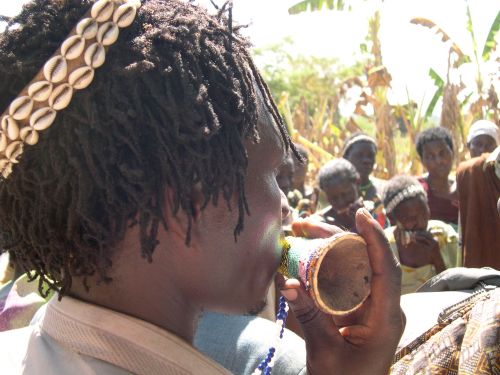
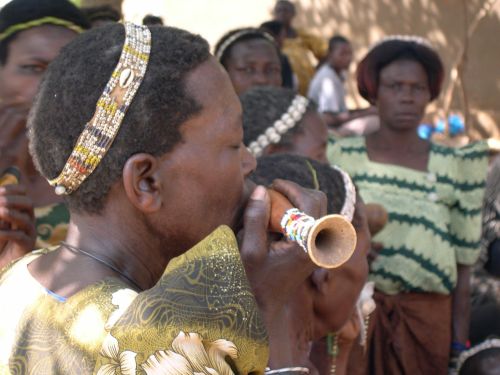
So much of my experience here has been consistent with patterns that I observed in my master’s thesis: ritual expressive culture brings together music with other arts in an aesthetic common to the entire Interlacustrine Region (that’s academic fancyspeak for the place between all those big lakes in East Africa).  That thesis used musical instruments as one form of evidence for these cultural cross-currents.  Well, I’ve discovered some new instruments that appear to be unique to eastern Uganda, but their appearance remains consistent with other ritual art in this region.  These are called bugwala (singular: kagwala) and they work somewhat like a kazoo in terms of sound production.

kagwala1

They’re pictured above and below with the rukinga headbands found among spirit mediums throughout this region.

kagwala2

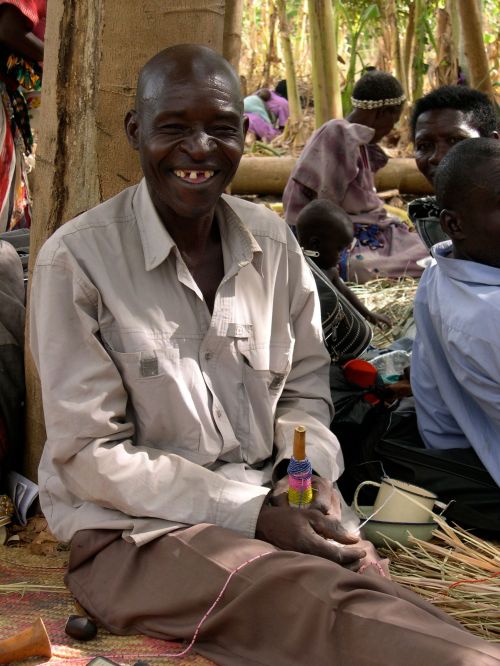
At an olumbe (funeral) for a muswezi healer, I got the rare opportunity to see the ritual master of ceremonies “dressing” these instruments.  The man named Kyambu below calls the beads “clothing for the bugwala.”  Here’s his infectious grin as he finishes the work:

kyambuakolabugwala

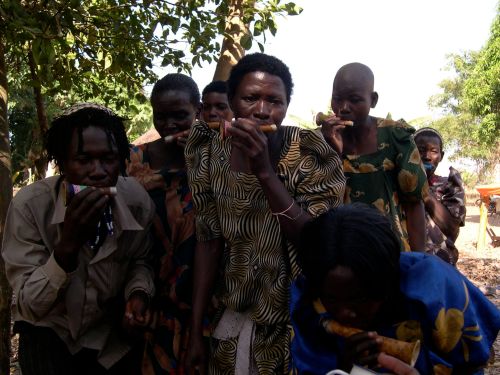
Some might eschew comparisons to the kazoo (particularly when they want their research to be taken seriously).  I’ve thought about this for a long time, and I think the comparison is apt.  Those who play bugwala are called nabuzaana when they are possessed, because they play out the un-lived dramas and games of children who died as babies.  They beat the ground looking for edible ants, they sing children’s songs, and they go around blowing their bugwala in cacophonous heterophony as people offer ritual contributions for their mini-performances:

bafuuwabugwala

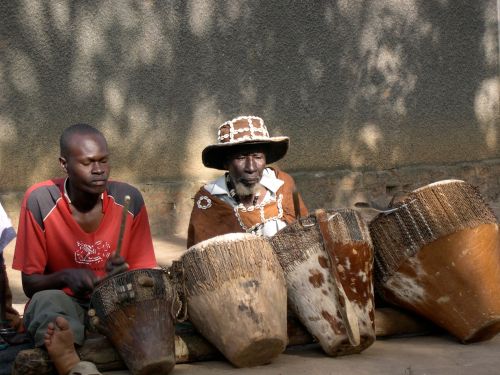
Finally, one of the most interesting things to note about the physical culture of ritual here has been how it marks the initiated.  In some cases it’s clear simply by looking at someone’s attire that he can be musically initiated without having been ritually initiated.  The ritually initiated must wear appropriate garb, because otherwise their patron spirits will either refuse to come or rebuke them when they note the absence of proper attire (or music, or sacrificial animals).  Here a young drummer embodies this divide, which is sometimes generational, sometimes merely experiential, and always notable:

oldandnew

I return to the east this week for some follow-up work on the rituals I’ve attended there and hopefully scheduling more trips to observe other rituals.  January has gone fast, and I’m sure February will go even faster.  However, I plan to be in Kampala more in the coming months, so hopefully that can mean more posts.  Until next time, beera bulungi (be well).

5 Comments

Filed under uganda

Ekyoto: Stories Around the Fire

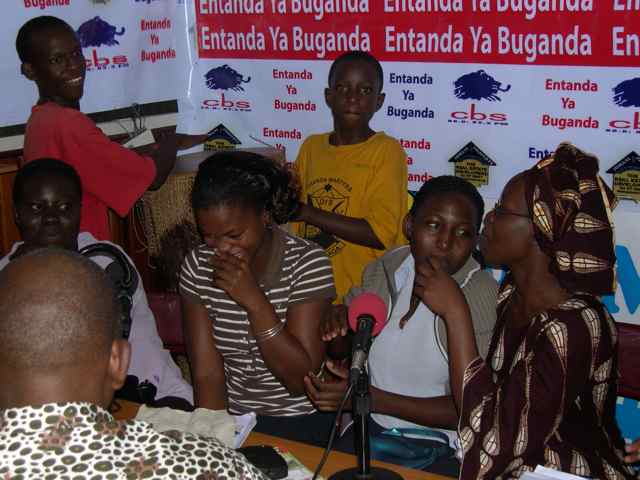
Part of Taata‘s (Dad/Mr. Magoba) job at CBS is to host a vernacular radio program called Ekyoto.  It’s a folklore program that’s fairly popular within Buganda.

102508-7

He tries to cater to a family audience with some fun games for kids and some really interesting language games that are fun for all ages.  He was kind enough to invite me to the program several times during my last visit.  The day after I arrived in town, he hosted me on the program to witness the dramatic stylings of several students from Makerere University.

They enjoyed musical collaborations with students from Makerere’s Department of Music, Dance, and Drama.102508-5

Magoba writes the radio plays himself, and the games and songs come along between plays and commercials.  The adverts you see on the wall are for Entanda ya Buganda, which is a periodical published by CBS and printed by New Vision.  Mr. Magoba is a major contributor and he supervises the marketing of the mag as well.  There are also two students from the Uganda Martyrs’ Primary School there on the left.

102508-3

Ekyoto is always fun, so I hope to be on the program again.  Many times the guests are school music programs that have done well in the national school music competition cycle.  Really good kids, amazingly long attention spans, and fantastic music…maybe I’ll try to include a sound clip next time!

4 Comments

Filed under uganda

Where I’m Comin’ From

Now normally I would not send anyone, least of all my readers, to a really dodgy newspaper website.  However, this particular one happens to be my hometown rag.  The editor-in-chief is a drummer and a big fan of the jazz program in my hometown, so he always gives good coverage to the state championships, where the Harlan Band has been placing in the trophy class since they started that competition.  I am proud to say that I played drums in that band the first time they ever won Iowa Jazz Championships in 1999.  Congrats to another group of young Iowa jazz players, the Harlan Jazz Experience.

You may not hear from me for a few days for the same reason that my posts have been sporadic and short for the past couple of weeks.  I’m in the middle of writing my preliminary exams, after which I’ll be ABD!  Then it’s off to Uganda again . . . that link should keep you busy while I’m out.

1 Comment

Filed under Uncategorized