To My Old Brown Earth, by Pete Seeger

Here’s just one of many tributes to a great fallen musician this week. Evidently nobody could have written a better eulogy for Seeger than ol’ Pete himself! Rest in Peace, dear friend of the masses.

lolarusa's avatarThe Chawed Rosin

seeger_roosevelt.jpg.CROP.promovar-mediumlarge

TO MY OLD BROWN EARTH

by Pete Seeger

To my old brown earth
And to my old blue sky
I’ll now give these last few molecules of “I.”

And you who sing,
And you who stand nearby,
I do charge you not to cry.

Guard well our human chain,
Watch well you keep it strong,
As long as sun will shine.

And this our home,
Keep pure and sweet and green,
For now I’m yours
And you are also mine.

In memory of Pete 1919-2014.

More Pete Seeger posts.

View original post

Leave a comment

Filed under Uncategorized

Featured Artist: Tedeschi-Trucks Band

Last night my wife and I witnessed a marvel of postmodern blues-making at North Charleston Coliseum and Performing Arts Center. Since shortly before the release of their June 2011 release of RevelatorSusan Tedeschi and Derek Trucks have led the Tedeschi Trucks Band. They’ve been busy since then, building on a solid foundation to remain the biggest, baddest blues outfit I’ve ever had the privilege of hearing live. We’ve been closely watching Tedeschi’s career since her 2002 record, Wait For Me. Trucks we’ve only discovered more recently, but last night the band made a believer out of this listener.

The Tedeschi Trucks Band understands two things thoroughly: how well the distinction between bandleader and singer can work, and how to value every single contributor. While he’s soloing or listening to Tedeschi, Trucks calmly participates in various ongoing communications within the band. Tyler Greenwell and J.J. Johnson stay locked into a singular groove–a formidable task for any band with two drummers–while they also manage to keep out of each other’s way and support the band with tasty exchanges. Brand new bassist Tim Lefebvre holds down the rhythmic and harmonic foundations with impeccably restrained taste. Kofi Burbridge wields his multi-keyboard setup masterfully, laying down basic harmonies on keys here, amping up the texture with a Hammond B3/Leslie combo there. Kebbi Williams, Maurice Brown, and Saunders Sermans each bring distinctive, entertaining personalities to the horn line. Behind them, a duo of highly versatile singers Mike Mattison and Mark Rivers alternate between providing stylized harmonic flavor and coming out front for their own features. Just don’t call them backup singers. Mattison began paying his dues well before singing lead on another Trucks project, and Rivers goes well beyond holding his own during shining moments in this band.

Meanwhile, capable leadership from Trucks keeps everything cued up and tight for Tedeschi, who has ample space to focus on bending phrases and wailing her way through blues idioms that make originals sound like classics. It is truly rare to hear a singer with rhythm as solid and consistent as hers. Every ornament, every nuance, every single rasp seems purposeful, but she delivers it all with a nonchalant humility, signaling to the audience that mastery is just part of her personal style.

To say that husband and wife both handle their instruments well as soloists would be a dramatic understatement. Tedeschi’s straightforward blues style has always served her well, and it’s a perfect compliment to the harder edge of her husband’s slide solo sound. Together with their collaborators they can bring the band from Metheny-esque soft subtlety to face-melting fever pitch, often within the same twelve-bar solo chorus.

This is unapologetic Blues with a capital B. Yes, they can funk it up with some tight horn lines, a good deal of interplay between their two drummers, and some good clean fun from a self-choreographed horn line. Yes, Derek Trucks can get his rockstar on with a bit of distortion, harmonics, and the help of some professional lighting that pales in comparison to his guitar lightning. But this music articulates a genealogy of American rock beginning with the Blues and only then moving through Jazz, Rock, and Funk in that order. The diverse backgrounds and personalities of the band come through this sound mightily. This music understands that all truly American art needs that variety in order to participate in moving sonic representations of who we are as a nation.

Tedeschi Trucks Band offered an evening of transcendent Americana last night. Soon they’ll take the show to Japan, India, and several European nations. They will make excellent emissaries for the venerable tradition of American Blues.

1 Comment

Filed under featured artists, reviews, Uncategorized

Those ends

One of the common turns of phrase that seems to come up again and again in Luganda–or in Luganda-speakers’ English–is to ask not only about one’s family, but about one’s place. How is Ntinda? How is America? How is South Carolina? And my personal favorite, how are those ends? (Alternatively, when will you come back to this side/these ends?) Well, until September 2011, I had never considered that any of “these ends” could so closely resemble “those ends,” either socio-linguistically or culturally. Then I attended kwanjula in Boston.

Well, the same bride who introduced her groom to her adoring family that weekend made him a very happy man this past weekend in Chicago. They have since relocated, and their wedding was no less a thoroughly Ugandan affair than was their introduction ceremony. The Boston contingent made the trek in large vans, by plane, and however else they could. I met others who traveled from Minnesota, Michigan, New York, and Ohio. But most–safely over 95%–were first or second generation Ugandan immigrants from Buganda. These are doctors and lawyers, nurses and fashion designers, students and teachers; they are a well-educated, high-achieving bunch, to be sure. It is easy to see how so many of the present generation of Africans in the Diaspora hold so much hope and promise for the future. As I look toward a new phase of research revolving around these Ugandan communities in the U.S., it is very exciting to see the great variety of things its members are doing in the world.

I had not intended my presence at this event to meet with the same conspicuous attention as my performance of the Ffumbe clan slogan at the kwanjula did in 2011. I had simply stayed in touch with the bride and groom, and I wanted to celebrate with them on their big day. As aunties have a tendency to do, however, the bassenga from Boston informed me that I would be reciting the bride’s paternal and maternal genealogies at the reception. As this had been become a major opportunity for networking and thinking about new research directions the last time I did it, I of course readily agreed. In any case, how could I say no to this bride, much less her aunties?

IMG_1299

When I initially started writing about the 2011 event, the connections between kinship, music and tradition fascinated me. Between then and now, however, I had the opportunity to travel back to Boston and experience some of the rest of the music scene in one of the largest Ugandan communities in the U.S. Traveling to Chicago then came with the promise of new possibilities for discovering how things might be different there…and how different they were.

The nightclub that played almost exclusively Ugandan pop in Waltham, Massachusetts was interesting, and it’s a place I hope to return. But the aptly named Club Enigma in Chicago provided a fascinating contrast. Far from the local pub experience that tends to attract Waltham’s slightly older crowd, Enigma was like walking into a Kampala nightclub. The ten-dollar cover charge, the security at the door, the lighting, the overpriced drinks, and especially the DJ’s mix of contemporary Ugandan and American pop made it seem like the whole place had been transplanted directly out of suburban Uganda’s upwardly mobile communities.

I might have come to expect this from a younger crowd closer to the Chicago city limits than Waltham is to Boston, even if both places are fairly typical of immigrant communities in American suburbia. What I didn’t expect was the utter disorienting experience that this club offered two completely different cultural experiences in the same building. At the bottom of the main staircase, a right turn means Ugandan Urban Underground, but a left turn translates to Bulgarian Boom Boom Room. The latter was nearly three times as large, and attracted a crowd befitting the space. Managing sound bleed seemed only a matter of cranking the volume in each space loud enough to mask anything coming from the other. For the most part, people came with a culturally specific experience in mind, but they frequently walked over to “the other side” to check out what was going on, do some people watching, hear the music, scope out a fleeting physical interest, or even dance to a bit different beat. Let me just say that the kasiki (a Ugandan version of a bachelor party) and the wedding after-party the next night did not offer nearly enough time to try to parse this one out. Enigma indeed.

Two things remained consistent between Waltham and Arlington Heights/Chicago: these events are still all about networks of kin, and both communities still revolve around Roman Catholic church life.
IMG_1286

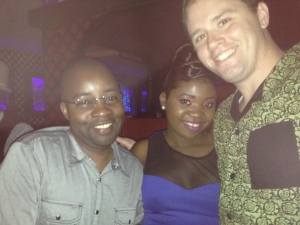
Above: the groom, Godfrey, with the maid of honor, Vivian and yours truly

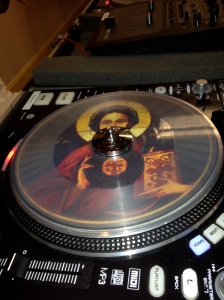
One of my favorite images came from the DJ booth:
IMG_1307

I call it “Ain’t No Party Like a Messiah Party”

(glossy facsimile on turntable)
Leave a comment

Filed under diaspora, travel, uganda

Jiggity-Jig

The handful of people who read this blog don’t need to notice my silence here to know that I’m home, because they probably all know me personally. Still, I’ve been quiet here and busy elsewhere since returning from this most recent trip to Uganda. It’s only now, two months later, that I’ve got my head above water enough to do some online reading and writing. 

I’ll have time this week to finish up a post on my recent trip to Chicago, but in the mean time, I’m reading some really fascinating stuff elsewhere. Here’s a piece that I think my students might enjoy, courtesy of my friend Mr. Shank. Then there’s this lively debate on the state of American higher ed. that’s far more interesting and important a debate than anything I’ve ever read in CHE. Meanwhile I’m jumping back into an old volume on The Professionalisation of African Medicine for my book write-up and reading several good articles and dissertations along the way. So, while I sympathize with some of JunctRebellion‘s perspectives, I’m fortunate to say that for those of us lucky enough to have full-time positions, it’s not all doom and gloom.

More soon on why…

Leave a comment

Filed under Uncategorized

Back to Buwaali

There’s one field site where I go quite regularly because I believe the community there is among the most innovative religious communities in the world. Buwaali is named for the disease Kawaali because it is associated with a 19th century smallpox outbreak. Likewise the patron spirit of this place, Jjajja Ndawula, is associated with afflictions of the skin. His drinking gourd has raised bumps, as does his tobacco pipe. I wrote about the overall look and feel of this place in another post. Here I’d like to return to Kakooge village, to the place called Buwaali, and see what has changed.

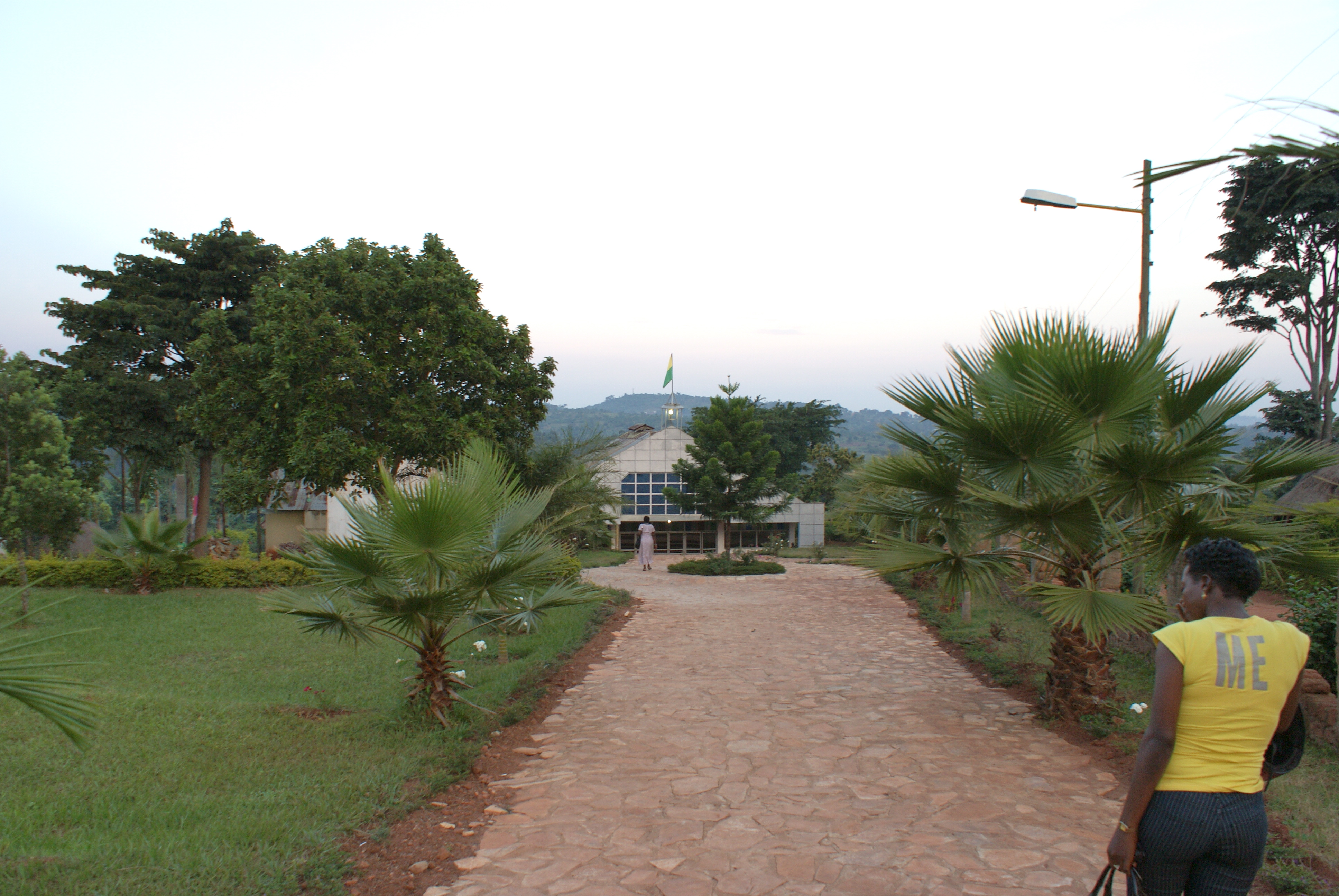
When I entered the estate where Jjajja Ndawula Community have built there main shrine, I noticed immediately how many cosmetic changes had been made. Inside the newly installed main gate, the grass and landscaping had been totally redone.

SONY DSC

The compound interior had not changed significantly, but there was one new spot in the midst of all of the various small shrines dedicated to different spirits: a group of mats lay beneath thick vines held up by a wooden pole frame.

Now the person I came with is a Muslim, and Ramadan was to begin that evening. A man soon came to this new place with his head covered, carrying a Qu’ran, a small ceramic portable fireplace full of burning coals, and waxy incense called kabanni. He sat down along with six or seven other people and began to recite suras as he placed some of the incense on the coals. For the next half hour, he alternated between sura recitation and Luganda prayers to ancestors and other patron spirits. The group grew, and by the end of the half hour prayer session, there were about twenty people seated there and responding to the prayers. Now it’s one thing for a Muslim to pray in a shrine, but quite another for a group to bring Qu’ranic recitation into the shrine space and to build a dedicated space for Islamic prayer.

At the conclusion of these prayers, the group disbursed to their various tasks. No Ramadan feasts tonight; just tea and dinner before the proceedings were to begin. We went into the main shrine, which had also changed significantly since my trip here in 2010. All of the windows had been installed, and the detailed painting around the trim had nearly been finished.

SONY DSC

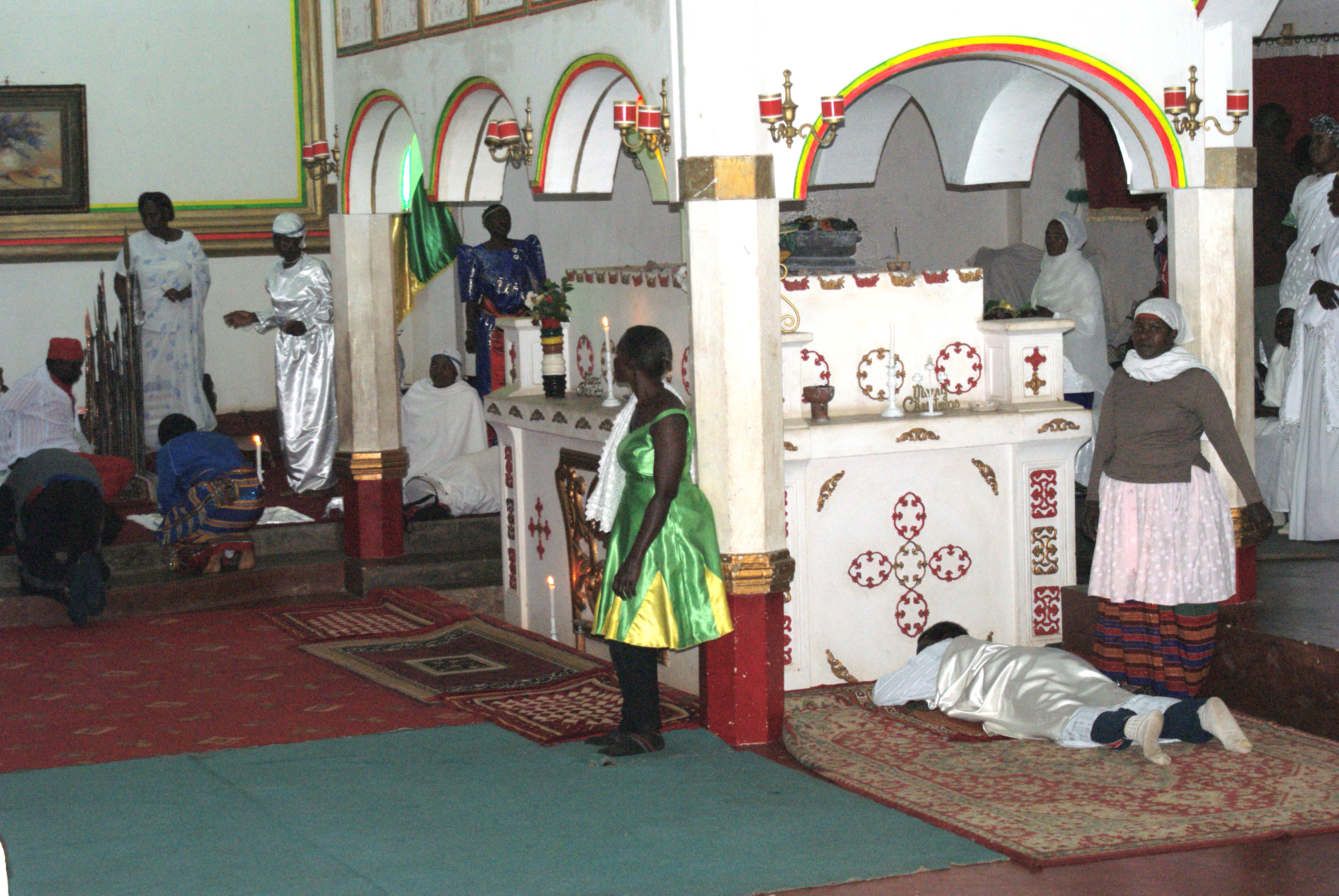
Curtains had been hung on the windows closer to the front of the space, and the group now had some chairs for people on the risers flanking the main nave. The shrine for Kiwanuka now had colorful trim, and the area at the front of the space had matching trim.

SONY DSC

The woman prostrate in front of the shrine there is praising Kiwanuka as others look on, attending to the main medium of the place, Jjajja Ndawula.

As on other occasions, dancing and singing went on well into the night. I’m pleased to report that during the meeting that followed, the community agreed to let me deposit video recordings from this shrine in an archive at Makerere University pending their receipt of DVD copies for community viewing.

Leave a comment

Filed under uganda, Uncategorized

On the road again: Nakawuka

I haven’t posted as much on this trip, maybe because I’m just not traveling as much. There’s only so much to show and say from inside an archive or at my home office/base. However, this past Friday I hired my trusty boda man Marko to take me out to Nakawuka about an hour’s drive southwest of Kampala.

I attended huge New Year celebrations there at the end of 2008 and again at the end of 2009. It’s a Mmamba clan estate, which is one of the largest clans in Buganda. It sits atop a large hill on top of a rock. This place is called Katwe Kagezi, or “the clever head.” At the back of the estate, there’s another huge boulder that the people there call ekyombo, a boat or ship. It’s about 15 ft. high by 30 ft. long and 10 ft. wide. Mmamba clan traditions hold that this ship arrived here with the first members of this clan and came to rest in this place. Tonda, the creator, called the place Katwe Kagezi because he was impressed with their ingenuity in the realm of transport. The people called it Kisuze because this is where they and their ship came to rest (okusula = to spend the night). The former name helps explain a connection between this place and a borough of Kampala also called Katwe, which I mentioned in this post on a musician with a home in Nakawuka and a business in Katwe, Kampala.

I went back to Nakawuka to speak with the musiige, a kind of ritual custodian of this place. Ronald Bbweete has dedicated his life and his career to preserving and protecting this place. He is among the most knowledgeable ritual experts in Buganda, and he introduced me to virtually everyone I know in Nakawuka, including Jjajja Byuma, the main spirit medium there. Both Bbweete and Jjajja Byuma gave their blessing to archive the materials I have recorded here at Kisuze. I left Bbweete with copies of these recordings, which he will share with others curious to hear them. This has become a standard of my archival practice here in Uganda, and I was happy to see Nakawuka become the next of several locations who have agreed to archive these materials for future research.

One thing I have never been able to do is photograph anything inside the compound at Kisuze. Jjajja and Bbweete simply do not allow it, nor indeed do their patron spirits. However, I have been able to photograph some very nice scenery on my way up and down the hill. I took the banner photograph on this blog after New Year celebrations in 2009/10. Here are a few others from my recent trip with Marko.

The road there is very dusty, but once you get up the hill...

The road there is very dusty, but once you get up the hill…

...the valley is gorgeous!

…the valley is gorgeous!

This post and these photographs have been brought to you by Marko Kyaligamba courtesy of Bajaj motorcycles...

This post and these photographs have been brought to you by Marko Kyaligamba courtesy of Bajaj motorcycles…

...and by Duluth Pack

…and by Duluth Pack

Note: no company actually endorsed this particular journey to Nakawuka, but I do receive generous support from UNCF/Mellon and my Duluth Pack is perfect for fieldwork.


Leave a comment

Filed under Uncategorized

Back Together in Nakifuma

Seasoned ethnomusicologist Bruno Nettl famously titled a chapter in his concept/method book, “Come Back Tomorrow.” Days like the one I had yesterday in Nakifuma remind me why, despite distractions, frustrations, and roadblocks, I keep doing exactly that.

Having already reunited with my dear friend Ssematimba, yesterday was to be a work day for us wherein we could talk through some of the issues and opportunities presented by the possibility of archiving some of his recordings. Given his generous nature and our good relationship in the past, I fully anticipated that he would be cooperative. The response I got yesterday went well beyond cooperation, though. Not only did he gather most of the people involved in those recordings at his office in Nakifuma, he also set up my explanation of this work in ideal fashion. Once I explained to people how much I wanted them to have access–here in Uganda–to their own recordings, they practically threw a party! Not only did they respond favorably to archiving old materials, they also insisted that I record new songs. We began yesterday, but they want me to come for an event this coming weekend and videotape it.

This rather business-like matter out of the way, it was very important to this group that I hang around and socialize with them. I spent a good deal of time with many of these folks in 2010, and we were all happy to be back together for a relaxing afternoon. From Ssema’s place, we went to Jjajja Bbali’s compound, a place that has many shrines for different Kiganda spirits. Between these two locations, some in the group introduced me to new spouses, others to new children, and all to new friends.

I have spent more time than I care to admit trying to capture the essence of convivial interactions that make ritual events so inviting for spirits in my writing. What struck me about yesterday was that this jovial atmosphere is not part of some rarefied break from everyday banalities. It is a cornerstone of daily living, something people actively pursue and often achieve in the company of family and close friends.

Image

One can never capture these moments, of course: they are as fleeting as this blurry image. Oh, who am I kidding? I’ll be glad when my nicer camera is fixed. That’s John Kyobinga on the left, Mwalimu Ssenogga in the middle, and his wife Nakayima on the right.

Leave a comment

Filed under uganda

Music and Method

The proposal for my current research, “Music is the Method,” draws upon years of previous research to strongly suggest that musicking, spending time with musicians, and getting to know their repertories is a good way to understand how they live and what matters to them. It is also, in the context of this project, a good way to understand how people think about what it means to be ill and what it means to live well.

This part of the project seeks to return some of my field recordings to Uganda on a permanent basis. There the people who made them should be able to access them, and others will hopefully be able to use them for further research. It never ceases to amaze me how much time and energy it takes just to get and stay organized with this much material in hand (it’s not only my daily chore now, but sometimes I rope my wife into it as well). I’ve got audio, photographs, and video to contend with, much of which I’ve  annotated through fieldnotes, coding, and blogging. This project breathes new life into my efforts at collating these materials and making sense of them beyond the life of my now-finished dissertation.

My hope, bolstered by an encouraging first couple of weeks of this work, is that I can continue to connect these materials, get them to talk to each other, and organize an ever increasing series of cross-references. The contours of a kusamira repertory emerged well before I ever finished the dissertation. If I am to understand it well enough to comment on its relationship to creation stories and other folklore of this region in my book, this new archival effort will be a crucial step in that process.

Leave a comment

Filed under Uncategorized

Singing at Ssezibwa

I had been in Uganda less than 48 hours when one of my dear friends, Ssematimba, called and invited me to a ritual at Ssezibwa Falls. We went there last year together to meet the main medium who lives there. Not intending to collect much new material on this trip, I took the opportunity to re-connect with Ssematimba and friends sans electronic devices. I didn’t even bring so much as a camera. I had forgotten how rewarding that experience can be.

It seems every time I go somewhere with Ssematimba, his wife and their friends, the rain washes out the roads or even the entire event. When I commented to him about this, he answered with a single word: “emikisa” (blessings). I then began to consider what kind of heart it takes to consider total inconvenience and a considerable amount of danger in passing over muddy bridges to be blessings. As we worked to get our truck unstuck and up a big muddy mess of a hill, it occurred to me that these are the kinds of blessings that we only reap through cooperation in a shared struggle. The danger factor always makes me nervous, but once up the hill, the challenge felt small compared to our camaraderie. 

Our arrival at Ssezibwa had the perfect soundtrack of two indistinguishable and equally powerful beating sounds: one of waterfalls beating down on rocks, and the other of hands beating drums. We drew nearer to the drums and the waterfall faded into the background as the playing and singing got stronger and stronger. The effect of this crossfade was intense, and it signaled the beginning of a truly powerful experience.

Playing music fosters a similar feeling of camaraderie described above, even if the circumstances are totally different. I was pleased to realize that all of the time I spent with Ssematimba and others on trips past has paid enormous dividends in terms of my ability to participate. Having transcribed and translated so many of those songs, I’ve become proficient enough at simultaneous playing and singing that I can focus my attention on lyrics or other elements of these events even while we’re playing. How Ssematimba knew I was ready for this, I’m not sure, but he didn’t hesitate to invite me into that experience. What a beautiful gift on top of a mountain of other blessings that he has shared with me! I can think of no more perfect way to have begun this journey.

Leave a comment

Filed under Uncategorized

Back in Uganda!

I’ve been here enough times now that arrival always feels somewhat like a homecoming. I’ve only just arrived, so there’s not really much to report, but it sure is good to see old friends. More in a few days on the work once I’ve had a chance to get something done. For now it’ll be a cold Tusker for jet-lag recovery, thank you very much.

1 Comment

Filed under Uncategorized